Entry Routes on Rolling Farm Ground
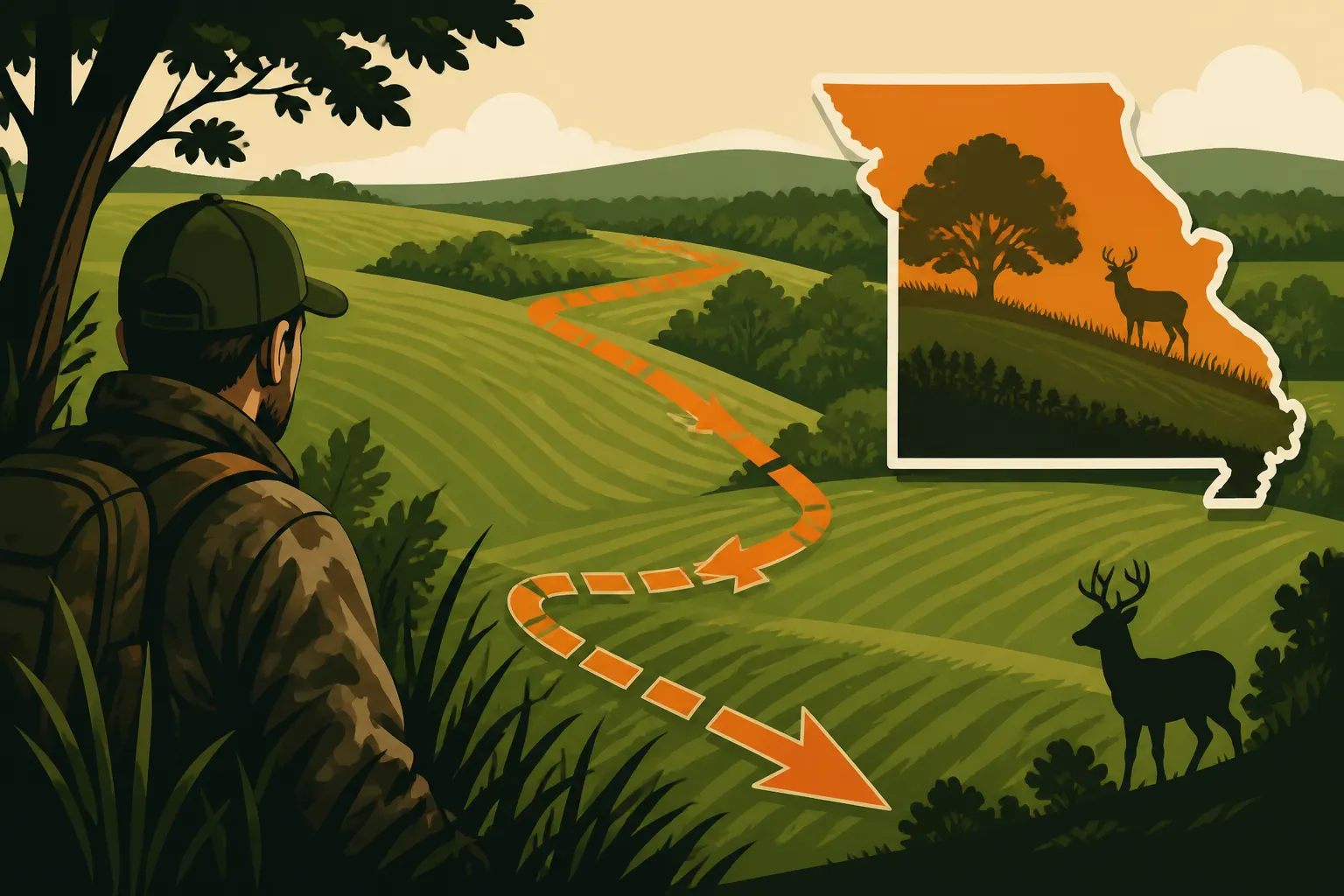
Anyone who's spent time deer hunting the rolling farm country of Missouri knows the frustration: you've patterned a magnificent buck, located his feeding or bedding area, and have the perfect stand setup, only to spook him on your walk-in. The open fields, timbered draws, and subtle elevation changes of this landscape make stealthy access a constant battle. This guide is here to walk you through the critical strategies for choosing and executing entry routes on rolling farm ground, ensuring you arrive at your stand undetected and ready for action.
Decoding the Terrain of Rolling Farm Ground
Hunting success on rolling farm ground hinges on your ability to understand the landscape, which is often a mosaic of open agriculture, small woodlots, and winding draws. Deer here are masters of using every subtle dip, rise, and patch of cover to their advantage, and so should you.
Identifying Key Features and Deer Movement
When we talk about rolling farm ground in Missouri, especially in the northern counties, we're picturing vast crop fields – corn, soybeans, wheat – interspersed with timbered drainages, fencerows, and small woodlots that cling to creek banks or ridge tops. These timbered draws are often the lifeblood of deer movement, acting as natural highways and bedding sanctuaries in an otherwise open world. Bucks frequently bed in these thicker draws or small pockets of timber, emerging to feed in the adjacent fields, particularly during the evening hours. They use the elevation changes to their advantage, often traveling just below the crest of a ridge for concealment or utilizing subtle benches along hillsides as travel corridors.
Understanding these patterns is paramount before you even consider an entry route. Pre-season scouting, whether it's through careful observation with binoculars from a distance, strategically placed trail cameras, or boots-on-the-ground exploration (when conditions allow and human intrusion is minimal), will give you the intel you need. You're looking for pinch points where terrain funnels deer, subtle crossings, and the precise locations of their bedding and feeding areas. Pay close attention to transition zones where timber meets field, as these are often prime spots for deer to stage before entering open areas. If you're looking for where North Missouri bucks bed, focusing on these timbered pockets within the larger agricultural landscape is always a smart move.
The Importance of Aerial Maps and Topography
You simply cannot overstate the value of a good aerial map and topographical data when hunting rolling farm ground. Tools like the Missouri Conservation Atlas or sophisticated mapping platforms such as GoHunt are invaluable resources. They allow you to virtually "walk" the terrain from the comfort of your home, identifying crucial features that might be hard to spot on the ground without disturbing the area.
When studying contour lines on a topo map, look for the subtle nuances. Tightly packed lines indicate steep changes in elevation, while widely spaced lines suggest gentler slopes. But it's the breaks in these patterns that often reveal deer highways. Look for subtle saddles that connect two ridge tops, benches that run along a hillside, or the bottom of a draw where deer might travel to avoid exposed ridge lines. These maps also help you identify all potential access points, property lines (which are crucial on private land), and roads or trails you can use to get close without walking through prime deer habitat. Learning how to read aerial photos for Ozark deer, or deer anywhere for that matter, is a skill that translates directly to success in farm country. You'll be able to pinpoint exactly where the timbered draw meets the standing corn, or where a deep ditch offers ideal concealment.
Mastering Wind and Thermals for Stealthy Entry
Once you've mapped out the terrain, the next, and arguably most critical, factor in choosing your entry route is understanding wind and thermals. These invisible forces dictate how deer perceive your presence, and a mistake here can ruin a hunt before it even begins.
Reading the Wind in Open and Varied Terrain
The golden rule of deer hunting is simple: never let your scent blow into the area where you expect deer to be. On rolling farm ground, this rule becomes incredibly complex. Unlike flat, open country where wind might be relatively consistent, rolling terrain creates a swirling, unpredictable environment. Wind can be funneled by timbered draws, blocked by hillsides, and can shift drastically as it moves over varied topography. What feels like a steady breeze at your truck might be a swirling vortex down in a creek bottom or over a saddle.
Always carry a reliable wind checker, whether it's a small squeeze bottle of powder or a simple piece of string. Use it constantly as you approach your stand. Check the wind direction not just at your eye level, but also down low near the ground, where deer typically travel. If you're walking along a fencerow between fields, for example, the wind might be different than if you were down in the timbered ditch running parallel to it. Knowing how wind and thermals in Ozark hills work, for instance, can provide a good foundation, but remember that the less dense timber and more open nature of farm ground will add another layer of complexity. The key is constant vigilance and an understanding that the wind is rarely uniform.
Understanding Thermal Air Currents
Thermals are essentially localized wind currents caused by temperature changes, and they play a huge role in rolling terrain, often impacting your scent cone as much as, if not more than, the prevailing wind. In the morning, as the sun begins to warm the earth, cooler, denser air that has settled in the valleys and draws begins to rise. This means your scent will be carried up and out of low-lying areas. Conversely, in the evening, as the sun sets and the air cools, the denser air sinks, carrying your scent down into the valleys and draws.
This natural phenomenon dictates intelligent entry and exit strategies. For a morning hunt, especially if you're planning to still-hunt or sit a stand in a draw, you'll want to enter from higher ground and slowly make your way down, allowing your scent to rise above you. For an evening hunt, approaching from lower ground and climbing to your stand will keep your scent sinking below you. Ignoring thermals is a common mistake that can blow your hunt, particularly when deer are bedded in draws or feeding on valley floors. They combine with the prevailing wind to create complex scent patterns, and a careful hunter must account for both.
Strategic Entry Routes for Undisturbed Hunting
With a solid understanding of the landscape, wind, and thermals, you can now craft genuinely strategic entry routes. This isn't about simply walking the shortest distance; it's about walking the smartest distance.
Utilizing Cover and Natural Funnels
The core principle of stealthy entry is to stay out of sight and out of mind. On rolling farm ground, this means making the most of every scrap of available cover. Hugging timber lines is an obvious tactic, but don't just walk along the edge; often, staying 10-20 yards inside the timber, especially on the downwind side, offers better concealment and masks your approach. Fencerows, even if they only have brushy growth, can provide a visual break. Ditch banks and creek beds are fantastic, offering not only visual cover but often masking sound as well, particularly if there's flowing water. The terrain itself is your best friend: utilize the backside of a ridge to stay below the skyline, or travel in the bottom of a draw where the banks hide your movement.
Imagine you're hunting a Missouri fencerow between fields, a classic setup. Instead of walking openly along the field edge, can you slip into the fencerow itself, using the growth and the slight depression it often creates? Or perhaps there's a small timbered draw in row-crop country that leads right to your stand. Use that draw, even if it means a slightly longer walk, to maintain cover. GoHunt's detailed satellite imagery can help you identify these subtle routes – those narrow fingers of timber, brushy ditches, or hidden folds in the landscape that allow you to slip in undetected.
Noise Reduction and Movement Discipline
Once you've chosen your route, how you move is just as important. Noise is a major concern on farm ground, where sound can carry far across open fields. This means slow, deliberate movement. Think "cat-like" steps, placing your foot down softly, testing the ground before committing your full weight. Avoid dragging your feet. Your clothing choice is critical too. Opt for quiet fabrics like wool or soft fleece, especially for outer layers, and avoid anything that rustles loudly against brush or your own body.
Try to step over, rather than through, dry leaves or crunchy vegetation. If you're carrying gear, make sure nothing rattles or clanks. A quiver full of arrows, a rangefinder banging against binoculars – these seemingly small noises can alert deer from a surprising distance. Many hunters swear by rubber boots for scent control, but they also offer a stealth advantage by providing quiet steps on many surfaces and keeping your scent from being distributed as widely as it would with porous fabric boots. Remember, the goal is to be a ghost, leaving no trace of your presence until you're safely in your stand.
Planning Your Exit as Part of Your Entry
It’s a mistake to only think about entry; your exit strategy is just as crucial. A poor exit can spook deer just as easily as a poor entry, ruining subsequent hunts. When planning your route into your stand, simultaneously consider how you will get out after your hunt. Ideally, your exit route should disturb the least amount of ground, especially the bedding areas or staging zones where deer might be moving to or from.
Sometimes, this means having a completely different exit path than your entry path. For example, if you entered a timbered draw from the south to catch deer moving to a northern field, your exit might involve continuing north along the timber edge after dark, rather than backtracking through the same sensitive area. If you harvest a deer, the recovery becomes part of your exit plan. Knowing how to efficiently field dress and cool in early-season heat, or how to get a deer out of a hollow alone, are all parts of this larger strategy, ensuring you minimize disturbance to the remaining deer population.
Adaptability and Situational Awareness
No matter how meticulously you plan, hunting in rolling farm ground always throws curveballs. The truly successful hunter isn't just a planner, but also an adaptable tactician.
Adjusting to Changing Conditions
Missouri weather is notoriously fickle. A bright, sunny morning can quickly turn into a drizzly, foggy afternoon. These changes drastically impact deer behavior and your entry/exit strategy. Rain can be your friend, masking sound and washing away some scent, making a noisy approach more forgivable. Fog, while limiting visibility, can also provide incredible cover for slipping into areas that would otherwise be too open. Always be ready to adapt your plan. A sudden wind shift means you might need to abandon your primary stand location and move to a backup that accommodates the new wind direction.
Perhaps you encounter deer unexpectedly on your entry route. This is where movement discipline is paramount. Freeze immediately, assess the situation, and if they haven't seen you, wait for them to move off or slowly back out. Don't push them into the area you intend to hunt. This adaptability is especially important when considering hunting pressure on Missouri public ground; areas that were undisturbed yesterday might be impacted by other hunters today, requiring you to change your plans on the fly.
The Role of Observation and Patience
Before you make that final push to your stand, take a few minutes. Find a concealed spot, get out your binoculars, and observe the area you're about to enter. Are deer already in the field you planned to hunt? Are they moving along a fencerow you intended to use? A few moments of patient observation can save you from bumping deer and ruining your hunt.
This isn't just about avoiding deer; it's about confirming patterns. Perhaps you see deer using a slightly different trail than you expected, or entering a field from a different corner. This immediate feedback can help you fine-tune your approach for that day, or even for future hunts. Tools like GoHunt can provide real-time weather and wind data, allowing you to double-check conditions against your plan right up until the moment you step out of your vehicle. Remember, sometimes the best entry route is the one you don't take, because patience told you it wasn't the right time.
| Scenario | Ideal Wind Direction | Best Entry Strategy | Key Considerations |
|---|---|---|---|
| Morning Hunt (Field Edge Stand) | Wind away from field | Approach from downwind, staying in timber/draw. | Thermals rising, stay low if possible, avoid crossing open. |
| Evening Hunt (Field Edge Stand) | Wind away from field | Approach from downwind, using terrain features. | Thermals sinking, high ground entry can be stealthier. |
| Stand in Timbered Draw | Wind away from draw | Approach along a parallel ridge or crosswind draw. | Avoid entering directly up/down the draw unless thermals allow. |
| Open Ridge Top Stand | Wind along ridge | Approach from downwind side, using topography for cover. | Minimal cover, noise is critical, watch for swirling winds. |
Disclaimer
Hunting is an inherently dangerous activity. Always prioritize safety, follow all local, state, and federal regulations, and be aware of your surroundings. The information provided here is for educational and entertainment purposes only, and individuals should exercise their own judgment and consult official resources before engaging in hunting activities.