Turkey Tactics for Crop Country
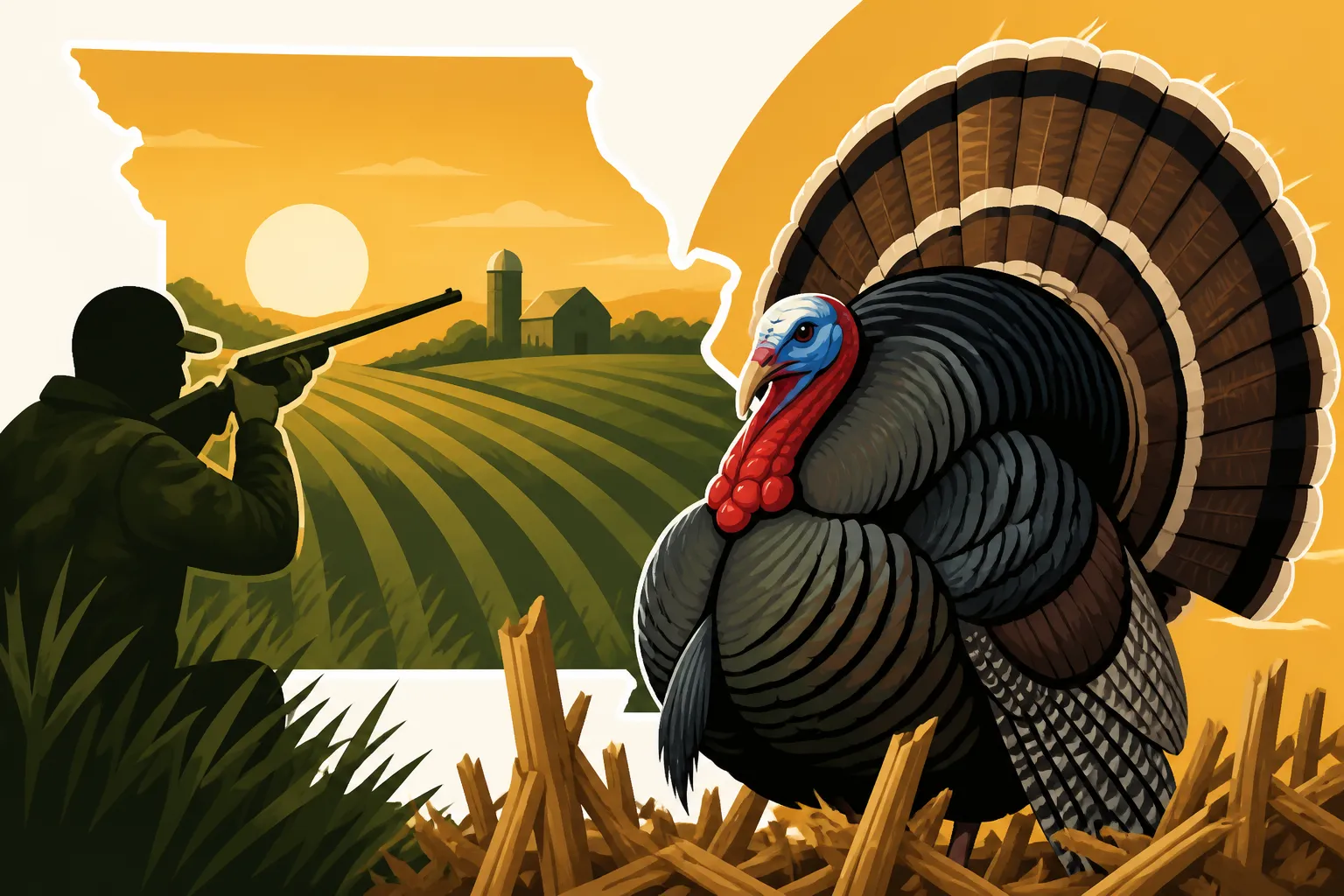
Chasing gobblers in Missouri's wide-open crop country can feel like trying to sneak up on a deer in a golf course. They see you coming from a mile away, hear every rustle, and often prefer to roost and strut on private land, leaving public ground hunters scratching their heads. This guide will walk you through proven tactics to outsmart these sharp-eyed birds, from smart scouting to effective calling and strategic setups, helping you fill your tag even in the most challenging agricultural landscapes.
Understanding the Landscape of Missouri's Crop Country Turkeys
Hunting turkeys in Missouri's agricultural regions, especially across the northern and central parts of the state, presents a completely different challenge than chasing birds in the dense timber of the Ozarks. Here, the landscape is a patchwork of vast cornfields, bean stubble, pastures, and smaller timber blocks. While these areas are often abundant with turkeys thanks to rich food sources, their open nature makes getting close incredibly difficult. Hunters often find themselves busted before they even get a chance to set up, leaving them frustrated and wondering if they'll ever get a shot.
The frustration is real. You might hear a gobbler hammering on the roost, feel your heart pound, and then watch helplessly as he flies down into the middle of a 200-acre bean field, completely out of reach. Or worse, he's on the neighbor's property, and you haven't secured permission. These challenges require a more nuanced and strategic approach than simply sneaking through the woods. It means thinking like a farmer, understanding property lines, and appreciating how these birds leverage the land.
The Allure and Challenges of Farm Country Gobblers
There's a special draw to hunting turkeys in farm country. The birds tend to be larger, often boasting impressive spurs and beards, a testament to the abundant nutrition available. You'll frequently hear multiple gobblers sounding off at once, creating an exhilarating chorus as the sun rises. The sheer volume of birds can be incredible, and it can feel like you're in the heart of prime turkey habitat.
However, the primary challenge is visibility. With fewer trees to break up your silhouette and provide natural cover, turkeys have an undeniable advantage. They can spot movement, even subtle adjustments, from incredible distances. This makes traditional run-and-gun tactics incredibly difficult, as you're constantly exposed. Another significant hurdle is access. Much of Missouri's prime crop country is privately owned, making securing permission to hunt crucial. Without it, you might be left looking at birds from afar, unable to pursue them. This is where tools like GoHunt, with its detailed mapping layers, can become invaluable for identifying land ownership and planning your approach before you even step foot in the field.
How Agriculture Shapes Turkey Behavior
The agricultural landscape fundamentally shapes how turkeys live, feed, and interact. During the spring, newly planted fields of corn and beans offer easy access to insects and residual grains from the previous year. Mature fields of winter wheat, clover, or alfalfa provide lush green forage and insect buffet lines, drawing birds in like magnets. These fields often act as critical feeding and strutting grounds, especially on clear, sunny mornings.
Roosting locations in crop country are often dictated by the largest, most mature timber stands available. These might be isolated timber blocks, fencerows with mature trees, or river bottom corridors running through agricultural areas. Turkeys will fly down from these roosts, often heading directly to nearby fields to feed and put on a show for hens. Understanding these consistent patterns – where they roost, where they fly down, and where they gather to feed and strut – is the bedrock of successful farm country turkey hunting. Their daily routines are closely tied to the cycles of the crops and the availability of suitable roosting and strutting habitat.
Scouting and Locating Birds in Open Terrain
Effective scouting is paramount when hunting turkeys in crop country. You can't just wander aimlessly and expect to stumble upon a gobbler; they'll likely see you long before you see them. Instead, you need a methodical approach that combines technology with boots-on-the-ground reconnaissance. This involves studying maps to identify key habitat features, using optics to observe from a distance, and, crucially, making connections with landowners to secure hunting access. Without a solid understanding of where the birds are and how they move within the landscape, you're fighting an uphill battle.
Remember, every bit of information you gather before the season or even during a mid-day lull can be a game-changer. It’s about minimizing guesswork and maximizing your chances of being in the right place at the right time. Being systematic in your scouting efforts will pay dividends when those crucial moments arrive.
Pre-Season Reconnaissance: Maps, Glassing, and Permission
Before the season even opens, your scouting should begin from the comfort of your home. Start by poring over aerial maps using platforms like the Missouri Conservation Atlas or paid services like GoHunt. Look for key features: large timber blocks bordering fields, isolated treelines, creek bottoms with mature trees, and fencerows. These are prime locations for roosting and travel corridors. Identify potential strutting zones—open fields, pastures, or even elevated spots within fields. Pay attention to property lines; knowing what's private and what's public is vital. For instance, knowing how to use the Atlas to find an area can save you countless hours of driving.
Once you have some areas identified, it's time for real-world glassing. With their keen eyesight, turkeys in crop country are notoriously wary. Use good quality binoculars or a spotting scope from a distance, ideally from a high vantage point, to observe fields at dawn and dusk. Watch for birds flying to and from roosts, strutting in fields, or feeding. This "spy-glassing" allows you to pattern birds without alerting them to your presence. Crucially, combine this with knocking on doors to secure permission. A friendly conversation with a landowner, perhaps offering to help with chores or share some wild game meat, can open up incredible hunting opportunities. Many Missouri landowners are receptive to respectful hunters, especially those who come prepared and show genuine interest in their property and wildlife.
Reading the Roost and Morning Fly-Down Routes
Understanding where turkeys roost and their subsequent fly-down routes is the golden ticket to success in crop country. Turkeys prefer to roost in large, mature trees that offer good visibility and protection. These are often the tallest trees in a timber block, along a river corridor, or within a dense fencerow. You can locate these roosts by listening for gobblers at dawn or dusk, or by visually scanning timber edges from a distance with your optics. Pay attention to droppings and feathers at the base of trees, which indicate consistent roosting spots.
Once you've identified a roost, the next step is to predict their fly-down route. Turkeys usually fly down from their roosts and immediately head to an open area to strut and gather hens. This might be a nearby alfalfa field, a fresh-cut bean field, or even a wide-open pasture. Look for subtle terrain features like slight rises, brush lines, or creek beds that might offer a direct, concealed path from the roost to these strutting zones. Your goal is to intercept them between their roost and their strutting grounds. Sometimes, this means setting up well before daylight, sneaking into a position where you can call to them as they fly down, or even catching them as they approach a specific opening. Remember, turkeys are creatures of habit, and their morning routines are often remarkably consistent.
Calling Strategies for Wide-Open Spaces
Calling turkeys in open crop country is a different ballgame than in thick timber. Your calls carry much further, but so do the turkeys' abilities to pinpoint your location. You need to consider how sound travels, how your calls will be perceived over long distances, and how to use them effectively without sounding unnatural or alarming. It's about finding that sweet spot between getting their attention and drawing them in close enough for a shot, all while battling the vastness of the landscape.
You'll quickly learn that subtlety often wins in these situations, but knowing when to unleash a loud series of yelps can be just as important. The key is adaptation and observation, letting the birds tell you what they want to hear and how close they're willing to commit. Don't be afraid to experiment with different calls and volumes; a single, clear yelp might be more effective than a frantic series if the birds are particularly wary.
Volume and Tone: Adjusting Calls for Distance
In crop country, the wind and open terrain can play havoc with your calls. What sounds good in your hand might be barely audible or completely distorted at 200 yards. When a gobbler is far off, perhaps across a sprawling field, you'll need to use louder, more aggressive calls to get his attention. Box calls, pot calls with a glass or aluminum surface, and loud diaphragm calls are excellent for this. A series of sharp, piercing yelps or cutting can travel a long way and often provoke a distant gobbler to respond. However, once he starts heading your way, or if he's already within 100 yards, it's time to drastically reduce your volume. Switching to softer tree yelps, clucks, or purrs with a mouth call or slate can draw him the last critical distance without alerting him to your exact, static position.
Think of it as a conversation: you shout to get someone's attention across a large parking lot, but once they're closer, you naturally lower your voice. Similarly, when hunting a long-tail situation like this, knowing when to quiet down is crucial. A common mistake is continuing loud, aggressive calling when a bird is close, which often makes him hang up out of range. If you find yourself needing to call a Missouri gobbler off the roost, start with those softer tree yelps and gradually increase as needed, but always be ready to back off the volume.
Decoy Setups and Placement in Crop Fields
Decoys are an absolute game-changer in crop country, often making the difference between success and failure. Because of the open terrain, turkeys can spot decoys from incredible distances, drawing them across fields where they might otherwise hang up. The key is realism and placement. A single hen decoy or a jake/hen combination often works wonders. Position your decoys where they are clearly visible from where you expect the gobbler to approach, but also within your effective shooting range. A good rule of thumb is 15-20 yards from your position.
Consider adding motion to your spread if possible, as it adds an extra layer of realism. A slight breeze can make feather-light decoys sway, mimicking a live bird. When setting up in a vast field, place your decoys so that an approaching gobbler has to pass through your shooting lane to get to them. Avoid placing them directly in front of you where the gobbler might stare straight at your position. For pressured birds, a lone hen or a small, submissive jake can be more effective than an aggressive strutting tom, which can intimidate wary gobblers. Remember, Decoy placement for pressured birds in any area, but especially open fields, needs careful thought. Using a ground blind, as discussed in Ground Blinds on Crop Field Edges, also allows you to be much more aggressive with your decoy setup without fear of being busted by the incoming birds.
Setting Up for the Shot in Crop Country
The vast, open nature of crop fields demands careful consideration for your setup. You can't just plop down anywhere and expect a gobbler to walk into range. Every stalk, every call, and every decision about where to sit needs to be calculated to maximize your concealment and optimize your shooting lanes. This isn't just about hiding; it's about making the environment work for you, drawing the bird into a position of vulnerability while keeping yourself invisible.
The right setup will exploit natural terrain features and man-made structures, turning potential weaknesses into strengths. Patience here isn't just a virtue; it's a necessity. You might have to wait longer, or move more slowly, but the payoff of a successfully outsmarted crop-country gobbler is incredibly rewarding.
Utilizing Natural and Man-Made Cover
In crop country, cover is often scarce, making its utilization critical. Natural features like fencerows, timbered draws, ditches, and creek beds become your best friends. These linear features provide excellent concealment for approaching your setup and for breaking up your silhouette. Setting up along the edge of a fencerow between fields, for example, allows you to observe a large area while remaining hidden. A well-brushed-in ground blind placed along a field edge offers superior concealment and allows for comfortable, patient hunting. Think about Brushing In a Blind on a Field Edge with local vegetation to make it blend seamlessly.
Don't overlook man-made cover either. Hay bales, abandoned farm equipment, or even the slight depressions from old irrigation ditches can offer just enough break in the terrain to conceal your approach and position. The key is to get low and stay still. If you’re caught in the open, even the slightest movement can send a bird running. Often, the best approach is to identify where you think the birds will be, then use any available cover to get within 100-150 yards undetected before you even consider making a call.
Dealing with Wary Gobblers and Long Approaches
Wary gobblers in crop country are a breed apart. They've seen it all, and their senses are on high alert. Expect them to hang up at 60-80 yards, well out of shotgun range, often on the far side of a fencerow or a dip in the terrain. This is where patience truly becomes a virtue. If a gobbler hangs up, resist the urge to move or make aggressive calls. Instead, try soft clucks and purrs, mimicking a hen that's comfortable and not rushing. Sometimes, no call at all is the best call, letting the decoys do the work.
When a gobbler hangs up, you have a few options:
- Patience: Often, if you remain silent and still, especially with decoys out, a curious gobbler will eventually commit.
- Subtle Movement: If you're in a blind, you might try a very slow, subtle movement to grab a leafy branch and wave it gently, mimicking a bird stretching. But this is risky outside a blind.
- Circumvention (if possible): If the terrain allows, you might try a wide, silent circle to get ahead of the bird or approach from a different angle, but this is incredibly difficult in open country.
- Changing Position: If a bird consistently hangs up in the same spot, you might need to adjust your decoy placement or move your blind slightly for the next hunt.
Always be ready for a long shot if you're comfortable with your rifle or Crossbow Hunting Under Missouri Rules as an alternative. However, for traditional shotgun hunting, getting them into that 30-yard sweet spot requires cunning. Sometimes, a "run-and-gun" approach might be tempting, but in open country, it's often a recipe for disaster unless you have significant terrain features or standing crops for concealment. Focus instead on being a master of concealment and patience, waiting for that one opportunity.
Here's a quick look at common calling and decoy scenarios:
| Scenario | Calling Strategy | Decoy Strategy (Approx. Yards from Hunter) | Ideal Cover Type |
|---|---|---|---|
| Distant Gobbler (300+ yds) | Loud yelps, cuts, aggressive box/pot calls | Strutter/Hen combo (20-25 yds) | Ground blind on field edge, timber edge |
| Mid-Range Gobbler (100-300 yds) | Medium volume yelps, clucks; use diaphragm/slate | Single hen, or jake/hen (15-20 yds) | Fencerow, timbered draw, hay bale |
| Close Gobbler (under 100 yds) | Soft clucks, purrs, light tree yelps | Single submissive hen (10-15 yds) | Thick brush, natural depression |
| Gobbler Hung Up (60+ yds) | Minimal soft purrs, clucks; mostly silent | Any spread; rely on realism | Any existing blind or thick cover |
This table provides a general guide, but remember that turkeys are individuals, and sometimes breaking the "rules" is what it takes. Always be observant, adapt to the bird's mood, and adjust your tactics accordingly. Knowing When Missouri gobblers go quiet can be just as important as knowing when to call loudly.
Disclaimer
Hunting is an inherently dangerous activity. Always prioritize safety, understand and follow all Missouri Department of Conservation regulations, and obtain proper permits and landowner permissions. The information provided here is for educational purposes and should not replace professional guidance or personal experience. Be aware of your surroundings, identify your target, and know what lies beyond.