Missouri Deer Transport Rules
There’s nothing quite like the rush of adrenaline and the quiet satisfaction after you’ve successfully harvested a deer in Missouri. The hard work of scouting, sitting, and making the shot culminates in that moment. But then, almost immediately, a new set of questions pops up: "What do I do now? How do I get this deer home or to the processor without breaking any rules?" The excitement can quickly turn into anxiety if you’re not clear on the state's deer transport regulations. This comprehensive guide is here to walk you through every step, ensuring your hard-earned harvest makes it legally and safely from the field to your freezer, alleviating that post-harvest scramble.
Understanding the Basics of Deer Transport in Missouri
Once you’ve got a deer on the ground, the clock starts ticking for a few important steps. It's not just about getting it out of the woods; it's about following the rules set by the Missouri Department of Conservation (MDC) to ensure sustainable hunting practices and prevent the spread of diseases. This initial phase is where many hunters, especially new ones or those used to different state regulations, can feel a bit lost.
Telecheck Requirements Before Moving Your Deer
This is perhaps the most critical step you need to take before you do anything else with your deer. You must Telecheck your deer immediately after harvest and before you begin any significant transport. What does "immediately" mean? The MDC states it means before you leave the county of harvest and definitely before midnight on the day you kill the deer. If you're out in the deep woods with no cell service, you need to field dress your deer, get it out of the immediate vicinity (perhaps to a road where you can drive to service), and then complete the Telecheck. This process involves calling a toll-free number or using the MDC's online system or the MO Hunting app.
During Telecheck, you'll need your permit number, the county where you harvested the deer, the date and time of harvest, and information about the deer itself (sex, and if it's an antlered buck, the number of antler points on one side). This unique confirmation number is what legally validates your harvest. I’ve heard countless stories from hunters who were so excited they forgot to write down their permit number or ran out of battery on their phone right when they needed it most. It's a real pain! Always have your permit handy, either printed or easily accessible on your phone, and a pen to jot down that crucial confirmation number. If you want a deeper dive, check out our guide on Telechecking a Missouri Deer.
Initial Transport From the Field
Once Telechecked, and you have that confirmation number in hand, you need to properly tag your deer. Your deer permit has detachable tags, and you'll use one of these. The MDC requires you to "notch" or cut out the month and day of harvest on the tag, then attach it securely to the deer. The tag should be visible, and the Telecheck confirmation number written on it. This tag, along with your valid permit and Telecheck confirmation, essentially makes your deer a legally transportable animal.
Moving the deer from its resting place to your truck is the very first instance of "transport," so ensuring it's Telechecked and tagged before it leaves the immediate kill site is paramount. Often, hunters will field dress their deer right where it falls to lighten the load and begin the cooling process. This is perfectly fine and often recommended, especially if you’re in for a long drag or hunting during warmer early archery seasons. However, even if field-dressed, the permit and Telecheck number must be affixed to the carcass.
Evidence of Sex and Antler Points
For regulatory and biological monitoring purposes, the MDC requires that certain parts of the deer remain attached during transport until the deer reaches its final destination, such as your home, a commercial processor, or a taxidermist. For antlered deer, this means the head with antlers must remain naturally attached to the carcass. For antlerless deer, proof of sex (either the head or external genitalia) must remain attached. This allows conservation agents to verify that the correct type of deer was harvested under your specific permit.
This rule is designed to prevent fraud and help the MDC collect accurate harvest data. For example, if you have an antlerless permit, and all evidence of sex is removed, it becomes impossible to prove you didn't harvest an antlered deer with that tag. Once you're at your final destination (home, processor), you can remove these parts. But until then, keep them attached. For more details on this, our article on Missouri Deer Tag Notching Rules goes into depth about proper tagging.
Transporting Deer Within Missouri and Across County Lines
Now that you've completed the initial steps and have your deer properly tagged and Telechecked, you're ready for the main journey. Transporting your deer within the state is generally straightforward, but there are still important considerations, especially regarding carcass movement and handling.
Rules for Intra-state Transport
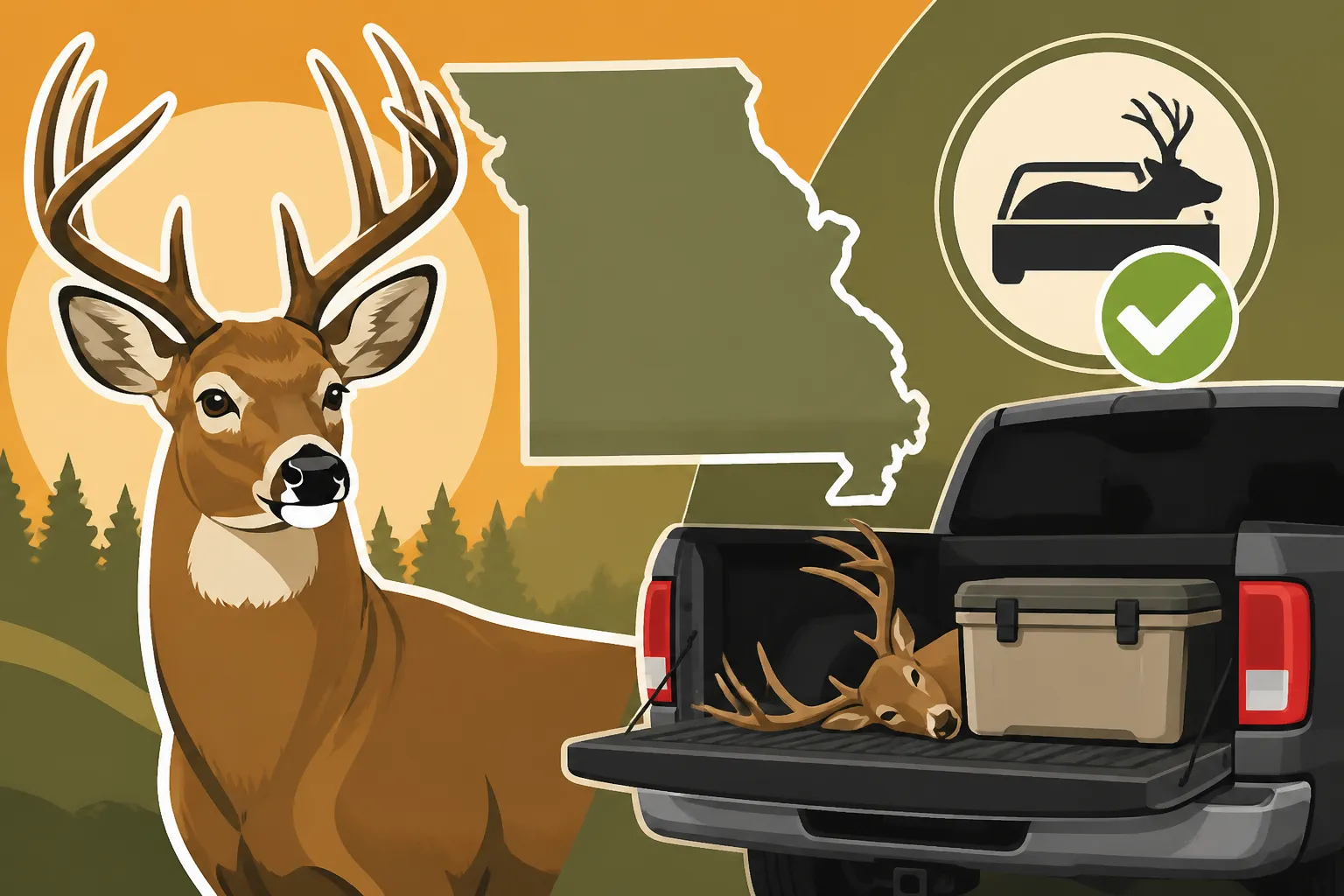
After your deer is legally Telechecked and tagged, you can transport it anywhere within Missouri. This includes taking it directly home, to a deer camp, a processing facility, or a taxidermist. The key here is that the permit, with the Telecheck confirmation number written on it, remains attached to the carcass and is visible. You should also be ready to present your valid hunting permit if asked by a conservation agent.
Practical considerations are just as important as the legal ones. Missouri can experience wildly varying temperatures during hunting season. An early September archery hunt might see temperatures in the 80s, while late December could be below freezing. If you're transporting a deer in warmer weather, getting that carcass cooled down quickly is paramount to preserving the meat. This often means having ice and a cooler ready for the field-dressed deer, or at least ensuring airflow if it's in the bed of a truck. Don't let your hard-earned venison spoil! We've got some great tips on Getting Deer Meat Cooled Quickly and Field Dressing and Cooling in Early-Season Heat that are worth a read.
Transporting Carcasses Through CWD Management Zones
This used to be a point of significant confusion and frustration for many Missouri hunters. In the past, specific counties were designated as Chronic Wasting Disease (CWD) Management Zones, which meant special restrictions on carcass transport out of those counties. However, as of recent changes by the MDC, the CWD Management Zone designation has been removed from all counties.
This is a huge relief for hunters! It means you can now transport whole deer carcasses harvested anywhere in Missouri throughout the entire state without needing to bone out the meat or adhere to specific carcass restrictions for intra-state travel. This change reflects the MDC's evolving management strategy for CWD. While the zones are gone, CWD itself is still present in some areas. The MDC continues to monitor the disease, and hunters are encouraged to participate in voluntary CWD Sampling and Testing for Hunters to help with surveillance. While statewide carcass movement is now permitted, it's always smart to stay informed about Missouri CWD Prevalence Rates in your hunting area.
Transport to a Processor or Taxidermist
If you're taking your deer to a commercial processor or a taxidermist, the process is quite simple. The key is ensuring your deer still has its attached, properly completed permit with the Telecheck confirmation number. When you drop off your deer, the processor or taxidermist will record this information. They are legally required to keep records of the deer they receive, including the hunter's name, permit number, and Telecheck confirmation.
Make sure to communicate clearly with your chosen facility about how you want your deer processed or caped. If you plan to get a shoulder mount, the taxidermist will need the head and a significant portion of the hide (the cape), and they'll handle the removal of those parts. If it's just for meat, the processor will take care of everything. This part of the journey is generally the least stressful once you’ve done your part.
Transporting Deer Out of Missouri
For non-resident hunters, or even residents who hunt out of state and want to bring their Missouri harvest elsewhere, the rules become more stringent, specifically due to the concern over Chronic Wasting Disease (CWD). These rules are designed to prevent the movement of potential disease-carrying materials across state lines.
Rules for Non-Resident Hunters
If you're a non-resident hunter who successfully harvests a deer in Missouri, congratulations! But before you hit the road home, there are critical steps to take. Just like resident hunters, you must Telecheck your deer before leaving Missouri. This is non-negotiable and applies to everyone.
The significant difference for non-residents is how the carcass must be prepared for transport out of Missouri. To prevent the spread of CWD to other states, you cannot transport a whole deer carcass across Missouri's borders. The brain and spinal column, which are known to harbor CWD prions, must be removed before you leave the state.
Acceptable forms for out-of-state transport include:
- Boned-out meat: All the meat removed from the bone.
- Quarters or other large pieces of meat: As long as no part of the spinal column or brain is attached.
- Hides: With no head or spinal column material attached.
- Antlers: Detached from the skull plate, or a cleaned skull plate.
- Cleaned skull plates: With all brain and nervous tissue removed.
- Finished taxidermy products: Once fully processed and mounted, they are safe to transport.
This often means you'll need to either bone out your deer yourself or use a Missouri-based processor before heading home. Planning ahead for this is crucial, especially if you're traveling a long distance. Many non-resident hunters find resources like GoHunt useful for navigating permit applications and understanding regulations not just in Missouri, but across various states they might hunt. Our guide, What a Nonresident Pays to Hunt Missouri, can help you understand the permit costs before you even hit the woods.
Why Carcass Restrictions for Out-of-State Transport?
These stringent rules for cross-state transport are a direct response to the threat of Chronic Wasting Disease. CWD is a fatal, neurological disease that affects deer, elk, and moose. It's caused by abnormal proteins called prions, which are highly concentrated in the brain, spinal cord, lymph nodes, and spleen of infected animals. These prions are incredibly hardy and can persist in the environment for years, potentially infecting other animals.
By restricting the movement of whole carcasses, especially those parts containing the highest concentration of prions, Missouri (and many other states) aims to slow or prevent the spread of CWD to new areas. It's an inconvenient truth that while these rules add a layer of work for hunters, they are absolutely critical for protecting the health of wild deer populations nationwide. It's about being responsible stewards of the resource, even if it means a little extra effort in the field or at camp. For more on this, you might find our article on Carcass Transport Rules Out of Missouri helpful.
Preparing Your Harvest for Cross-State Travel
If you plan to take your Missouri deer home to another state, you'll need a game plan. For many, this means boning out the deer. This involves carefully removing all the meat from the bones, leaving the spinal column and skull behind in Missouri (or properly disposing of them in an approved landfill). Many hunters learn the "gutless method" to quickly debone a deer in the field, which can be a huge time and effort saver, especially if you're by yourself.
Once the meat is deboned, it needs to be packaged and cooled immediately. Heavy-duty game bags and plenty of ice in a quality cooler are your best friends here. For capes, if you’re planning a shoulder mount, you can skin out the deer and bring the cape home. Just make sure no brain or spinal column material is attached to the skull plate that comes with the cape. Clean the skull plate thoroughly. Remember to also check the regulations of your destination state, as they might have their own specific entry requirements for deer harvested elsewhere. Tools like GoHunt can be invaluable for researching and comparing regulations across different states, ensuring you're compliant no matter where your hunting adventures take you.
| Condition of Deer Carcass | Where it can be transported | Key Requirement(s) |
|---|---|---|
| Untagged / Un-Telechecked | Only from kill site to nearest point of Telecheck | Hunter must be present; Telecheck immediately upon reaching service/phone. |
| Telechecked, Tagged, Whole Carcass | Anywhere within Missouri | Permit with Telecheck # attached, evidence of sex/antlers attached. |
| Telechecked, Tagged, Boned-Out Meat | Anywhere (in-state or out-of-state) | All meat removed from bone; skull/spinal column removed before crossing state lines. |
| Telechecked, Tagged, Cleaned Skull Plate/Antlers | Anywhere (in-state or out-of-state) | All brain/nervous tissue removed; skull plate cleaned of all meat/tissue. |
| Telechecked, Tagged, Finished Taxidermy | Anywhere (in-state or out-of-state) | Must be a fully processed and mounted product. |
Disclaimer
The information provided in this guide is for general informational purposes only and is subject to change. Hunting regulations can be complex and are regularly updated. Always consult the most current Missouri Department of Conservation (MDC) hunting regulations and official publications before heading into the field.