How Far to Walk From the Parking Lot
We've all been there: you pull into the public land parking lot on a crisp fall morning, full of anticipation, only to find a dozen other trucks already there. That sinking feeling sets in – have all the good spots been taken? Is it even worth getting out of the truck? The truth is, one of the biggest challenges for Missouri hunters, especially those relying on public land, is finding ground that hasn't been heavily pressured. This guide is all about tackling that challenge head-on by exploring the critical question of how far you really need to walk from the parking lot to find success and solitude.
The Public Land Paradox: Why Walking Matters
It's a common lament among public land hunters: "There's just too much pressure." And while it's true that some areas see a lot of boots on the ground, the reality is often that the majority of that pressure is concentrated surprisingly close to easy access points. Understanding this human dynamic, and how game animals react to it, is the first step in crafting a strategy that puts you in better positions.
The Human Element: Overcoming the Easy Access Trap
Let's be honest with ourselves: very few people enjoy walking a mile or more in the dark, through rough terrain, with all their gear strapped to their back. It's tough, it's exhausting, and it often feels unnecessary when there's perfectly good-looking timber or fields right off the gravel road. We naturally gravitate towards convenience, and hunters are no different. This leads to a phenomenon where the first few hundred yards around any parking area or established trail system become a gauntlet of human activity. You'll find old boot tracks, discarded snack wrappers, and even temporary ground blind setups from previous seasons. Most hunters, for completely understandable reasons, just don't venture beyond that initial, easily accessible zone. They're often targeting the "low-hanging fruit," hoping a deer or turkey just happens to be passing through.
This isn't a judgment, it's just a reality. We've all been tempted to hit that easy spot, especially on a frigid November morning or when time is short. But by understanding this inherent human tendency, we can exploit it. The hunter willing to push past that initial comfort zone, to put in the extra effort, often finds themselves in a different world entirely, one where the deer are less skittish and the woods feel more wild. It separates the "road hunter" from the determined "walker."
Game Reaction: How Pressure Shapes Behavior
Missouri deer, particularly the mature bucks we all dream of, are incredibly intelligent and adaptable creatures. They quickly learn to associate human scent, noise, and visual disturbances with danger. When an area gets hunted consistently, especially near roads and parking lots, these animals don't just disappear – they shift their patterns. They become more nocturnal, moving primarily under the cover of darkness. They utilize the thickest, nastiest cover available during daylight hours. They might even relocate entirely to areas with less human intrusion.
Think about it from a deer's perspective: if every time they step out near a particular ridge line or food plot that's close to the road, they encounter human scent, hear doors slamming, or see flashlights, they're going to choose a different route. This is why you often see "ghost" bucks that are only captured on trail cameras at 2 AM near access points, but never during legal shooting light. They know the score. Turkeys, too, become incredibly wary, often henned up and silent on high-pressure properties. To consistently encounter undisturbed game moving naturally during hunting hours, you often need to go where the animals feel safe, and that's usually where fewer people are willing to go. This means getting beyond the immediate bubble of human activity that emanates from every parking area.
Finding the Sweet Spot: How Far is "Far Enough"?
So, if walking further is the key, how far is far enough? There's no single magic number, unfortunately, as conditions vary wildly across Missouri's diverse landscapes. However, we can use some general guidelines and adapt them based on scouting and experience.
The "Half-Mile Rule" and Beyond
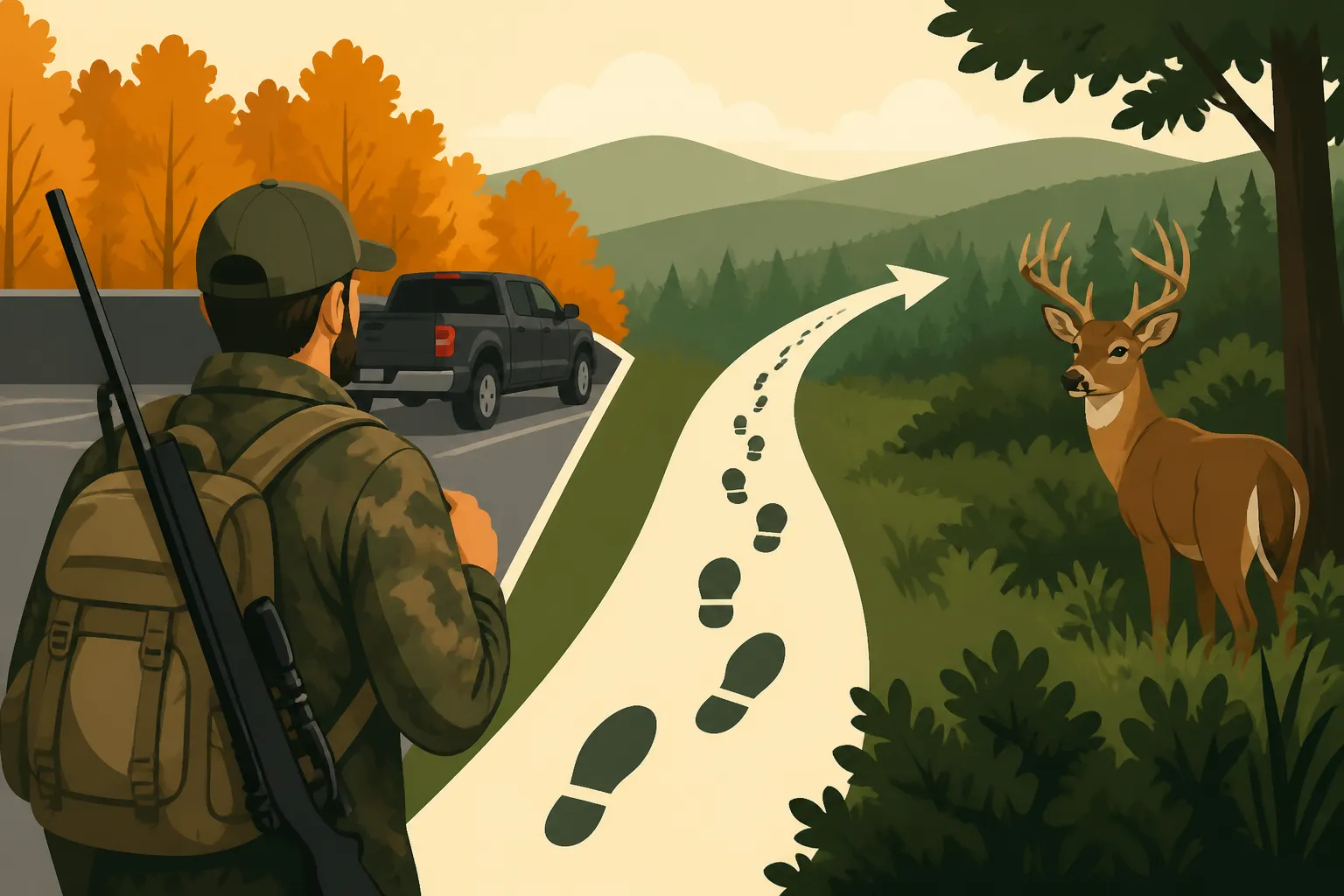
A good general rule of thumb for many public lands, especially during peak seasons, is that the significant majority of hunters don't venture more than about 400-800 yards (roughly a quarter to a half-mile) from their vehicle or a well-worn trail. This means if you can push past that half-mile mark, you've already eliminated a huge percentage of the competition. For truly unpressured game, especially wary bucks, sometimes that number needs to stretch to a mile or even further, particularly on larger tracts of public ground.
Consider this your starting point, not a hard-and-fast rule. In areas with extremely rugged terrain, like parts of the Deer Hunting the Missouri Ozarks, even a quarter-mile might feel like a mile, and the number of hunters willing to go there drops dramatically. Conversely, on flat, easily traversable Hunting North Missouri's Big-Buck Farm Country, that half-mile mark might not be enough to truly escape the crowds, and you might need to commit to a full mile or more to find true solitude. The key is to be flexible and let the land and the pressure tell you how far to push.
Reading the Landscape: Features That Funnel Hunters and Deer
Understanding topography and natural features is paramount when deciding how far, and where, to walk. Hunters, like water, tend to follow the path of least resistance. That often means sticking to ridge lines, logging roads, or the easiest path through a timbered draw. Game animals, however, often use these same features, but also seek out the nastiest, most overlooked cover.
When you're looking at a map, whether it's a paper Scouting With the Missouri Conservation Atlas or a digital platform like onX Hunt, identify key features. Look for deep, timbered draws that extend far back from roads, hidden creek bottoms, isolated pockets of thick cover, or finger ridges that drop off into dense bedding areas. These are often natural funnels for deer movement, and if they're a bit of a hike, they're less likely to be hunted. Conversely, identify features that attract other hunters: wide, open timber with easy walking, obvious food plot edges, or prominent saddles near parking. Plan your route to bypass these high-traffic areas. Hanging a Stand on a Ridge Saddle might be a great tactic, but if that saddle is 100 yards from a parking lot, it's likely over-hunted. The real challenge, and the real reward, comes from finding that same type of feature a mile or more deeper in the timber.
Assessing Pressure: When You Need to Walk Further
Sometimes, the number of vehicles in the parking lot tells only half the story. You need to assess the actual pressure on the ground. When you first step out of your vehicle, pay attention. Are there fresh boot tracks everywhere? Is there an obvious "highway" trail leading from the parking lot into the woods? Are there older, semi-permanent ground blinds or hastily built brush blinds every couple of hundred yards? These are all clear indicators of high pressure.
Opening weekend of Missouri's November Firearms Portion is a prime example of when you absolutely must walk further if you want to find anything but spooked deer. The same goes for the early days of archery season in accessible areas, or prime Spring Turkey Calling in Missouri Timber spots in the spring. If you find yourself thinking, "Man, I bet someone else is already here," then you probably need to be walking another half-mile. It’s frustrating, especially when you’ve put in the scouting, to feel like your efforts are being diluted by other hunters. But that validation of your frustration should be a motivator to push deeper, past where most people are willing to go.
Here's a quick guide to how far you might need to walk, depending on the scenario:
| Hunting Scenario | Minimum Walking Distance from Parking | Notes |
|---|---|---|
| Early Archery Season (low temp) | 0.25 – 0.5 mile | Can be less if deep cover/terrain acts as a barrier. Still-hunting effective. |
| Mid-Season Archery (rut, weekdays) | 0.5 – 1 mile | During the Hunting the Peak Rut Week in Missouri, deer are more active, but so are hunters. |
| Firearms Opening Weekend | 1+ mile | Absolutely critical to get deep to find less pressured deer. Consider Deer Drives on Missouri Public Ground for distant spots. |
| Mid-Week Firearms Season | 0.75 – 1.5 miles | Pressure lessens, but game remains wary. Seek out remote pockets. |
| Late Season (cold/snow) | 0.5 – 1 mile | Fewer hunters, but game is focused on food. Identify remote food sources. |
| Spring Turkey (accessible areas) | 0.5 – 1 mile | Gobblers get shy quickly. Early morning walks to roosted birds. |
| Small Game (squirrel/rabbit) | 0.25 – 0.5 mile | Often less pressure. Focus on good habitat, but still move away from roads. |
| Waterfowl (non-managed wetland) | 0.5 – 1 mile | Getting away from road ditches on river bottoms can make a huge difference. |
Strategies for Deeper Penetration and Success
Knowing that you need to walk further is one thing; actually doing it effectively is another. It requires a thoughtful approach to gear, scouting, and execution.
Packing Smart: Gear for the Long Haul
When you're committed to walking a mile or more into the Missouri timber, every ounce in your pack counts. You need essential gear, but you need to be ruthless about leaving anything unnecessary behind. Your core kit should include: ample water (especially in early season heat or during strenuous hikes), a compact first-aid kit, a reliable headlamp with fresh batteries, a sharp field dressing knife, and a way to communicate (phone, GPS, or two-way radio if cell service is spotty in the Ozarks).
Your treestand or ground blind setup needs to be as lightweight and packable as possible. If you're using a treestand, climbing sticks are often more versatile than a bulky climber, especially on the gnarled oaks and hickories you find deep in Missouri's public lands. Consider a saddle hunting setup, which is incredibly lightweight and allows for agile movement through thick cover. Saddle Hunting in Missouri Oaks can be a game-changer for those long walks. Your footwear is also paramount. Boots for Walking Ozark Rock need to be sturdy, provide good ankle support, and be broken in to prevent blisters. Nothing will cut a long walk short faster than aching feet. And finally, always consider how you'll get a deer out from that deep spot. A good game cart or a plan for the gutless method and game bags might be more realistic than trying to drag a whole deer a mile uphill.
Utilizing Digital Tools: Your Scouting Secret Weapon
In today's hunting world, digital mapping applications like onX Hunt are indispensable, especially for public land hunters. They allow you to virtually "walk" the terrain from your couch, identifying potential access points, hidden funnels, thick cover, and even property lines (so you don't inadvertently trespass). You can use the aerial imagery to spot natural barriers that might deter other hunters but could be a perfect route for you. Look for subtle terrain changes, logging roads that aren't obvious from the main road, or even old fencerows that create linear travel corridors far from typical access.
Beyond onX Hunt, other robust scouting platforms can offer valuable insights. While platforms like GoHunt are often geared towards western big game, the principles of using advanced mapping, weather overlays, and historical data to identify patterns can absolutely be applied to Missouri deer and turkey hunting. For instance, you can use these tools to identify isolated patches of oaks for Squirrel Hunting in Hickories or remote food sources that might be overlooked. Don't forget the more traditional resource, the Missouri Conservation Atlas, which offers detailed maps of Conservation Areas, and downloading those specific area maps to your phone for offline use is always a smart move. Combining these digital tools with boots-on-the-ground scouting before the season opens will give you a significant advantage, allowing you to plan your long walks with precision.
Planning Your Route: Entry and Exit Tactics
Walking further isn't just about covering distance; it's about doing it smartly. Your entry and exit routes are just as critical as your stand location. The goal is to get in and out of your hunting spot without alerting game animals. This means:
- Silent Approach: Plan your route to avoid crunching leaves, snapping twigs, or stepping on noisy dry creek beds. Sometimes this means taking a slightly longer, but quieter, route.
- Use Natural Cover: Stay in the shadows, use the contours of the land, and keep thick cover between you and potential bedding areas. You want to be a ghost moving through the woods.
- Mind the Wind and Thermals: This is absolutely critical, especially on long walks. Always consider the prevailing wind, and in hilly terrain like the Ozarks, understand how thermals will affect scent distribution, especially during early morning ascents and late evening descents. Wind and Thermals in Ozark Hills are notoriously tricky, and a long walk can be wasted if your scent blows into the primary bedding area before you even get set up. A good rule of thumb is to avoid walking directly into the wind toward your stand, as your scent will be pushed ahead of you.
- Time Your Arrival: Give yourself ample time for the walk, especially in the dark. Rushing will lead to more noise and more sweat, both of which are detrimental to a quiet approach. Arriving at your stand 30-60 minutes before shooting light is ideal to allow the woods to settle down around you.
The Rewards of the Extra Mile
While walking further certainly involves more effort, the rewards can be truly significant, transforming your hunting experience in Missouri.
Finding Undisturbed Game
The most obvious benefit of venturing deep into public land is encountering animals that haven't been subjected to constant human pressure. These deer, turkeys, and small game often behave more naturally. They might be less jumpy, more prone to responding to calls, and more likely to move during daylight hours. You'll observe more natural patterns of movement, feeding, and bedding. Instead of seeing a buck slinking through at the last minute, you might witness him confidently working a scrape line, or chasing a doe, acting like a deer that hasn't seen a human in weeks. This doesn't guarantee a harvest, of course, but it significantly increases your chances of a quality encounter. It's the difference between hunting a "ghost" and hunting a living, breathing, naturally moving animal.
The Satisfaction of Solitude
Beyond the tangible benefit of more game encounters, there's an immense, intangible reward: solitude. There's a profound satisfaction that comes from sitting in a spot so deep in the woods that you haven't heard a single human sound all day. No distant slamming truck doors, no ATV engines, no barking dogs from a nearby farm. Just the rustle of leaves, the call of a crow, or the distant gobble of a turkey. It's about being truly immersed in the wild, away from the constant hum of civilization.
This solitude can be transformative. It allows you to connect with nature on a deeper level, to truly observe the subtle nuances of the forest, and to clear your mind. For many of us, hunting isn't just about the kill; it's about the entire experience, the challenge, the strategy, and the escape. And in Missouri's public lands, especially during busy seasons, that escape often begins a half-mile or more from the nearest parking lot.
Disclaimer
This article is for general informational purposes only and does not constitute professional advice. Laws, prices and regulations vary by location and change over time. Consult a qualified professional for guidance on your specific situation.