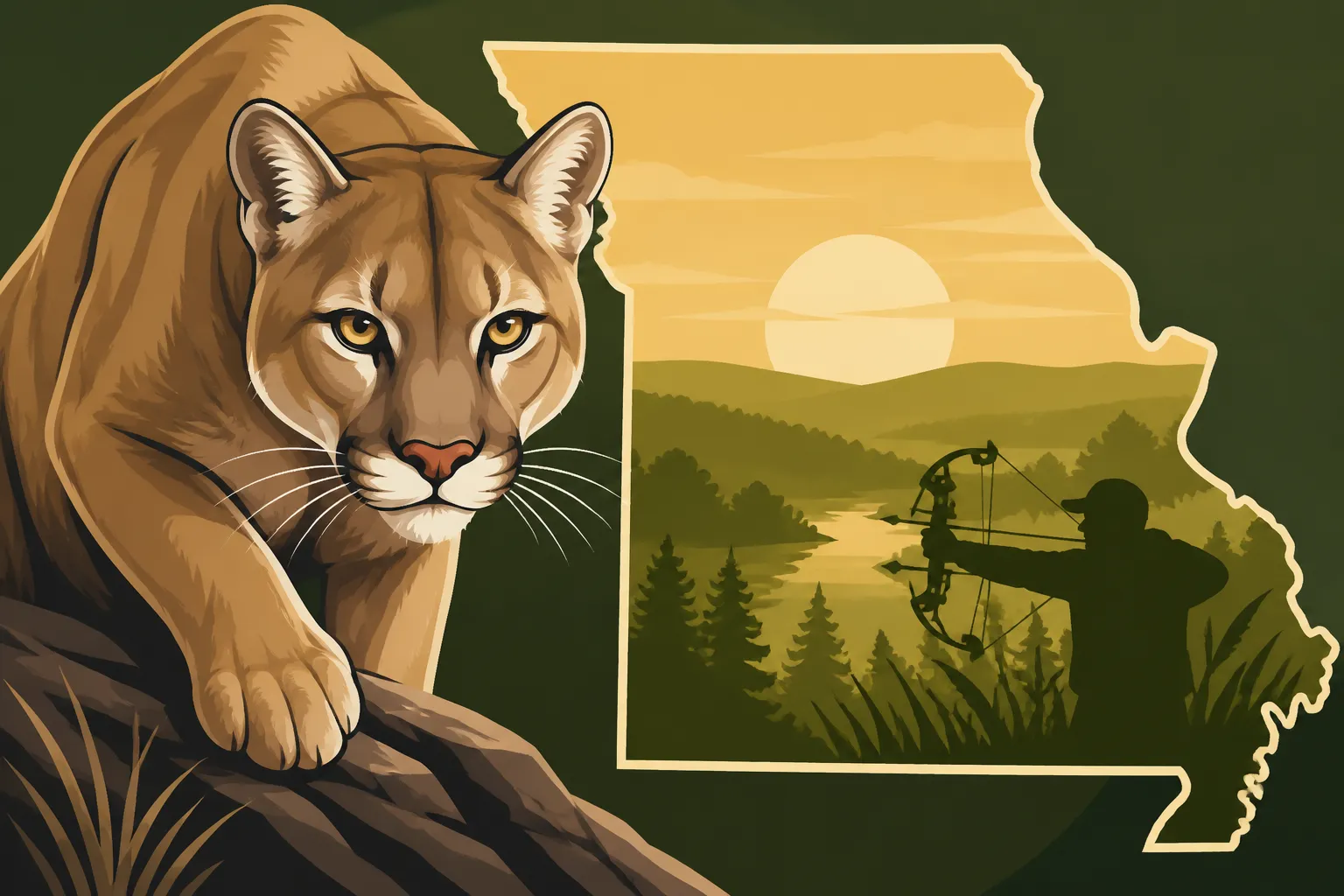
Missouri Mountain Lion Confirmations
The whispers about mountain lions in Missouri have been circulating for generations, a phantom presence in our woods that captures the imagination and sometimes ignites a bit of fear. For every blurry photo or fleeting glimpse, there's a fervent debate: are they truly here, or is it just another tall tale? This guide aims to cut through the folklore and delve into the solid, confirmed evidence of mountain lions in Missouri, exploring where they come from, how they move through our landscape, and what their verified presence really means for hunters and outdoor enthusiasts.
The Elusive Hunter: Understanding Missouri's Mountain Lions
For many of us who spend countless hours in Missouri's timber and fields, the idea of a mountain lion lurking nearby is both thrilling and a little unsettling. These apex predators are the stuff of legend, but their reality in our state is more nuanced than many realize.
A Brief History of Mountain Lions in Missouri
Missouri wasn't always devoid of mountain lions. Historically, these magnificent cats, also known as cougars or pumas, roamed the vast wild expanses of what would become our state. They were an integral part of the ecosystem, predating on deer and other wildlife. However, with European settlement came significant habitat loss, intense hunting pressure, and the general belief that predators were a threat to livestock and human safety. By the early 1900s, mountain lions were effectively extirpated from Missouri, meaning they were completely wiped out from our native landscape.
For decades, they were gone, existing only in old stories and the occasional unverified sighting. But nature has a way of reclaiming its own, and as conservation efforts have restored deer populations and protected wild lands in neighboring states, the opportunity for dispersal has increased. This isn't a reintroduction effort on Missouri's part; rather, it's a natural phenomenon of transient individuals venturing beyond their established territories.
Characteristics and Behavior
Mountain lions are incredibly powerful and stealthy predators. An adult male can weigh between 110 and 220 pounds and measure up to 8 feet from nose to tail tip, while females are smaller, typically 80 to 140 pounds. Their tawny, unspotted coats help them blend seamlessly into various environments, from rocky bluffs to dense forests.
They are primarily crepuscular and nocturnal, meaning they are most active during dawn, dusk, and nighttime hours, which further contributes to their elusive nature. Their diet in the Midwest largely consists of white-tailed deer, but they will also prey on smaller mammals like raccoons, rabbits, and even domestic livestock if the opportunity arises. They are solitary animals, generally avoiding humans and typically traveling vast distances within large home ranges. This solitary, wide-ranging behavior is key to understanding why we see transient individuals but not established breeding populations here in Missouri.
Confirmed Sightings: What the Data Really Shows
When you hear a story about a mountain lion, it's easy for the imagination to run wild. But the Missouri Department of Conservation (MDC) takes these reports very seriously, and they have a clear process for confirming a sighting versus simply reporting one. This distinction is crucial for understanding their actual presence in the state.
Decoding the "Confirmed" Status
The MDC defines a "confirmed" mountain lion sighting as one supported by concrete evidence that can be scientifically verified. This isn't just a fleeting glimpse or a blurry photo that could be a house cat or a dog. Instead, a confirmation requires:
- Clear photographs or video: High-quality images that unequivocally show a mountain lion. Trail cameras have become invaluable for this.
- Physical evidence: Tracks that can be measured and identified by wildlife biologists as belonging to a mountain lion, scat (feces) that can be analyzed for DNA, or hair samples.
- Carcass verification: The unfortunate discovery of a deceased mountain lion, which provides undeniable proof.
- DNA evidence: Genetic material obtained from a kill site, hair snag, or scat sample, confirmed through laboratory analysis.
It’s important to understand that a significant number of reported sightings each year are investigated and turn out to be misidentifications. Often, coyotes, bobcats, or even large domestic dogs can be mistaken for mountain lions, especially at a distance or in poor light. The MDC's rigorous verification process ensures that when they say a sighting is "confirmed," there's no doubt about it.
Tracking the Numbers: Missouri Mountain Lion Confirmations
Between 1994 and 2023, the Missouri Department of Conservation has officially confirmed 91 mountain lion sightings across the state. This might sound like a lot, but consider it over nearly three decades, and it paints a picture of infrequent, widely dispersed occurrences rather than a dense population. The vast majority of these confirmations have come from trail cameras, which have revolutionized wildlife monitoring, allowing us to see what moves through our woods when we're not there.
These confirmations aren't evenly spread. There are years with more activity and years with less. For example, some years might see a handful of confirmations, while others might only have one or two. This fluctuating pattern is consistent with transient animals rather than a stable, reproducing population.
Geographic Distribution of Confirmations
While mountain lions could theoretically show up anywhere in Missouri, the confirmed sightings tend to cluster in specific types of landscapes. Many confirmations have occurred in the rugged, heavily timbered counties of the Ozarks, which provide ample cover and a good deer population for sustenance. Areas around the Mark Twain National Forest are prime examples of this kind of habitat.
Additionally, major river corridors like the Missouri River and Mississippi River bottoms act as natural travel routes, allowing dispersing animals to move significant distances relatively unseen. You'll find a scattering of confirmations along these river systems and into the more agricultural areas where timbered draws and fencerows offer some concealment. For hunters using tools like GoHunt to scout and understand terrain, visualizing these movement corridors can be fascinating, even if the odds of encountering a lion are slim. It helps connect the dots on how these animals traverse the state.
For example, counties along Missouri's western border have also seen confirmations, likely due to dispersal from established populations in states like Nebraska and South Dakota. It paints a picture of an opportunistic traveler, moving from one suitable habitat to the next.
| Year Range | Total Confirmed Sightings (Approx.) | Primary Evidence Types | Key Regions of Confirmations |
|---|---|---|---|
| 1994-2005 | ~10-15 | Tracks, Photos, Carcass | Western/Central MO, Ozarks |
| 2006-2015 | ~25-30 | Trail Cam Photos, DNA, Carcass | Ozarks, Major River Corridors |
| 2016-2023 | ~45-50 | Trail Cam Photos, DNA, Tracks | Ozarks, Northwest MO, River Bottoms |
| Total (1994-2023) | 91 | Various, with increasing trail cam data | Statewide, concentrated in Ozarks & river corridors |
Note: Numbers are approximate based on MDC historical data. Specific yearly breakdowns are often aggregated.
How Mountain Lions Get to Missouri
The presence of mountain lions in Missouri isn't a mystery if you understand the ecology of these animals. They aren't magically appearing; they're undertaking natural, often arduous journeys from established populations elsewhere.
Dispersal from Western Populations
The primary reason we see mountain lions in Missouri is dispersal from established populations in western states. Young male mountain lions, in particular, are known to roam hundreds, sometimes thousands, of miles in search of new territory and mates. As populations grow in states like Colorado, Nebraska, and the Dakotas, these young, adventurous males strike out on their own to avoid competition with older, dominant males.
They follow river systems, timbered corridors, and suitable habitat, slowly making their way eastward. It’s a remarkable testament to their endurance and adaptability. These animals are simply doing what mountain lions have done for millennia: exploring new frontiers. They are not intentionally relocating to Missouri; they are transient travelers passing through or attempting to establish a temporary territory.
The Question of Breeding Populations
This is perhaps the most crucial point to understand: Despite 91 confirmed sightings, the Missouri Department of Conservation has found no evidence of a breeding population of mountain lions in Missouri.
What does this mean? It means that while individual mountain lions are present, they are almost exclusively transient animals. We haven't found female mountain lions with cubs, nor have we consistently found male and female animals occupying the same territory for extended periods. A breeding population requires multiple individuals, male and female, establishing home ranges and successfully reproducing. All confirmed evidence to date points to single animals passing through, rather than settling down to raise a family.
This distinction is important because the ecological impact of a transient individual is far different from that of a self-sustaining population. While a lone lion might occasionally prey on local deer, it's not going to significantly alter the overall deer population estimate in the way an established population would.
Life on the Move: Habitats and Home Ranges
Understanding how mountain lions utilize the landscape can provide insights into their movements through Missouri. They aren't just wandering aimlessly; they are seeking out specific features that provide cover, food, and safe passage.
Preferred Missouri Landscapes
Even as transients, mountain lions still prefer certain types of terrain. Missouri's vast, unbroken stretches of timber, particularly in the Ozarks, offer excellent cover. This includes areas within the Mark Twain National Forest, where dense canopy, steep ravines, and less human disturbance create ideal conditions for a reclusive predator. Such areas provide not only concealment but also a healthy population of white-tailed deer, which are their primary food source. For hunters who spend time in the deep woods of the Ozarks, reading an Ozark hollow for deer movement also means understanding potential corridors for other large predators.
Beyond the deep timber, river bottoms and their associated bluffs and wooded corridors serve as crucial pathways. The Missouri River and its tributaries, as well as the Mississippi, Big Muddy, and other large waterways, create natural, vegetated highways across the state. These corridors often link larger blocks of timber and provide ample deer and other small game, offering a relatively safe route for a dispersing animal.
Transient Nature and Movement Patterns
The confirmed mountain lions in Missouri are, by their very nature, travelers. Their movement patterns are characterized by long, sometimes circuitous routes, often covering hundreds of miles. They aren't looking to "settle down" in a specific Missouri county unless they find a perfect, undisturbed niche with an abundant food source and no competition, which has yet to be consistently observed.
This means a mountain lion confirmed in one part of the state might be hundreds of miles away a few weeks or months later. Their home range, even for a transient, is enormous. This constant movement makes them incredibly difficult to track and observe, contributing to their mystique and the challenge of proving their presence. They are opportunists, hunting as they move, always pushing forward, sometimes retreating, but generally on an onward journey. Using tools like the Missouri Conservation Atlas or even digital platforms like GoHunt can help visualize the vastness of these potential travel corridors and the sheer amount of terrain a dispersing lion might cover.
Living with Mountain Lions: What Hunters Need to Know
For hunters and outdoor enthusiasts, the confirmed presence of mountain lions, even if transient, naturally brings up questions about safety and impact on local wildlife. It's a valid concern, but one that context can help alleviate.
Safety While Hunting
Let's be realistic: encountering a mountain lion while hunting in Missouri is an extremely rare event. The odds are astronomically low. Mountain lions are inherently shy and reclusive animals that generally avoid human contact. If they detect a human presence, their instinct is almost always to avoid or flee rather than confront.
However, it's always wise to be aware of your surroundings in any wilderness setting. If you were to have the incredibly rare experience of seeing a mountain lion, the MDC offers common-sense advice:
- Do not approach the animal.
- Give it an escape route.
- Do not run. Running can trigger a chase instinct.
- Make yourself appear large. Raise your arms, open your jacket, face the animal directly.
- Make noise. Shout, clap your hands, throw rocks or sticks if necessary.
- Protect children and pets. Pick up small children or pets immediately.
- Fight back if attacked. Although extremely rare, if an attack occurs, fight back aggressively.
These are the same general safety guidelines provided for mountain lion encounters in states with established populations. While they are powerful predators, they do not view humans as prey, and attacks are almost unheard of.
Impact on Deer and Other Game
With Missouri's healthy white-tailed deer population, some hunters worry that mountain lions could significantly impact local deer numbers. The reality, however, is that the current number of confirmed mountain lions—all of them transient individuals—is far too low to have any measurable impact on Missouri's overall deer herd. The occasional deer taken by a lone mountain lion is a minuscule fraction compared to the annual deer harvest by hunters or natural mortality from other causes like EHD or vehicle collisions.
Mountain lions are a natural predator, and a few individuals passing through fit into the ecosystem without causing imbalance. Our deer herds are managed to sustain healthy numbers with various predators, including coyotes, and the confirmed mountain lions are currently just a footnote in that larger ecological picture. It's not like the potential impact of an invasive species; it's a natural re-colonization by a native species, albeit a very limited one at this time.
Are They Legal to Hunt?
No. In Missouri, mountain lions are fully protected under state law. It is illegal to hunt, kill, or trap a mountain lion in Missouri. If a mountain lion is observed threatening livestock or humans, specific guidance should be sought from the Missouri Department of Conservation or local law enforcement. For hunters, this means if you see one while out in the field during deer season, for instance, it's a moment to observe, appreciate, and potentially report, but never to harvest. They are considered a protected species. This also means understanding that when you're hunting within the state, there are game species you cannot hunt in Missouri, and the mountain lion is firmly on that list.
Reporting a Sighting: Your Role in the Data
If you're lucky enough to witness a mountain lion in Missouri, or find compelling evidence of one, your actions can play a crucial role in helping the Missouri Department of Conservation gather accurate data and monitor these rare visitors. Don't just tell your buddies at deer camp; report it!
What Information is Critical
The more detail you can provide, the better. When reporting a potential mountain lion sighting or evidence, try to gather as much of the following information as possible:
- Date and Time: When exactly did you see it or find the evidence?
- Precise Location: Be as specific as possible. GPS coordinates from your phone or a mapping app like GoHunt are ideal. Note the nearest road, landmark, or distinct natural feature.
- Description of the Animal: If seen, what was its size, color, tail length, and any distinguishing marks? What was it doing?
- Photos or Video: This is gold. Clear, well-lit photos or video are the best way to get a confirmation.
- Tracks: If you find tracks, take photos with a ruler or common object (like a coin or knife) next to them for scale. Note the size, shape, and presence or absence of claw marks (mountain lion tracks typically do not show claw marks, unlike dog tracks).
- Scat or Hair: Do not handle directly. Take photos and note the location. If possible, cover it to protect it from weather until MDC staff can arrive.
- Witnesses: Are there other people who saw it with you? Their contact information can be helpful.
It's better to report something you're unsure about than to assume it's nothing. The MDC would rather investigate a false alarm than miss a genuine confirmation.
The MDC Process for Verification
Once you report a sighting, the Missouri Department of Conservation takes over. Their wildlife biologists and conservation agents are trained to investigate these reports thoroughly. They will:
- Contact You: They'll reach out to get more details about your sighting.
- Visit the Site: If the information warrants it, they will visit the location to look for physical evidence (tracks, scat, hair, kill sites).
- Collect Evidence: Any potential evidence will be collected, measured, photographed, and potentially sent for laboratory analysis (e.g., DNA from scat or hair).
- Analyze Data: Biologists will compare the evidence against known mountain lion characteristics and eliminate possibilities of misidentification.
- Confirm or Deny: Based on the evidence, the sighting will either be officially confirmed or determined to be unconfirmed/misidentified.
This rigorous process is how the MDC maintains an accurate database of mountain lion confirmations in Missouri, ensuring that the data reflects true events and not just speculation. Your cooperation is vital for them to continue monitoring these fascinating, although rare, creatures that occasionally traverse our state.
Disclaimer
This information is for general guidance and informational purposes only and does not constitute legal advice. Hunting regulations and wildlife management policies are subject to change. Always consult the current Missouri Department of Conservation (MDC) regulations and guidelines before engaging in any hunting activities.