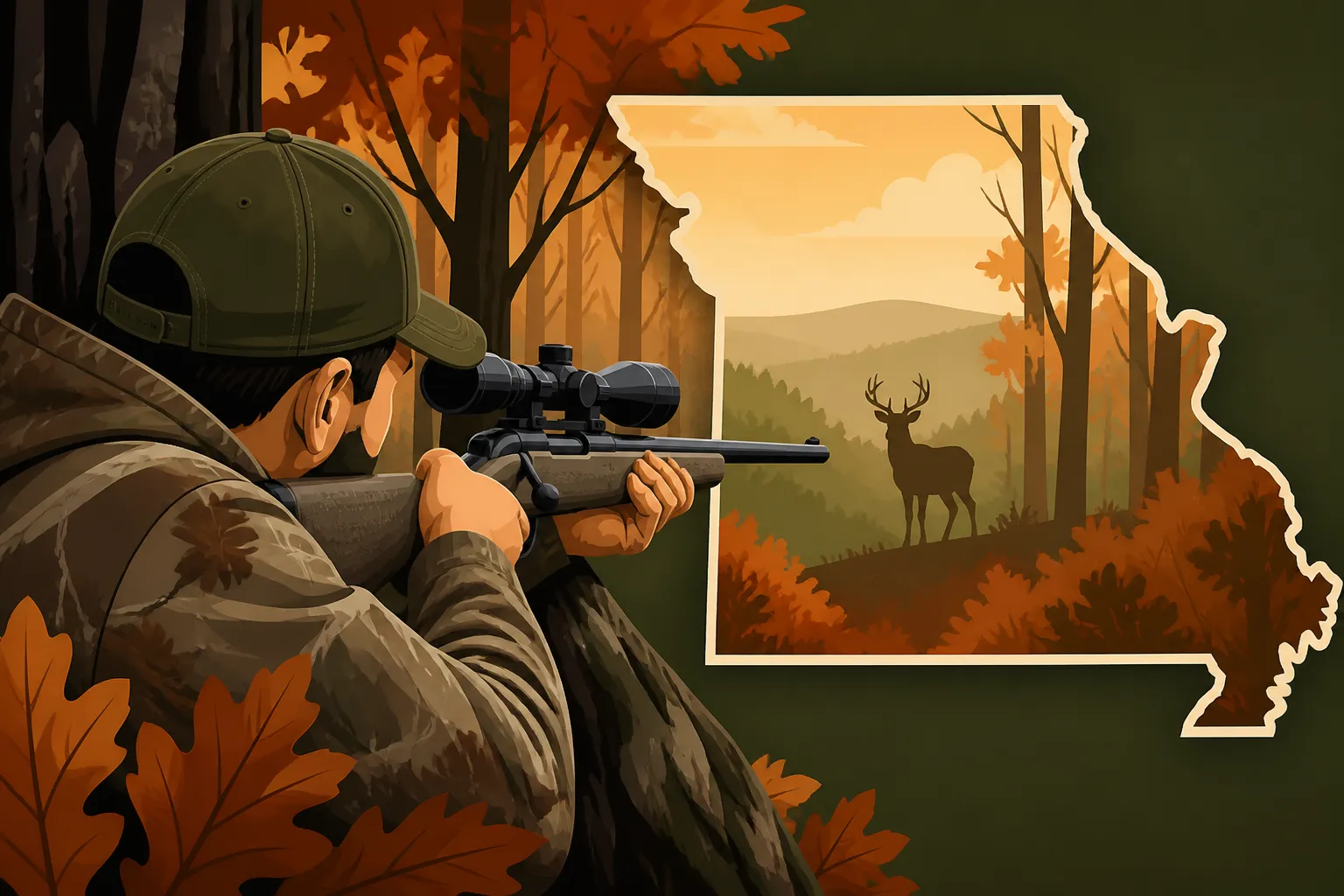
Rifle Ranges Realistic in Missouri Timber
If you've spent any time at all hunting Missouri's deer woods, you know the dream of a long, open-field shot often gives way to the reality of dense timber, thick brush, and fleeting glimpses of a whitetail. It's easy to picture a deer standing broadside at 200 yards in a cut bean field, but the truth is, most shots in our state's varied forests are far closer and often far more challenging than hunters anticipate. This guide is all about helping you understand what a truly realistic rifle range looks like in Missouri's timber, acknowledging the unique difficulties and equipping you with the knowledge to make ethical shots when it matters most.
The Unique Challenges of Hunting Missouri Timber
Hunting in Missouri's timber isn't like hunting the wide-open spaces out west. Here, our forests are often a mosaic of dense undergrowth, thick stands of hardwoods, and steep, broken terrain that drastically limits visibility and shot opportunities. These aren't just minor inconveniences; they fundamentally change how you need to approach your shot selection and preparation.
Visibility Constraints and Shot Lanes
One of the biggest frustrations for any Missouri deer hunter is trying to find a clear shot lane. You might be set up in what looks like a perfect spot, only for a small sapling, a tangled vine, or a low-hanging branch to suddenly appear directly in your deer's path. These aren't just "brush shots" to be ignored; they're direct obstacles to an ethical kill. In Missouri's timber, a clear 50-yard lane can feel like a mile, and finding a window past 100 yards through the trees and undergrowth is a genuine rarity on most days. This constant battle with visibility means your effective range is often dictated not by your rifle's capability, but by what you can actually see through.
Many times, a deer will appear and disappear in a matter of seconds, giving you only a narrow opening to thread a bullet through. This isn't just about bullet deflection – though that's a real concern – it's about making sure your projectile has a clean, unobstructed path to the vitals. Hunters often carry smaller pruners or folding saws to clear shooting lanes around their stands, but you can only do so much. The vast majority of the timber remains a dense maze, and understanding this limitation is the first step to being a more effective and responsible hunter.
Topography and Cover Density
Missouri's diverse landscape means our timber varies wildly from one region to another. The rolling, often rugged Ozark hills, with their deep hollows and steep ridges, present a different challenge than the flat, often marshy river bottom timber of the Missouri River or the relatively smaller woodlots nestled within agricultural fields up north. In the Ozarks, for instance, a deer might be 150 yards away horizontally but significantly below you, or vice-versa, making range estimation tricky and bullet drop calculations less straightforward than on flat ground. If you're Deer Hunting the Missouri Ozarks, you know this firsthand.
Then there's the sheer density of the cover. Early in the season, before the leaves drop, finding a deer at 75 yards can be a miracle. Even in late season, thick cedar thickets, multiflora rose patches, or honeysuckle can create impenetrable visual barriers, forcing deer into predictable funnels, but also severely limiting your ability to spot them until they're very close. This cover density is precisely why many hunters prefer to still-hunt or use ground blinds when hunting areas like river bottoms or dense creek draws. It's not just about the trees; it's about all the stuff between the trees.
Unpredictable Deer Movement
Missouri whitetails are masters of their timbered domain. They know every ditch, every thicket, and every contour that offers them an advantage. This often translates to unpredictable movement patterns within dense cover. A deer might be feeding calmly one moment and then suddenly bolt through a thicket at high speed, offering a fleeting, difficult shot. During the rut, bucks might be cruising through cover you'd never expect, leading to snap-shot opportunities.
Unlike hunting over a vast agricultural field where deer movement might be more deliberate and visible from a distance, timber hunting frequently demands quick reactions and the ability to estimate range and make an ethical shot under pressure. You often don't have the luxury of watching a deer for minutes on end, slowly ranging it multiple times, and settling into a perfect shooting position. This element of surprise and the rapid nature of encounters in the timber further reinforce the need to know your rifle and your personal limitations at closer, often less-than-ideal, ranges.
Understanding Your Effective Range in the Woods
When we talk about "effective range" in the context of Missouri timber, we're not just discussing how far your rifle can shoot, but how far you can shoot it accurately and ethically under real hunting conditions. This is a critical distinction, and one that often gets overlooked in favor of ballistic charts and magazine articles showing impressive long-range groups.
What "Effective Range" Really Means
Your "effective range" is the maximum distance at which you can consistently place a bullet precisely into a deer's vitals (roughly an 8-inch circle) every single time, given all the variables of a hunting scenario. This isn't about bragging rights or one lucky shot. It's about confidence and responsibility. For most hunters, this range is significantly shorter in the woods than it is on a calm, open shooting range.
Consider these factors: the deer might be quartering, not broadside. You might be shooting offhand, or from an awkward position in a treestand. The light might be dim. Your heart might be pounding. The wind might be swirling through the trees. All these real-world elements degrade your potential accuracy. Your effective range is where you can overcome these variables and still guarantee a clean kill. In dense timber, where shot lanes are narrow and detection is difficult, this often means being prepared for close-quarters engagements, which you can be excellent at if you spend time working on it.
Factors Affecting Your Personal Effective Range
Several personal and environmental factors play a huge role in determining your true effective range in the timber:
- Shooting Skill: This is paramount. Can you hold a stable sight picture under pressure? Can you control your breathing? Can you execute a smooth trigger squeeze when adrenaline is flowing? Regular practice from realistic hunting positions, not just a bench rest, is key. If you are learning How Missouri's Archery Split Works, you know that bowhunters are masters of practicing from stands, and rifle hunters should too.
- Physical Conditioning: Long walks through the Ozarks, carrying your gear, can leave you winded when a shot presents itself. Your ability to recover and stabilize for a shot impacts accuracy.
- Optics Quality: Clear, bright optics that perform well in low light can extend your visual range and aid in target identification, but they won't compensate for a poor shot or physical obstacle. We'll delve more into Optics for Missouri Deer Hunting in a bit.
- Rifle and Ammunition: A rifle you are comfortable with and ammunition that shoots consistently in your specific firearm are crucial. Knowing your bullet's trajectory at various ranges is important, even if those ranges are often under 100 yards in the timber.
- Confidence: Perhaps the most underrated factor. If you lack confidence in making a shot, you shouldn't take it. Confidence comes from practice and a thorough understanding of your limitations.
It's a combination of all these things that defines your personal, ethical range. This isn't a static number; it can change based on conditions and your own readiness.
Testing and Practicing for Woodland Shots
To truly understand your effective range in Missouri timber, you need to practice under conditions that mimic it. Simply shooting groups at a static target on an open range isn't enough.
Here's how to get realistic:
- Practice from Hunting Positions: If you hunt from a treestand, practice shooting from a stand. If you use a ground blind, practice from a blind. If you still-hunt, practice shooting offhand or using natural rests like trees or shooting sticks. Too often, hunters only shoot from a bench, which bears little resemblance to a real hunting scenario.
- Vary Your Ranges: Don't just shoot at 100 yards. Practice at 25, 50, 75, and 125 yards. These are far more common timber ranges. Pay attention to how your bullet performs at these closer distances. You might be surprised at the slight variations. Zeroing a Rifle for Short Woods Shots is a skill worth developing.
- Shoot Through Small Openings: Set up targets behind natural brush or small openings (with a safe backstop, of course) to simulate shooting through narrow lanes. This helps you understand bullet deflection and forces you to pick a precise path for your shot.
- Timed Drills: Have a friend call out a target and a range, then quickly get into a shooting position and take the shot within a limited time. This simulates the fleeting opportunities in the woods.
- Use a Rangefinder: Even at what seem like "close" distances, practice ranging targets. Your eyes can deceive you in the woods. Is that deer at 60 yards or 80? That 20-yard difference can feel huge when you're making a quick decision. GoHunt's mapping features can help you pre-plan ranges from your stand, allowing you to mark distances to key landmarks.
By putting in this kind of realistic practice, you'll gain invaluable confidence and a clearer picture of your actual ethical shooting limits in Missouri's demanding timber environment.
Common Calibers and Their Practicality in Timber
When it comes to choosing a rifle for Missouri's timber, many hunters get hung up on caliber. While some cartridges are definitely better suited for long-range precision, others truly shine in the dense woods where shorter, quicker shots are the norm.
Traditional Brush Guns
The term "brush gun" might be a bit of a misnomer, as no bullet is truly "brush-busting" without deflection. However, certain calibers and rifle types have earned their reputation in the timber for good reason: they're typically chambered in cartridges that perform well at closer ranges, often in fast-handling platforms like lever-actions.
- The .30-30 Winchester: This is the quintessential timber cartridge for good reason. Loaded in a lightweight, quick-to-shoulder lever-action, the .30-30 is perfectly adequate for the vast majority of shots taken in Missouri's woods. Its moderate velocity and heavier, slower bullet tend to be less prone to catastrophic deflection than a high-velocity, lightweight bullet if it clips a small twig, though any deflection is bad. Its effective range for deer is typically considered to be within 150-175 yards, which for most Missouri timber hunters, covers 90% of their actual shot opportunities. Many hunters still swear by a classic Marlin or Winchester .30-30 in the thick stuff.
- The .45-70 Government: While perhaps overkill for deer, the .45-70 is a thumper at close range. Its heavy, large-diameter bullet delivers tremendous energy, making it an excellent choice for short-range work, especially if you also hunt hogs or bear (though black bear hunting in Missouri is very limited). It's also a popular choice for the Alternative Methods Portion Weapon Choices due to its straight-wall cartridge design. Like the .30-30, it's often found in lever-action platforms, making it very quick on target.
- Other Medium Velocity Cartridges: Think about cartridges like the .35 Remington or even modern straight-wall offerings like the .350 Legend or .450 Bushmaster. These are designed for excellent performance at typical timber ranges, providing ample energy without excessive recoil or muzzle blast, and many are now available in bolt-action or semi-auto platforms in addition to lever guns.
Popular Deer Calibers
While the traditional brush guns have their place, many modern, popular deer calibers are also perfectly viable and often excellent choices for Missouri timber, especially when paired with the right bullet. The key is to understand their performance at closer ranges.
- The .308 Winchester: This cartridge is incredibly versatile. It's accurate, has manageable recoil, and delivers plenty of punch for whitetails. While it can certainly reach out to 300+ yards in open country, it performs exceptionally well at 50-150 yards in the timber. Its widespread availability and variety of bullet choices make it a top contender for any Missouri deer hunter. For many, it's the Best Rifle Caliber for Missouri Deer.
- The .270 Winchester: Another classic, the .270 is known for its flat trajectory and excellent terminal performance. Like the .308, it's capable of much longer shots, but it's equally effective at timber ranges. The key is selecting a bullet designed for rapid expansion on deer, even at higher impact velocities, to avoid over-penetration with minimal energy transfer.
- The 6.5 Creedmoor: This relative newcomer has taken the hunting world by storm, largely due to its exceptional accuracy and mild recoil. While often lauded for its long-range capabilities, the 6.5 Creedmoor with a good hunting bullet is devastating on deer at timber ranges. It's an absolute joy to shoot accurately and reliably. Don't let its long-range reputation fool you; it's a superb timber cartridge, and many hunters are finding the 6.5 Creedmoor for Timber Deer to be incredibly effective.
The common thread here is choosing a bullet that will expand reliably at the impact velocities expected at 50-150 yards. Many modern bullets are designed to perform across a wide range of velocities, making them excellent all-around choices.
Lever Actions and Straight Wall Cartridges
Lever-action rifles have a long and storied history in Missouri, and they remain incredibly practical for timber hunting. Their compact size, quick follow-up shots, and ease of carrying make them ideal for still-hunting through thickets or sitting in tight treestands.
The resurgence of straight-wall cartridges, largely driven by changing regulations in other states that allow these in former "shotgun-only" zones, has provided new options for Missouri hunters as well. While Missouri doesn't have such broad "shotgun zones," these cartridges are popular for specific portions. Legal Firearms for Missouri Deer can vary by portion.
- Why Lever Actions are Great for Timber:
- Fast Handling: They're typically shorter and lighter than many bolt-action rifles, making them quick to shoulder and point in dense cover.
- Quick Follow-Up Shots: The lever-action mechanism allows for rapid cycling of the action without breaking your cheek weld, which can be critical for a second shot if needed.
- Compactness: Many come with shorter barrels (e.g., 18-20 inches), making them less prone to snagging on branches when moving through thick woods.
- Traditional Feel: For many, there's just something about hunting with a classic lever gun in the timber that connects them to generations of hunters before them.
While a high-powered magnum might sound impressive, in the close confines of Missouri's timber, often it's the fast-handling, moderate-range rifle that truly excels.
Gear and Tactics for Extending or Confirming Your Range
Even with an intimate understanding of your rifle and your personal shooting abilities, the right gear and smart tactics can make a significant difference in how effectively and ethically you hunt Missouri timber. These tools aren't about compensating for poor judgment, but rather enhancing your ability to make informed decisions.
The Role of Quality Optics
Good optics are absolutely vital for hunting Missouri timber, perhaps even more so than in wide-open spaces. In dim light, dense cover, and fleeting moments, clear, bright glass can be the difference between confidently identifying your target and passing on a questionable shot.
- Binoculars: Don't skimp on a good pair of binoculars. An 8×42 or 10×42 power is generally perfect for the woods, offering a wide field of view and excellent light-gathering capability. Use them constantly to scan for deer, identify antlers, and confirm clear shooting lanes. They're also essential for glassing through thick timber for nervous flickers of ears or tails that indicate a hidden deer. A good pair of binoculars can help you pick apart dense cover, confirming that what you think is a deer is actually a deer, and not a stump or shadow.
- Rifle Scopes: For timber hunting, a scope with a lower magnification range is often preferable. A 1-4x, 2-7x, or 3-9x variable power scope is ideal. You want a wide field of view on the lowest setting for quick target acquisition at close range, but enough magnification to make a precise shot if a longer opportunity arises. Low-light performance is key here; a larger objective lens (e.g., 40mm or 42mm) can gather more light, giving you precious extra minutes at dawn and dusk when deer are most active. An Illuminated Reticles for Dark Timber can also be a huge advantage, providing a clear aiming point against a dark background.
Remember, quality optics don't extend your ethical shooting range in terms of bullet trajectory, but they absolutely extend your visual range and your confidence in target identification, which are equally important in the timber.
Rangefinders: Not Just for Open Country
Many hunters assume rangefinders are only for long-range western hunting. Nothing could be further from the truth in Missouri timber. In fact, a rangefinder is arguably more important here because our eyes are so easily tricked by distance and varying topography in dense cover.
- Eliminating Guesswork: Is that deer at 50 yards or 80? In thick woods, with trees and shadows playing tricks, it's incredibly hard to judge distances accurately, especially when adrenaline is pumping. A rangefinder removes all doubt. Knowing the exact distance to your target, even if it's "only" 70 yards, allows you to hold precisely and make an ethical shot.
- Pre-Ranging Landmarks: Before a hunt, take the time to range various landmarks from your stand or chosen hunting spot. Know the distance to that big oak, that fallen log, or that bend in the creek. You can use mapping tools like GoHunt to visualize your hunting area and mark these key distances, giving you a mental map of your potential shot opportunities. When a deer steps out, you'll immediately have a reference point and a confirmed range. This foresight can be the difference between a clean shot and a miss.
- Angle Compensation: Many modern rangefinders offer angle compensation, which is invaluable in the steep terrain of the Ozarks. A deer standing 100 yards away horizontally but 30 feet below you requires a different hold than a deer on flat ground. An angle-compensating rangefinder gives you the "shoot-for" distance, simplifying your shot.
Even for close-range timber hunting, a rangefinder is an indispensable tool for ensuring precision and ethical shot placement. Don't leave home without it.
Choosing the Right Ammunition for Timber
The ammunition you choose can significantly impact your rifle's performance in the timber. While modern bullets are remarkably advanced, selecting the right type for the conditions you'll encounter is important.
- Controlled Expansion: For deer hunting, you want a bullet that will expand reliably and consistently upon impact with soft tissue, creating a large wound channel, but also retain enough weight and momentum to penetrate deeply and exit the animal. Many premium bullets are designed for controlled expansion, meaning they won't blow up on the surface at high velocities (common at close range in timber) but will still mushroom effectively.
- Bullet Weight: Generally, heavier bullets for a given caliber tend to retain more energy and penetrate deeper, which can be beneficial when a deer is quartering or if you need to break bone. Lighter, faster bullets can sometimes fragment too quickly at close range, leading to less penetration and a smaller exit wound.
- Trajectory vs. Impact: In timber, extreme flat trajectory isn't as critical as consistent terminal performance at closer ranges. You're typically not making 300-yard shots where a few inches of drop matters. You're making 50-100 yard shots where reliable expansion and energy transfer are paramount.
- Practice with Your Hunting Ammo: Always practice with the exact ammunition you plan to hunt with. Different loads can shoot to different points of impact, even from the same rifle. Confirm your zero with your hunting rounds before you hit the woods.
The right ammunition, combined with proper practice and good optics, completes the package for confident, ethical hunting in Missouri's timber.
Missouri-Specific Considerations for Timber Hunting
Hunting in the Show-Me State's timber has its own distinct flavor, shaped by the landscape, hunting pressure, and regulations. Understanding these local nuances will help you better plan your hunts and maximize your chances of success.
Public Land Pressure and Deer Behavior
Missouri boasts an impressive amount of public hunting land, particularly through its vast network of Conservation Areas and the Mark Twain National Forest. While this offers incredible opportunities, it also means that many timbered tracts see significant hunting pressure, especially during the Missouri's November Firearms Portion. This pressure profoundly impacts deer behavior.
- Deer Get Nocturnal and Tightly Bedded: On heavily hunted public timber, deer quickly become more nocturnal, moving primarily at night. During the day, they will often bed down in the thickest, nastiest cover they can find – dense cedar thickets, steep hollows choked with briars, or impenetrable patches of honeysuckle. This means you'll need to work harder to get close, or focus your efforts on periods of peak activity like dawn and dusk.
- Movement in Sanctuaries: Deer will often move into unpressured "sanctuaries" such as posted private land, small untrodden public parcels, or even areas within public land that are simply too steep, too wet, or too difficult for most hunters to access. Learning to identify these sanctuaries using tools like GoHunt's property line overlays and aerial maps can give you an edge. Sometimes, your best bet is to set up on the edges of these sanctuaries, catching deer as they enter or exit.
- The "One-More-Ridge" Rule: In the Ozarks, especially, the tendency is for hunters to only go "one more ridge" past the parking lot. If you're willing to walk two or three ridges deep, you'll often find significantly less pressure and deer that behave more naturally. Finding Ground Others Walk Past is a key public land skill. This also means your shots might be in more remote, unmanaged timber.
Adapting your tactics to account for hunting pressure is crucial for success in Missouri's timber.
Ozark Hills vs. Northern Timber Blocks
The type of timber you're hunting in Missouri will significantly influence realistic shot ranges and tactics. The state's geography creates two distinct timber hunting experiences.
- The Missouri Ozarks: Characterized by steep, rocky hills, deep hollows, and hardwood forests (primarily oak and hickory). The timber can be relatively open in some areas, especially on ridge tops, but incredibly dense in the hollows and along creek bottoms, which are often choked with thick undergrowth and cedar glades.
- Shot Ranges: Variable. You might have a 100-yard shot across a hollow, but just as often, a deer will appear at 30 yards in a thick draw. Uphill and downhill shots are common, requiring careful range estimation (and ideally, an angle-compensating rangefinder). Wind and Thermals in Ozark Hills also play a massive role in how deer move and how you approach your stand.
- Tactics: Still-hunting can be effective in the more open hardwoods, but patience in a well-placed stand overlooking a natural funnel or food source in a hollow or on a bench is often more productive. Glassing with binoculars is critical to pick apart the broken terrain.
- North Missouri Farm Country Timber: In contrast to the Ozarks, northern Missouri is characterized by rolling agricultural fields interspersed with timbered draws, fencerows, and larger blocks of hardwoods, especially along major river systems.
- Shot Ranges: Often shorter due to the typically denser undergrowth and more limited sight lines within smaller timber blocks. However, you might also have shots that open up onto field edges, creating 150-200 yard opportunities. Hunting a Missouri Fencerow Between Fields often means you're expecting those kind of varying ranges.
- Tactics: Ground blinds are very effective on field edges, offering concealment and scent control. Treestands are common within timber blocks, often overlooking pinch points between bedding and feeding areas. Deer often funnel through these smaller timbered corridors, leading to close encounters. GoHunt's aerial imagery is particularly useful here for identifying these key travel routes and pinch points.
Knowing which type of timber you're in helps you anticipate shot ranges and choose the best gear and strategy for the conditions.
Legalities and Safety in Dense Cover
Hunting in dense Missouri timber also brings specific legal and safety considerations that every hunter must be aware of.
- Hunter Orange Requirements: During certain firearms portions, Missouri has strict Missouri Hunter Orange Rules that require hunters to wear a minimum of 400 square inches of hunter orange, visible from all directions. This is paramount for safety in dense cover where visibility to other hunters can be extremely limited. Even if you're bowhunting during a portion that allows it, wearing some orange is a good idea. This applies to both public and private land.
- Positive Target Identification: This is perhaps the most critical safety rule in dense timber. You must be 100% certain of your target and what is beyond it. In thick cover, it's easy to mistake movement, a flash of brown, or even another hunter for a deer. Never shoot at sound or movement. Identify antlers clearly (if hunting antlered deer) and ensure you have a safe backdrop before taking any shot.
- Access and Retrieval: Getting into and out of dense timber can be a challenge, especially when retrieving a deer. If you successfully harvest a deer in a deep Ozark hollow, for instance, Getting a Deer Out of a Hollow Alone can be an monumental task. Plan your entry and exit routes carefully, and always let someone know where you're hunting. Have a plan for getting your deer out before you even step into the woods.
- Property Lines: Even on public land, conservation areas often border private property. In dense timber, it can be easy to inadvertently cross a property line. Always know where you are, use a GPS or a reliable mapping app like GoHunt, and respect posted signs and private land boundaries.
By understanding and adhering to these Missouri-specific considerations, you ensure a safer and more responsible hunting experience in our beautiful timber.
Realistic Rifle Ranges in Missouri Timber: A General Guide
To give you a clearer picture, here's a general guide to realistic ethical ranges for various popular rifle calibers when hunting deer in typical Missouri timber. Remember, these are generalizations and your personal effective range will always be the most important factor.
| Caliber | Typical Max Ethical Range in Open Field | Realistic Max Ethical Range in Missouri Timber (approx.) | Primary Advantages in Timber |
|---|---|---|---|
| .30-30 Winchester | 175-200 yards | 100-150 yards | Excellent terminal performance at closer ranges, often in fast-handling lever actions. Moderate recoil. |
| .308 Winchester | 300-400+ yards | 150-200 yards | Versatile, accurate, good energy at timber ranges, wide variety of bullet options. Can easily double as an open-country rifle. |
| 6.5 Creedmoor | 400-500+ yards | 150-200 yards | Superb accuracy, mild recoil, excellent terminal performance with proper hunting bullets. Flat trajectory is less critical but still beneficial if a longer shot presents itself. |
| .270 Winchester | 350-450+ yards | 150-200 yards | Flat trajectory, excellent energy. Choose bullets designed for reliable expansion at closer timber velocities to avoid over-penetration. |
| .45-70 Government | 150-250 yards | 100-125 yards | Heavy hitting, huge wound channel at close range. Great for very dense cover and heavy game. Often found in quick lever actions. |
| .350 Legend | 200-250 yards | 125-175 yards | Low recoil, good energy for deer, often very accurate, legal in many "straight-wall only" zones (and thus legal for Missouri's alternative methods portion). Popular in AR platforms and bolt actions. |
| .243 Winchester | 250-350+ yards | 125-175 yards | Very low recoil, excellent for smaller-framed shooters or youth. Still effective on deer with good shot placement and appropriate bullet. Is a .243 Enough for Missouri Whitetails? is a common question, and yes, with good shot placement, it absolutely can be in the timber. |
This table illustrates that while a rifle might be capable of reaching out much further, the practical realities of Missouri's timber significantly condense those ranges. Always prioritize ethical shot placement within your comfort zone.
The bottom line for hunting Missouri timber is this: preparation and self-awareness are your most powerful tools. Forget the Hollywood long shots; focus on being deadly accurate and disciplined at ranges that are truly realistic for the environment you're hunting. Spend time practicing from actual hunting positions, verify your distances with a rangefinder, and choose a rifle and ammunition combination you have absolute confidence in for those often fleeting, close-range opportunities. When you step into those Missouri woods, be ready for anything, but expect those close encounters, and you'll be set up for success.
Disclaimer
This article is for general informational purposes only and does not constitute professional advice. Laws, prices and regulations vary by location and change over time. Consult a qualified professional for guidance on your specific situation.