Turkey Shotguns and Chokes
There's nothing quite like the sound of a gobbler hammering at first light in a Missouri woodlot. It sends chills down your spine and sets your heart racing. But bringing that bird into range, especially a wily old longbeard that's heard it all before, is a challenge that demands precision, preparation, and the right gear. Many hunters struggle to consistently anchor birds because their shotgun setup isn't optimized for the unique demands of turkey hunting. This comprehensive guide will walk you through everything you need to know about selecting, tuning, and patterning your turkey shotgun and choke combination to ensure you're ready when that tom steps into range.
Understanding the Modern Turkey Shotgun
Hunting turkeys isn't like shooting doves over a field or pheasants in a ditch. Turkeys, especially the big gobblers we chase in Missouri's spring woods, require a setup designed for accuracy and dense patterns at a relatively short, but often precise, range. The traditional upland bird gun, while perfectly capable for other species, usually isn't the best tool for the job when a gobbler's head and neck are your target.
Beyond the Upland Gun
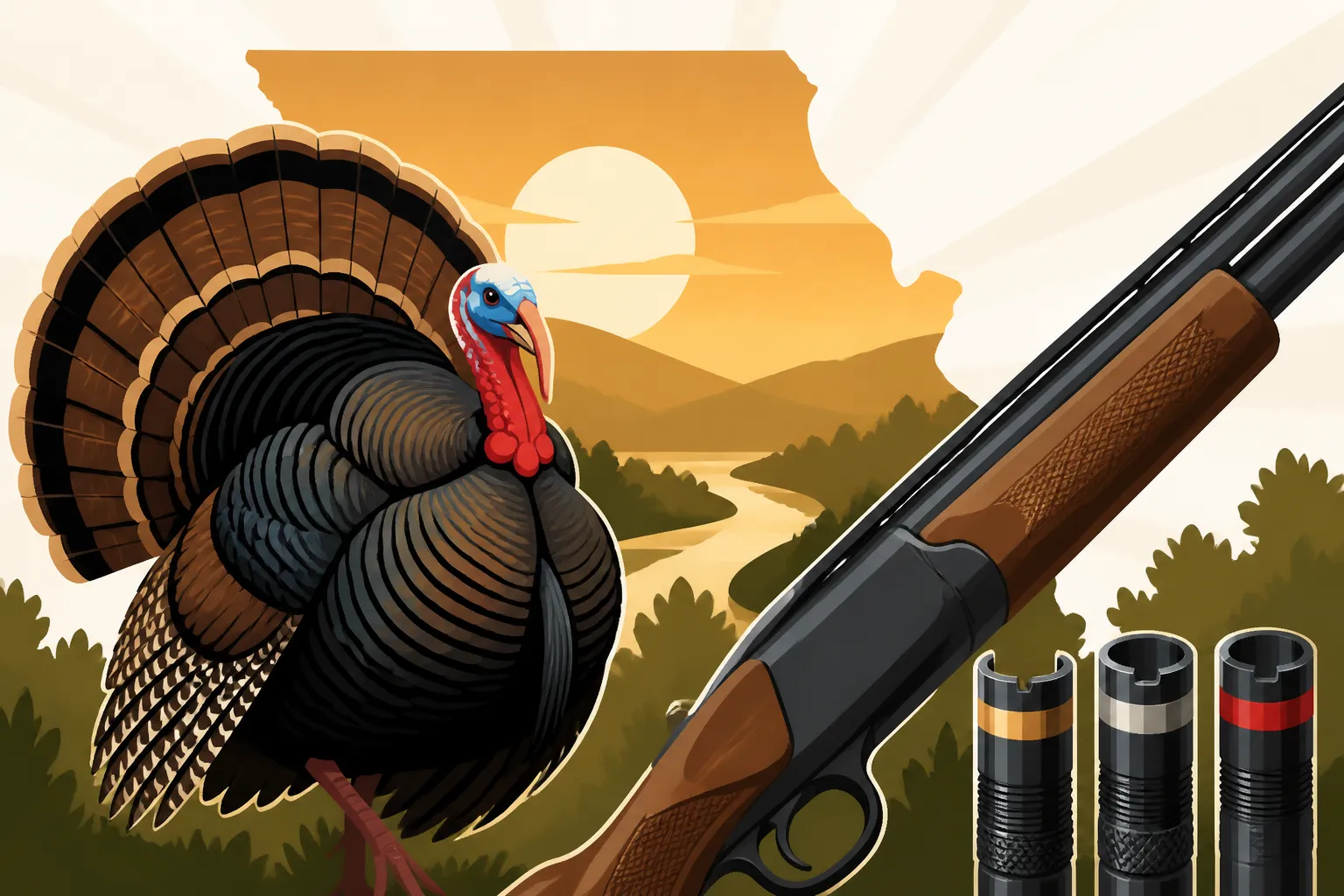
When you think of a turkey shotgun, envision something purpose-built. These aren't your grandpa's old double-barrel used for squirrels. Modern turkey guns often feature shorter barrels, typically 20 to 24 inches, which make them handier in thick cover and easier to maneuver in a ground blind or against a tree. The shorter barrel doesn't significantly impact pattern density at turkey hunting ranges, and it can actually improve pointability in tight spots. You'll also notice many turkey guns are heavier than their upland counterparts, which helps absorb recoil from powerful turkey loads, allowing for quicker follow-up if needed, though ideally, one shot is all it takes. This robust construction is all about consistency and delivering a concentrated payload where it counts.
Unlike an upland gun meant to throw a wide, even pattern to hit fast-flying birds, a turkey shotgun is about putting as many pellets as possible into a small, vital area. This is where the marriage of a good barrel, a specialized choke, and specific ammunition really comes into play. The goal is to create a pattern that's tight and lethal enough to incapacitate a turkey with a head or neck shot, minimizing the chance of wounding a bird or ruining breast meat.
Key Features to Look For
Modern turkey shotguns come packed with features designed to improve your odds. One of the most obvious is the finish: most dedicated turkey guns are camouflaged to help you blend into the spring woods. This isn't just aesthetic; it's practical. A gobbler's eyesight is legendary, and any glint of sun off a blued barrel can send him running. Brands like Mossberg, known for their venerable 835 Ulti-Mag and 500 series, or Remington with their 870 Turkey Express models, often offer various camo patterns right from the factory.
Another common feature is a pistol grip, either integrated into the stock or as a separate grip, which allows for a more secure and comfortable hold, especially when aiming from an awkward position or holding steady for an extended period. Many dedicated turkey shotguns also come drilled and tapped, meaning they're ready to accept a scope mount or, more commonly, a red dot sight. This is a huge advantage for precise aiming, especially with the tight patterns modern chokes and loads produce. Reliability in all weather conditions is also paramount; you might find yourself hunting in a misty spring rain or a crisp, cold morning, and your gun needs to perform every time.
Choke Tubes: The Heart of the Turkey Pattern
If the shotgun is the engine, the choke tube is the precision steering. This small, often overlooked component is absolutely critical to achieving the tight, dense patterns needed to consistently harvest turkeys. It’s where the magic happens, transforming a cloud of pellets into a concentrated stream aimed squarely at that gobbler's head.
What is a Choke Tube and Why It Matters
A choke tube is essentially a constricted tube inserted into the muzzle end of your shotgun barrel. Its job is to control the spread of the shot pellets as they exit the barrel. Without a choke, pellets would disperse too quickly, making it nearly impossible to deliver enough energy and density to the small target area of a turkey's head and neck beyond very close range. For turkey hunting, we're not looking for a wide pattern to cover a lot of area; we're looking for a tight, consistent cluster of pellets that will reliably put down a bird.
The degree of constriction determines how tightly the pellets are held together. A tighter choke means a smaller, denser pattern at a given distance, while a more open choke produces a wider, more spread-out pattern. For turkeys, where the target is small and the shot must be lethal, we always opt for the tightest possible constriction that still produces a consistent, even pattern. This ensures maximum pellet count in the critical zone, increasing your chances of a clean harvest. The goal is to get a minimum number of pellets (often cited as 100-120) into a 10-inch circle at your chosen maximum ethical range, usually 40 yards.
Types of Turkey Chokes
While standard chokes range from Cylinder to Full, turkey hunting demands something more specialized. You'll typically be looking at "Extra Full," "Super Full," or chokes specifically marketed as "Turkey Chokes." These are significantly tighter than a standard full choke. Many aftermarket choke tube manufacturers, like Primos, Carlson's, or Jebs, offer a bewildering array of options, each with slightly different internal geometries designed to strip wad petals, straighten shot strings, and deliver the tightest patterns possible.
These specialized chokes often have constrictions that might seem extreme, sometimes as tight as .650 or .665 inches for a 12-gauge, compared to a standard Full choke which might be around .690 inches. It's crucial to understand that a "turkey choke" isn't a one-size-fits-all solution; what works perfectly in one shotgun with one type of ammunition might not perform as well in another setup. This is why patterning is non-negotiable, as we'll discuss later.
Here's a quick look at common choke types and their general application for turkey hunting:
| Choke Type | Constriction (Typical 12-Gauge) | Primary Use for Turkeys | Notes |
|---|---|---|---|
| Full | 0.690 – 0.700" | Marginal, mostly for lead loads | Can work for closer shots, but not ideal for modern loads. |
| Extra Full | 0.670 – 0.685" | Good for heavier lead, some Bismuth | Better than Full, but often outperformed by dedicated turkey chokes. |
| Turkey | 0.650 – 0.670" | Best for heavy lead, Bismuth, TSS | Designed for maximum pattern density, often ported. |
| Super Full | 0.640 – 0.660" | Optimized for TSS and ultra-dense loads | Can be too tight for some lead or Bismuth, causing blown patterns. |
Remember, these are general guidelines. Your gun, choke, and ammunition will dictate your actual performance.
Choke Materials and Design
The material and design of a choke tube can also influence its performance and durability. Most modern chokes are made from stainless steel, but you'll find options in various alloys, sometimes coated for durability or to reduce fouling. Some chokes are "ported," meaning they have small holes drilled into the sides. These ports are designed to help reduce recoil and strip the shot wad more consistently, potentially leading to more uniform patterns. Whether porting actually makes a significant difference is often debated among hunters, but many swear by it.
The key is to match your choke to your ammunition. If you're shooting heavier-than-lead loads like TSS (Tungsten Super Shot) or Bismuth, you might find that slightly tighter chokes perform better, as these denser pellets hold together more effectively and aren't as prone to deformation as traditional lead shot. However, some extremely tight chokes can actually "blow" patterns with certain loads, meaning the constriction is so severe that it deforms the shot or creates inconsistencies. This is why testing is paramount. Using GoHunt's robust scouting tools can help you find excellent locations to safely set up a patterning board and test various combinations to see what truly performs best for your specific shotgun, choke, and load in a Missouri setting.
Ammunition: The Other Half of the Equation
You can have the finest turkey shotgun and the most specialized choke tube, but if you're not loading it with the right ammunition, you're severely limiting your potential. Modern turkey loads have revolutionized what's possible in the turkey woods, extending ethical ranges and increasing your chances of a clean harvest.
The Evolution of Turkey Loads
For decades, lead shot was the standard for turkey hunting. Loads of #4, #5, or #6 lead were common, and with a good choke, could be effective out to 30-35 yards. However, the introduction of non-toxic shot regulations in some areas and the constant desire for improved performance led to significant advancements. Today, you have incredible options like Bismuth and, most notably, Tungsten Super Shot (TSS).
TSS has truly been a game-changer. These pellets are incredibly dense, much heavier than lead or even steel. This increased density means that smaller TSS pellets carry more energy and penetrate deeper than larger lead pellets. For example, a #9 TSS pellet can carry more energy than a #5 lead pellet. This allows for incredibly high pellet counts in a shell, leading to vastly denser patterns at extended ranges. While TSS comes with a higher price tag, the performance gains are undeniable, especially for hunters looking for maximum effectiveness at 40+ yards or those who simply want the most lethal pattern possible. Bismuth offers a good middle-ground: denser than steel and lead, but usually less expensive than TSS, offering improved performance over lead without the extreme cost of TSS.
Shot Size and Pellet Count
When choosing your turkey load, shot size is a critical consideration. For traditional lead, #4, #5, and #6 are common. #4 lead offers good individual pellet energy but fewer pellets per shell. #6 lead offers more pellets but less individual energy. #5 lead is often considered a good balance. However, with modern TSS, you can go much smaller. Many hunters now opt for #7, #8, or even #9 TSS because of its extreme density. These smaller TSS pellets still deliver devastating energy while providing an exponential increase in pellet count, resulting in phenomenally dense patterns.
Consider this: a 3-inch 12-gauge shell loaded with #5 lead might contain around 300 pellets. A similar 3-inch 12-gauge shell loaded with #9 TSS could contain well over 600 pellets. That difference in pellet count directly translates to more hits on the turkey's head and neck, increasing your chances of dropping the bird cleanly. It's a trade-off between individual pellet energy and sheer numbers, and with TSS, you often get the best of both worlds within a smaller pellet.
Matching Load to Choke to Gun
This is where all the pieces come together, and it cannot be stressed enough: your shotgun, choke tube, and ammunition form a critical triad. No two shotguns, even identical models, will pattern exactly the same with the same choke and load. You absolutely cannot assume that a load that patterns well in your buddy's gun will perform similarly in yours. This is a common mistake that leads to frustration and missed opportunities in the field.
The process of matching is called patterning, and it's the single most important thing you can do to prepare for turkey season. You need to take your specific shotgun, with your chosen choke, and shoot various turkey loads at paper targets to see which combination delivers the best, most consistent, and most lethal pattern. Some chokes are designed with specific shot types in mind, so paying attention to manufacturer recommendations can be a starting point, but always verify with your own testing. You'll likely try a few different choke tubes and several different brands and shot sizes of turkey loads before you find the "sweet spot" where your setup truly shines. For more in-depth knowledge on specific ammunition, check out Turkey Loads for Missouri Birds.
Patterning Your Turkey Setup for Missouri Success
Alright, you've got your turkey shotgun, picked out a promising choke, and maybe a couple of different ammunition types. Now comes the most crucial step: patterning. This isn't just a suggestion; it's a non-negotiable requirement for any ethical and successful turkey hunter. Without patterning, you're essentially guessing, and that's not how we approach chasing Missouri gobblers.
The Absolute Necessity of Patterning
Why is patterning so incredibly important? Because it reveals the true performance of your specific gun, choke, and load combination. It shows you exactly where your gun shoots relative to your point of aim, and more importantly, how dense and consistent your pattern is at various ranges. You need to know, with absolute certainty, how many pellets are consistently hitting a turkey's vital head and neck area at 20, 30, and 40 yards (and perhaps beyond, depending on your setup and confidence).
Many hunters make the mistake of simply screwing in a "turkey choke," buying a box of "turkey loads," and heading straight to the woods. This is a recipe for frustration. You might find your gun shoots high, low, left, or right with that combination, or that your pattern is sparse and inconsistent, especially at longer ranges. Patterning eliminates these unknowns, allowing you to fine-tune your setup and build confidence in your ability to make a clean shot when the moment of truth arrives. It's also an ethical responsibility to ensure your equipment is capable of a humane harvest.
The Patterning Process Step-by-Step
Patterning your turkey gun is straightforward but requires patience and attention to detail.
- Safety First: Always follow all firearm safety rules. Wear eye and ear protection.
- Location: Find a safe shooting range or a large, open area where you can safely set up targets.
- Targets: Use large sheets of paper, at least 3×3 feet or 4×4 feet. You can draw a small turkey head and neck silhouette in the center, or buy specialized patterning targets. The larger paper helps you see the overall pattern, even if your point of impact is off.
- Distance: Start patterning at a realistic hunting distance. 40 yards is a common benchmark for modern loads and chokes, but also shoot at 20 and 30 yards to understand your pattern up close.
- Rest: Shoot from a solid rest (a bench rest, sandbags, or a sturdy tripod) to eliminate human error. You're testing the gun and load, not your shooting ability.
- Aim: Aim precisely at the turkey head/neck silhouette. If you're using a red dot, ensure it's sighted in at 25 yards first, then fine-tune at 40. For iron sights or a scope, aim for the center of the head.
- Shoot Multiple Shots: Don't just shoot one round. Fire at least three to five shots with each gun/choke/load combination. This helps identify consistency and average performance.
- Evaluate: After each series of shots, carefully examine your target. Draw a 10-inch circle around the densest part of the pattern, ideally centered on the head/neck. Count the number of pellets within that 10-inch circle. Also, evaluate the evenness of the pattern outside the core. Are there any holes or gaps a turkey could escape through?
This process might sound tedious, but it's incredibly informative. For a visual guide and more tips on range, check out Patterning a Turkey Gun at 40 Yards.
Interpreting Your Pattern and Making Adjustments
Once you've shot several targets, it's time to interpret the results and make adjustments.
- Point of Impact: Is the densest part of your pattern consistently centered on your aim point? If it's consistently high, low, left, or right, you might need to adjust your sights or, if using a red dot or scope, adjust your optic. If using bead sights, you might need to adjust your hold or consider adding an optic.
- Pattern Density: How many pellets are consistently hitting that 10-inch circle? For modern heavy-density loads like TSS, you're looking for well over 100 pellets, ideally 150-200+, in that 10-inch circle at 40 yards. For lead, 80-100 pellets might be acceptable at 30-35 yards, but less desirable at 40.
- Pattern Consistency and Evenness: Is the pattern consistently round and evenly distributed, or are there "clumps" and "holes"? An uneven pattern can lead to wounded birds.
If your pattern isn't satisfactory, don't despair. This is why we pattern! Here are your options:
- Try a Different Load: Your current load might not be compatible with your choke. Experiment with different brands, shot sizes, and shell lengths (e.g., 3-inch vs. 3.5-inch if your gun can handle it).
- Try a Different Choke: If the load is good, try a different choke tube with a slightly different constriction or internal geometry. A slightly tighter or more open choke might be the ticket.
- Optics Adjustment: If your point of impact is off, adjust your red dot or scope. If you're still using bead sights and find your patterns consistently off-center, strongly consider adding a red dot sight.
The goal is to find the gun/choke/load combination that consistently delivers a dense, evenly distributed, and accurately centered pattern at your maximum ethical hunting range. Only then can you head into the Missouri turkey woods with true confidence.
Optics and Accessories for Your Turkey Gun
While the shotgun, choke, and ammo are the core, a few key optics and accessories can significantly enhance your turkey hunting experience and improve your accuracy when that gobbler finally commits. Don't overlook these tools in your quest for a successful Missouri spring.
Red Dot Sights for Precision
One of the most impactful upgrades you can make to a turkey shotgun is adding a red dot sight. Traditional bead sights, while perfectly functional for wing shooting, can be less precise for the pinpoint accuracy required for a turkey's head and neck. A red dot sight projects a small, illuminated dot onto a lens, providing a single, clear aiming point that is parallax-free (meaning the dot stays on target regardless of minor head movement) and easy to see in various light conditions, from the dim pre-dawn woods to bright midday sun.
The benefits are numerous: faster target acquisition when a gobbler suddenly appears, more precise aiming for that small kill zone, and reduced eye strain during long waits. Many turkey hunters swear by them, and for good reason. Most dedicated turkey shotguns come drilled and tapped, making mounting a red dot sight straightforward. You'll want a durable, waterproof red dot that can withstand the rigors of the field. Brands like Vortex, Leupold, and Burris offer excellent options for turkey guns. For more detailed information on setup and choices, refer to Red Dots on a Turkey Shotgun.
Sling, Padded Stock, and Other Comforts
Turkey hunting often involves a lot of walking, sitting, and waiting. Having the right accessories can make a huge difference in your comfort and effectiveness. A good quality sling is essential for carrying your shotgun through miles of Missouri timber, especially if you're Run-and-Gun Turkey Tactics in the Missouri Ozarks. Look for a sling that's wide, padded, and made of a durable, quiet material. A non-slip backing is a bonus. You want to be able to quickly transition from carrying to shooting without fumbling or making unnecessary noise.
The powerful turkey loads we discussed earlier can deliver a stout kick. A high-quality recoil pad on your stock can make long patterning sessions and the actual shot much more comfortable. Many factory stocks come with decent pads, but aftermarket options can further reduce felt recoil, allowing you to stay on target better and recover faster. Small things like camo tape to cover shiny spots on your gun or quiet sling swivels can also make a difference in fooling a keen-eyed gobbler.
The Role of Rangefinders and Calls
While not directly attached to your shotgun, a rangefinder is an indispensable tool for turkey hunting, especially when using a tightly patterned setup. Knowing the exact distance to a gobbler before you take the shot is critical to staying within your ethical range. With tight patterns, a turkey at 45 yards can be a clean kill, but that same setup might only wound a bird at 55 yards. A rangefinder eliminates guesswork. It's particularly useful when a gobbler hangs up just out of what you think is range, or when calling a bird across an open field. Having pinpoint distance information allows you to make an informed decision on whether to shoot or wait for a closer approach. For more on this, check out Rangefinders in Thick Cover.
Of course, none of this matters if you can't get a gobbler to come in! High-quality turkey calls are fundamental to enticing those wary Missouri longbeards. From slate calls and box calls to mouth diaphragms and locator calls, having a selection and knowing how to use them effectively is paramount. Your ability to speak the language of the birds will often dictate whether you even get a shot opportunity. For a deep dive into vocalizations and strategy, Turkey Calls Worth Carrying in Missouri is a must-read. Combining strong calling with the strategic use of GoHunt's satellite imagery can help you identify prime ambush points and subtle terrain features that might funnel turkeys right into your ideal shooting lane.
Specific Considerations for Missouri Turkey Hunting
Missouri offers diverse terrain and a healthy turkey population, making it a fantastic state for chasing gobblers. However, understanding how to tailor your shotgun and choke setup to these specific conditions can make all the difference in your success.
Terrain and Shot Opportunities
Missouri's landscape ranges from the rugged, timbered hills and hollers of the Ozarks to the expansive crop fields and river bottomlands of North Missouri. Each environment presents unique challenges and dictates different kinds of shot opportunities.
In the Ozarks, you're often hunting in dense hardwood timber, navigating steep ridges and winding creeks. Here, shot distances tend to be shorter, often 20-30 yards, as gobblers might appear suddenly through the trees. A highly maneuverable shotgun with a fast-acquiring red dot is a huge asset. While a tight pattern is still desired, extreme long-range setups might be less critical than pinpoint accuracy in tight windows. Being able to quickly shoulder your gun and get on target is key. If you're exploring Hunting Turkeys in Ozark Hollows, you know how quickly opportunities can arise and disappear in that challenging terrain.
Conversely, in North Missouri's farm country, you might find yourself hunting along field edges, fencerows, or in more open timber blocks adjacent to crop fields. Here, gobblers might hang up at 40-50 yards, especially later in the season when they've been pressured. This is where those heavy-density TSS loads and super-tight chokes truly shine, giving you the reach and pattern density to confidently take those longer shots, provided you've patterned your gun thoroughly at those distances. Understanding Turkey Tactics for Crop Country is vital for this kind of hunting, as the open landscape demands a different approach.
Ethical Shooting Distances and Bird Behavior
Regardless of your setup, it is absolutely paramount to understand and respect your personal ethical shooting distance. Just because your gun can put 150 pellets in a 10-inch circle at 50 yards on a patterning board, doesn't mean you should take every 50-yard shot in the field. Factors like wind, obstacles, the turkey's movement, and your own composure all come into play. Always strive to bring the bird closer, aiming for 20-35 yards when possible.
Missouri gobblers, especially those on public land or areas that see heavy pressure, can be incredibly wary. They've heard it all, seen it all, and are experts at hanging up just out of comfortable range. This is where your calling skills, camouflage, and patience are tested. Effective use of decoys can sometimes draw those wary birds closer, but even then, a gobbler might circle wide. Check out Turkey Decoys That Work on Pressured Birds for tips on how to fool educated birds. Your tightly patterned shotgun ensures that when a gobbler does finally commit and steps into your ethical range, you're ready to make a clean, decisive shot. Never take a shot beyond your proven, ethical range.
Legality and Safe Handling
Before heading out, always review the most current Missouri Department of Conservation (MDC) regulations for turkey hunting. These cover everything from legal shooting hours to bag limits and legal weapons. Understanding Missouri Turkey Shooting Hours is essential to avoid accidental violations. Make sure your shotgun and ammunition choices comply with all state regulations.
Beyond regulations, safe gun handling is always the top priority. Treat every firearm as if it's loaded. Be absolutely certain of your target and what's beyond it. Turkey hunting often involves subtle movements and calling in dense cover, so always be aware of your surroundings and any other hunters in the area. Practice your safe gun handling during patterning sessions, ensuring that you can shoulder your shotgun, acquire your target, and make a safe shot smoothly and confidently. Your patterned setup is a tool for ethical hunting, and responsible use is part of that ethic.
Disclaimer
This article is for general informational purposes only and does not constitute professional advice. Laws, prices and regulations vary by location and change over time. Consult a qualified professional for guidance on your specific situation.