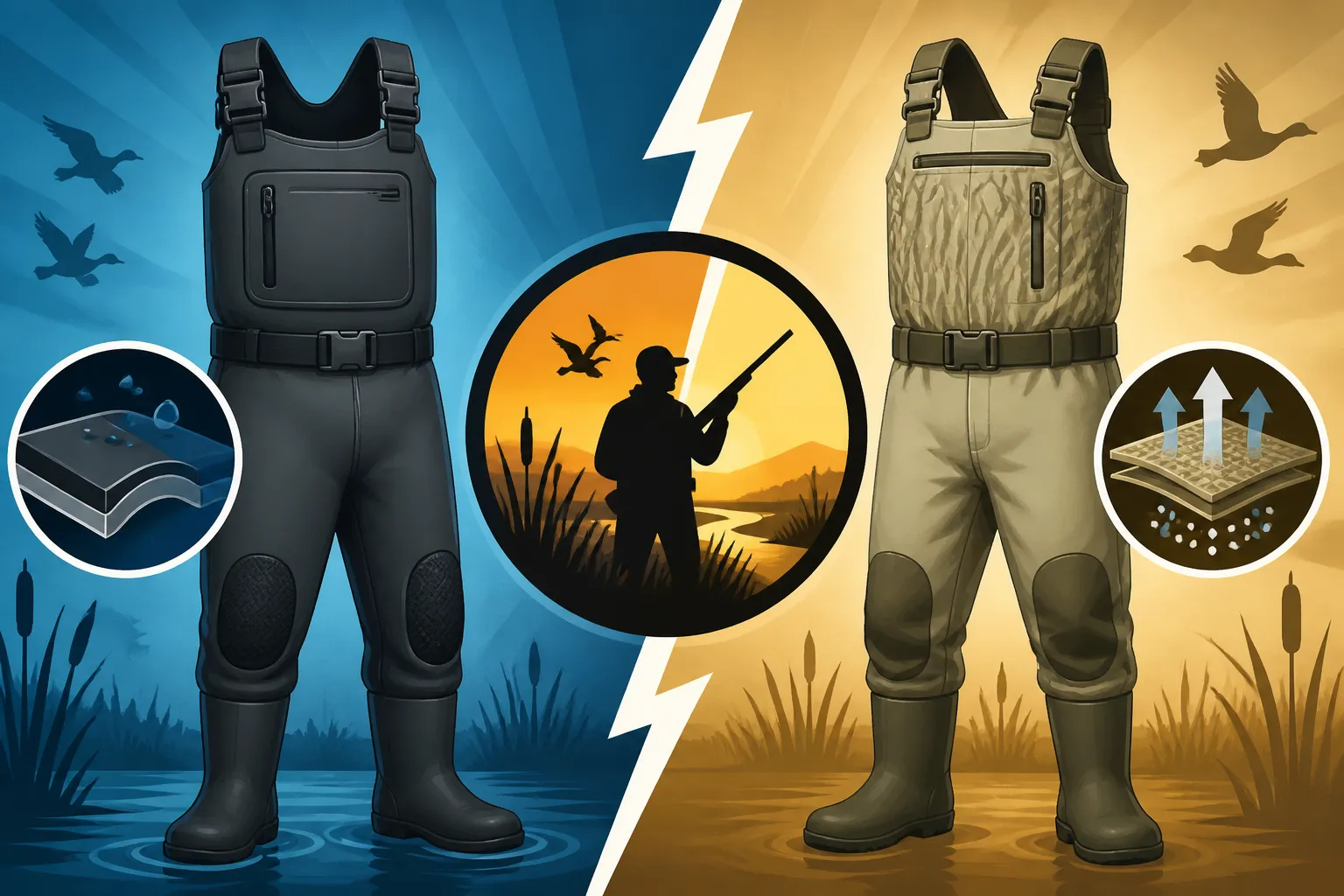
Neoprene Versus Breathable Waders
It's a familiar feeling, isn't it? You're staring at your hunting gear, maybe getting ready for another Missouri duck season, and you find yourself wondering if you truly have the right waders for the job. The choice between neoprene and breathable waders can feel overwhelming, especially with Missouri's wildly fluctuating weather and diverse hunting scenarios. This guide is here to break down the real-world differences, helping you decide which type will keep you comfortable and effective, whether you're slogging through a flooded timber hole or setting decoys in a chilly field.
The Classic: Neoprene Waders and Their Unmistakable Presence in Missouri Hunting
For generations, neoprene waders have been the workhorse of the waterfowler, a tried-and-true option that has kept countless hunters warm in the most biting conditions. When you think of sitting in a frigid duck blind or breaking ice in a creek, neoprene is often the first thing that comes to mind. There's a certain reassuring bulk to them, a feeling of impenetrable warmth that many hunters swear by, especially when the mercury truly plummets.
When Neoprene Shines: Cold Weather and Still Hunting
Neoprene waders are champions of insulation. Imagine yourself wading into a flooded timber hole off the Mississippi River in late December, the water barely above freezing. Your legs are submerged, and the wind is cutting right through you. In this scenario, the thick, wetsuit-like material of neoprene is absolutely invaluable. It traps a layer of water against your skin, which your body heats up, providing excellent thermal protection. This means you can stand relatively still for hours, waiting for those mallards to cup their wings, without your legs turning into icicles.
This insulation isn't just about water temperature, either. Even on dry land, if you're hunkered down in a snowy ditch waiting for geese, neoprene offers a robust barrier against the cold air. They're particularly well-suited for situations where you're not moving much, such as in a permanent pit blind, a boat blind, or stationary in a Missouri Flooded Timber Duck Tactics setup. The bulk that can be a disadvantage in other scenarios becomes a comforting hug against the harsh realities of a truly cold Missouri winter hunt.
The Downsides of Neoprene: Heat and Mobility
While neoprene excels in the cold, it has significant drawbacks when temperatures rise or when you need to be on the move. Picture an early October teal hunt on a balmy 70-degree morning. You've got to carry your decoys, your gun, and maybe a stool across a muddy flat to get to your spot. Within minutes, you'll feel that clammy, suffocating sweat building up inside your neoprene waders. They simply don't breathe, turning your lower body into a sauna. This isn't just uncomfortable; it can be dangerous, leading to dehydration and fatigue before the sun even fully rises.
Their inherent bulk also severely limits mobility. Trying to navigate tangled brush, climb over downed logs in the timber, or even just walk a long distance can feel like you're fighting against your own gear. The thick material is less pliable, making kneeling, bending, and crouching much more difficult. If your hunting style involves covering significant ground, making quick adjustments, or getting into tight spots, the effort required in neoprene waders can be exhausting and downright frustrating. This lack of maneuverability can even affect your shooting, making it harder to swing naturally or pivot quickly to track a bird.
The Modern Edge: Breathable Waders for Active Hunters
In contrast to the traditional neoprene, breathable waders represent a significant leap forward in comfort and versatility for the modern hunter. They’re designed with advanced fabrics that allow perspiration to escape while still keeping water out. This technology has revolutionized how many of us approach waterfowl hunting, making longer walks and more active strategies far more feasible and enjoyable. They’ve become the go-to for many who value comfort throughout varied conditions.
Why Breathable Waders Are a Game Changer: Comfort and Versatility
The primary advantage of breathable waders is right there in the name: they breathe. This means that on those mild early season days, or when you’re hoofing it a long way to a remote slough, the sweat and moisture from your body can escape, preventing that clammy, overheated feeling. Think about a brisk morning setting up a spread in a river bottom, followed by a warm afternoon wait for wood ducks. With breathable waders, you can layer up or down underneath them to perfectly match the conditions, staying comfortable whether you’re breaking a sweat walking in or sitting still as the morning chill bites. This versatility means one pair of waders can often cover a much wider range of Missouri hunting conditions.
This improved breathability also translates directly into better mobility. Made from lighter, more flexible materials, breathable waders don't restrict your movement in the same way heavy neoprene does. You can crouch, kneel, and walk with a far greater range of motion, which is crucial for dynamic hunting scenarios like Run-and-Gun Turkey Tactics in the Missouri Ozarks that might involve stream crossings, or simply navigating dense cover to your duck blind. For anyone who uses a mapping app like GoHunt to pinpoint precise hunting locations that require a significant hike or maneuvering through difficult terrain, the freedom of movement offered by breathable waders is a huge benefit. They just feel less like a wetsuit and more like a rugged pair of pants, allowing you to focus on the hunt, not on fighting your gear.
The Trade-Offs: Durability and Insulation
While breathable waders offer superior comfort and mobility, they do come with their own set of considerations, primarily around durability and inherent insulation. Because the fabric is designed to be lighter and more flexible, it can sometimes be more susceptible to punctures and abrasions than thick neoprene. Imagine pushing through a dense thicket of blackberry bushes or stepping over a barbed-wire fence on a cold morning. A stray thorn or a sharp edge might be shrugged off by neoprene, but could spell a slow leak or even a quick soaking with breathable materials. While manufacturers are constantly improving fabric technology and reinforcing high-wear areas, it's still generally a point where neoprene tends to have an edge in sheer ruggedness.
Furthermore, breathable waders offer very little inherent insulation on their own. This isn't necessarily a flaw, but it means you must manage your layering system much more carefully for cold weather. On a bitter January morning chasing ducks in the Missouri North Duck Zone Dates, you can’t just throw on a thin pair of jeans under breathable waders and expect to stay warm. You'll need substantial base layers, perhaps fleece pants or even insulated bibs underneath, to provide the necessary thermal protection. This adds an extra step to your getting-ready routine and potentially more gear to purchase, but it also gives you complete control over your warmth, adapting to changes in temperature from dawn until dusk.
Making Your Choice: Factors to Consider for Missouri Conditions
Choosing the right waders for Missouri isn't about finding a universally "best" option; it's about finding the best fit for your specific hunting style, the conditions you typically face, and your comfort priorities. Missouri's weather can be notoriously unpredictable, swinging from mild to bone-chilling in a matter of hours, and our diverse landscapes offer every kind of hunting challenge imaginable. Thinking through these factors before you buy will save you a lot of discomfort and buyer's remorse down the road.
Your Hunting Style and Activity Level
Your personal hunting style is perhaps the most critical factor in deciding between neoprene and breathable waders. Are you the type of hunter who finds a spot and stays put for hours, patiently waiting for the action to unfold? Perhaps you prefer the static comfort of a permanent blind during Flooded Timber Duck Hunting in Missouri or simply post up on a beaver run to jump shoot Wood Ducks in Bottomland Timber. If so, especially in colder conditions, the superior insulation of neoprene might be your preferred choice. You won't be generating much body heat, so the passive warmth of neoprene will be a blessing.
On the other hand, if you're an active hunter who loves to scout, walk, and adapt, then breathable waders are likely to be your best friend. This includes chasing Missouri Small Game and Rabbits along creek bottoms that require frequent crossings, or those "run-and-gun" duck hunting days where you might relocate blinds multiple times. If your hunting involves covering significant distances before you even get to your water, or if you're carrying a heavy load of decoys and gear to a remote spot that you've mapped out on a platform like GoHunt, then the reduced bulk and excellent ventilation of breathable waders will make your day far more enjoyable and less physically demanding.
Typical Missouri Weather and Water Temperatures
Missouri’s weather is anything but consistent, and the specific time of year you hunt will heavily influence your wader needs. Early archery season in September and early October, especially for deer, can still have warm temperatures. Even early teal season often sees mild mornings quickly turn into hot afternoons. In these warmer periods, neoprene waders would be unbearable, leading to excessive sweating and discomfort. This is where breathable waders truly shine, allowing you to layer minimally underneath and stay dry from the inside out.
However, as you move into the late duck season in December and January, or the Missouri Late Antlerless Portion Dates of deer season when creek crossings are unavoidable and temperatures are often at or below freezing, the tables turn. During these frigid times, the excellent insulation of neoprene is a distinct advantage, providing crucial warmth when submerged in icy water. For many Missouri hunters, the ideal solution might even be to own both types, using breathable waders for early season hunts and neoprene for the deep freeze. Consider when you'll be spending most of your time afield and in what temperatures.
Budget and Longevity
Let's be realistic, hunting gear can be an investment, and waders are no exception. Generally, good quality breathable waders tend to have a higher initial price point than neoprene, especially if you're looking for top-tier brands with advanced fabric technology and reinforced seams. This higher cost reflects the complexity of their construction and the performance of the materials. However, if cared for properly, both types of waders can offer several seasons of use.
When considering longevity, neoprene waders, due to their thick, robust material, are often perceived as more puncture-resistant to general wear and tear from brush, sticks, and general abuse. They can take a beating. Breathable waders, while more comfortable, might require a bit more careful handling to avoid tears or punctures, particularly in aggressive environments. However, repairs for minor leaks are often straightforward for both types, with patch kits readily available. The long-term cost also depends on how frequently you hunt and how rough you are on your gear. If you’re a fair-weather hunter, a less expensive pair might last you years. If you’re out every weekend in the harshest conditions, investing in higher quality from the start for either type will likely pay off in fewer frustrations and a longer lifespan.
| Feature | Neoprene Waders | Breathable Waders |
|---|---|---|
| Insulation | Excellent, inherent warmth | Minimal inherent insulation, relies on layering |
| Breathability | Very Low (traps sweat) | High (allows moisture to escape) |
| Weight | Heavy and bulky | Lightweight and flexible |
| Mobility | Restricted, challenging for active movement | High, excellent freedom of movement |
| Durability | Generally very rugged, resistant to minor punctures | Good, but can be more susceptible to tears |
| Ideal Use | Cold weather, stationary hunting, icy water | Warm to moderate weather, active hunting, long walks |
| Comfort | Warm in cold, but clammy in mild temps | Comfortable across wider temperature range with layering |
| Cost | Generally more affordable | Often higher initial investment |
Disclaimer
This article is for general informational purposes only and does not constitute professional advice. Laws, prices and regulations vary by location and change over time. Consult a qualified professional for guidance on your specific situation.