Shotguns and Loads for Missouri Birds
There's nothing quite like the rush of a covey rise, the sudden flutter of a dove wing, or the distant honk of geese on a cold morning. Missouri offers an incredible diversity of bird hunting experiences, but figuring out the right shotgun and the perfect load for each scenario can feel like a puzzle. You want to make clean shots, maximize your chances, and frankly, just have a good time without constantly second-guessing your gear. This comprehensive guide will walk you through everything you need to know about selecting the ideal shotgun and ammunition to make your Missouri bird hunting seasons more successful and enjoyable.
Understanding Missouri's Bird Hunting Landscape
Missouri is a truly special place for bird hunters, offering a smorgasbord of opportunities from early autumn right through the winter. But this diversity, while wonderful, means you can't just grab any old shotgun and expect it to be perfect for every feathered quarry. It’s a common frustration for hunters, especially those new to a specific type of bird, to feel under-gunned or over-gunned, leading to missed shots or, worse, poorly hit birds.
Diverse Habitats, Diverse Birds
Think about the sheer variety of terrain we hunt here in Missouri. One weekend you might be walking through dense brush and CRP fields in search of quail and rabbits, where quick, close-range shots are the norm. The next, you could find yourself tucked into a layout blind in a vast, cut-corn field, staring up at high-flying geese that require long-range stopping power. Then there's the unique challenge of Flooded Timber Duck Hunting in Missouri, where shots are often taken at fast-moving birds through a canopy of trees, or the wide-open expanse of a dove field where birds zip and dive at incredible speeds.
Each of these environments and each species of bird presents its own set of challenges. A shotgun that's perfect for a quick-flushing bobwhite quail might be entirely inadequate for a big Canada goose, and vice-versa. The type of cover, the typical flight patterns, and even the size and resilience of the bird itself all play a crucial role in determining what kind of firearm and ammunition will give you the best chance for a clean, ethical harvest.
The Importance of Matching Your Gear to the Game
Have you ever been out in the field, maybe on a dove hunt, and found yourself burning through boxes of shells with limited success? Or perhaps you've been on a pheasant hunt, only to have a bird flush at the edge of your effective range, and your shot just tickles its feathers? These frustrating moments often stem from a mismatch between your gear and the game. It's not always about skill; sometimes, it's simply that your shotgun and load combination aren't optimized for the situation.
A "one-size-fits-all" approach to bird hunting often leads to disappointment. If your pattern is too tight for close-flushing quail, you'll be shooting holes around them. If it's too open for high-flying geese, you'll wound more birds than you harvest. Ethical hunting demands that we do everything in our power to make clean, humane kills, and that starts with having the right tools for the job. This means taking the time to understand the nuances of different gauges, shot sizes, and chokes, and then selecting the combination that gives you the highest probability of success for the specific birds you're pursuing on that particular day.
Choosing the Right Shotgun Gauge for Missouri Birds
The gauge of your shotgun is arguably the most fundamental decision you'll make. It dictates the size of the barrel and, consequently, the maximum amount of shot it can propel. While many hunters stick to one or two gauges, understanding the strengths and weaknesses of each can really refine your approach to Missouri's diverse bird hunting.
The Versatile 12-Gauge
The 12-gauge is, without a doubt, the most popular and versatile shotgun gauge in America, and Missouri is no exception. It's the workhorse of the bird hunting world for good reason. Its main advantage lies in its ability to handle a wide range of shot payloads, from light target loads to heavy magnum waterfowl shells, including 3-inch and even 3.5-inch options. This means it can throw a dense pattern of larger shot, making it incredibly effective for tougher birds like pheasants and turkeys, and especially for waterfowl like ducks and geese where longer shots and more stopping power are often needed.
The sheer availability of 12-gauge ammunition is another huge plus. Walk into any sporting goods store, and you'll find shelves overflowing with 12-gauge options for every conceivable scenario, often at more competitive prices than other gauges. This makes it a great choice for hunters who want one gun that can do a little bit of everything. However, the downside can be its recoil, especially with heavier loads, which can be stout for some shooters, and the overall weight of the gun can become noticeable during long days of Walking Missouri Quail Cover With a Dog.
The Nimble 20-Gauge
If the 12-gauge is the workhorse, the 20-gauge is the agile middleweight. It's gained immense popularity over the years, and for good reason. The 20-gauge offers a fantastic balance of manageable recoil, lighter gun weight, and still enough shot payload to be highly effective on most upland birds and even close-range waterfowl. For hunters who find the 12-gauge a bit much, or for youth hunters just starting out, the 20-gauge is a superb choice.
For species like bobwhite quail, grouse, woodcock, and doves, the 20-gauge shines. Its lighter weight makes it a joy to carry all day, and its quicker handling means you can get on fast-flushing birds with greater ease. While its maximum shot payload is less than a 12-gauge, modern advancements in ammunition, particularly with non-toxic options like bismuth and tungsten-matrix, have significantly boosted the 20-gauge's capabilities, making it a viable option for even larger upland birds like pheasants. It's important to remember that a well-placed shot with a 20-gauge is always more effective than a poorly placed one with a 12-gauge.
The Classic 16-Gauge and Smaller Gauges (.410 & 28-Gauge)
The 16-gauge occupies a unique place in the shotgun world. Often called the "gentleman's gauge," it fires a shot payload closer to a 12-gauge but from a receiver built on a lighter 20-gauge frame. This offers a perceived sweet spot of power and portability. The challenge with the 16-gauge, however, is ammunition availability. While it's having a bit of a resurgence, finding a wide variety of loads can still be difficult compared to the 12- or 20-gauge, and prices can be higher. If you stumble upon a vintage 16-gauge that fits you perfectly, it can be a beautiful upland gun, but for a new purchase, ammunition logistics are a real consideration.
The 28-gauge is another upland hunter's darling, renowned for its incredibly light recoil and efficient patterns with smaller shot charges. It's a delightful gun to carry and shoot, perfect for fast-action birds like quail and doves, especially if you're sensitive to recoil or just love the feel of a diminutive, quick-handling firearm. Like the 16-gauge, ammunition can be less common and more expensive.
Finally, the .410 bore is the smallest of the common shotgun gauges. It throws a very light shot charge, making it a challenging gun for most bird hunting unless you are an exceptionally skilled shot or are hunting very close-range birds, such as squirrels. Many hunters start youth hunters on a .410 due to its minimal recoil, but it can sometimes lead to frustration due to its very tight pattern and sparse shot string at range. It truly is a specialist's gun for wing shooting, often better suited for small game at close quarters or as a novelty for experienced shooters seeking an extra challenge.
Understanding Shotgun Actions and Features for Bird Hunting
Beyond the gauge, the way your shotgun operates—its "action"—plays a huge role in its performance and suitability for different types of bird hunting in Missouri. Each action type has its own feel, pros, and cons that can significantly impact your experience in the field.
Break-Action Shotguns (Over/Under & Side-by-Side)
Break-action shotguns, which include the classic over/under and side-by-side configurations, are often considered the traditional choice for upland bird hunting. Their elegance and simplicity are undeniable. With an over/under, you have two barrels stacked vertically, while a side-by-side has them horizontally. Both offer the distinct advantage of having two separate barrels, meaning you can set up two different choke constrictions for your first and second shots – perhaps an Improved Cylinder for a close flush and a Modified for a follow-up shot at a retreating bird.
The beauty of a break-action lies in its reliability and ease of use. There are fewer moving parts compared to other actions, making them extremely dependable and relatively easy to clean. When you break the action open, it's immediately clear if the gun is loaded or unloaded, which is a significant safety feature, especially in a hunting camp or when traversing tricky terrain. The downside for some hunters is the slower reload time compared to a pump or semi-auto, which can be a factor during high-volume shooting like a fast Hunting Missouri Dove Fields in September session. They can also be heavier than some other actions, which might be a consideration for those long, all-day walks.
Pump-Action Shotguns
The pump-action shotgun is the quintessential "everyman's" hunting shotgun – rugged, reliable, and incredibly versatile. It's often the first shotgun many hunters own, and for good reason. With a pump, you manually cycle the action to eject a spent shell and load a new one by sliding the fore-end back and forth. This manual operation means they are generally very reliable, as there are fewer gas or inertia systems to potentially foul up. They tend to be less sensitive to the specific power of the loads you're shooting, happily cycling everything from light target loads to heavy magnum waterfowl loads without a hitch.
Pump-actions are a fantastic choice for nearly all types of bird hunting in Missouri, from early-season doves to late-season geese. They are typically more affordable than semi-automatics and many break-actions, offering great value. While they might be slightly slower for follow-up shots than a semi-auto, a practiced hunter can cycle a pump with surprising speed. Their robust construction makes them ideal for the rough-and-tumble conditions of duck blinds or thick pheasant cover. Brands like Remington (with their 870) and Mossberg (with their 500 series) have built legendary reputations on the pump-action platform, proving their enduring popularity.
Semi-Automatic Shotguns
For sheer speed and recoil reduction, the semi-automatic shotgun is king. Once you pull the trigger, the gun uses either gas pressure or kinetic energy (inertia) from the firing shell to automatically cycle the action, ejecting the spent hull and loading a fresh one into the chamber. This means you can fire multiple shots very quickly, which is a huge advantage when you're facing multiple birds flushing simultaneously or need a rapid follow-up shot on a fast-moving target. The self-loading action also significantly reduces felt recoil, making them much more comfortable to shoot, especially during high-volume hunts like dove seasons or intense waterfowl action.
Semi-autos are a favorite among waterfowl hunters and dove hunters who appreciate the quick recovery for subsequent shots and the reduced shoulder fatigue. The gas-operated systems tend to have softer recoil than inertia-driven ones, but they can be a bit more prone to fouling and require more frequent cleaning. Inertia systems are typically cleaner running but might have slightly more felt recoil. While semi-automatics are generally more expensive and have more complex internal mechanisms than pumps or break-actions, their performance benefits often outweigh these considerations for dedicated bird hunters. They are also usually lighter than break-actions, which can be a real blessing on long treks.
Decoding Shotgun Shells: Shot Size, Material, and Payload
Choosing the right shotgun shell is just as critical as selecting the right gun. The vast array of options on the shelf can be overwhelming, but understanding a few key components will help you make informed decisions for your Missouri bird hunts.
Shot Size Selection for Different Birds
The "shot size" refers to the diameter of the individual pellets inside your shell. It's a bit counterintuitive: the smaller the number, the larger the pellet. So, #2 shot is larger than #7.5 shot. Your choice of shot size is a balance between penetration (larger pellets carry more energy and penetrate deeper) and pattern density (smaller pellets mean more pellets in the pattern, increasing the chance of hitting the bird).
Here's a general guideline for common Missouri birds:
- Quail, Woodcock, Snipe, Smaller Doves: #7.5, #8, or even #9 shot. These birds are small and delicate, requiring a dense pattern of small pellets to ensure multiple hits.
- Larger Doves, Rabbits, Squirrels: #6 or #7.5 shot. A bit more punch is good for these slightly larger or tougher targets.
- Pheasant: #5 or #6 shot. Pheasants are robust birds with heavy feathers, especially in late season. You need enough energy to penetrate and reach vitals.
- Ducks (Decoying/Close Range): #3 or #4 (non-toxic steel); #4 or #5 (bismuth/tungsten). Smaller shot can work if patterns are dense.
- Ducks (Pass Shooting/Long Range): #2 or #3 (non-toxic steel); #3 or #4 (bismuth/tungsten). You need more energy for longer shots.
- Geese: BB, BBB, T, or F (non-toxic steel); #1, BB, or BBB (bismuth/tungsten). Geese are large, tough birds that require the largest shot sizes to ensure penetration and knockdown power at typical ranges.
- Turkey: #4, #5, or #6 (lead); #5, #6, #7 (heavy non-toxic). Turkey hunting is a specialized pursuit, often requiring dense patterns of small, extremely heavy pellets from specialized loads like Tungsten Super Shot (TSS) for maximum range and energy on the bird's head and neck. Spring Turkey Calling in Missouri Timber is a great time to be thinking about these specialized loads.
Lead vs. Non-Toxic Shot Requirements
This is a critical distinction for Missouri bird hunters. For all waterfowl hunting (ducks, geese, coots, rails, snipe), federal law requires the use of non-toxic shot. This means you absolutely cannot use lead shot for these species. Additionally, many public hunting areas, including numerous Missouri Conservation Areas, have regulations requiring non-toxic shot for all hunting, including upland birds. Always check the specific area regulations, perhaps through a resource like Scouting With the Missouri Conservation Atlas, before you head out.
Common non-toxic alternatives include:
- Steel Shot: The most common and affordable non-toxic option. It's lighter than lead, so you typically need to go up two shot sizes (e.g., #4 lead equivalent to #2 steel) to get similar energy. Steel patterns very tightly, so you often need more open chokes than you would with lead.
- Bismuth Shot: Denser and softer than steel, performing much closer to lead. It can often be used in older shotguns not rated for steel. It's more expensive than steel but offers better energy transfer.
- Tungsten-Matrix/Tungsten Super Shot (TSS): These are the densest, heaviest, and most expensive non-toxic options. They offer incredible knockdown power and range, allowing for smaller shot sizes to be used effectively. TSS, in particular, has revolutionized turkey hunting.
Always confirm the specific requirements for your hunting location and species. Using the wrong shot material can result in fines and wasted opportunities.
Understanding Shot Payload and Velocity
Shot Payload refers to the total weight of the pellets in your shell, usually measured in ounces (e.g., 1 oz, 1 1/8 oz, 1 1/4 oz). Generally, more shot means a denser pattern, which increases your chances of hitting the bird. However, excessively heavy payloads can lead to more recoil and sometimes less uniform patterns. For upland birds, a 1 oz or 1 1/8 oz load is often perfect. For waterfowl and pheasants, you might move up to 1 1/4 oz or even 1 1/2 oz for more pellets and knockdown power.
Velocity is how fast the shot exits the barrel, typically measured in feet per second (fps). Higher velocity loads generally hit harder and can make judging lead on fast-flying birds slightly easier. However, very high-velocity loads can sometimes distort patterns and increase felt recoil. For most bird hunting, standard velocities (around 1200-1300 fps) are effective. "High velocity" or "heavy loads" push above 1350 fps and are often used for longer-range waterfowl or large upland birds. Experimentation at the range with various loads, combined with knowing your effective Missouri Duck Daily Bag Limit, will reveal what works best for you and your gun.
Choke Tubes: Fine-Tuning Your Pattern
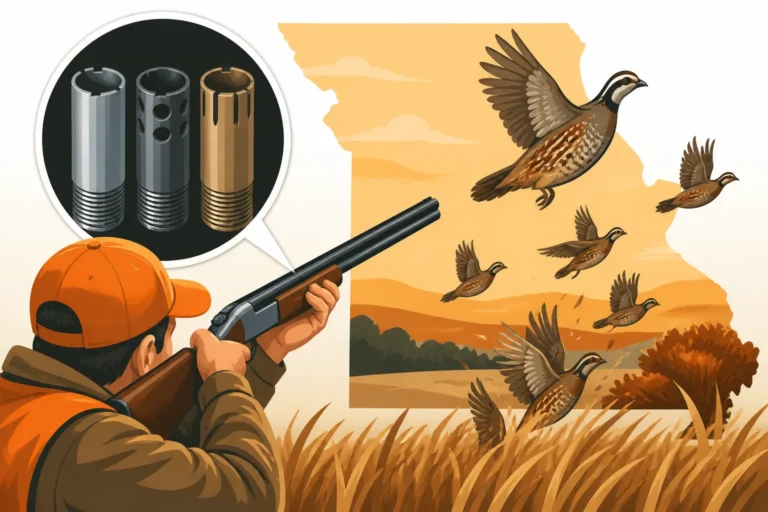
Think of your shotgun's choke as a traffic controller for your shot pellets. This constriction at the muzzle of your barrel dictates how tightly your shot string holds together, directly impacting your effective range and pattern density. Understanding and utilizing choke tubes is absolutely vital for maximizing your success and making clean, ethical shots on Missouri's diverse bird species.
The Role of Chokes in Shotgun Performance
A choke literally constricts the end of your shotgun barrel, forcing the pellets closer together as they exit. A tighter constriction keeps the pellets in a denser cluster for a longer distance, making for a tighter pattern suitable for longer shots. A more open constriction allows the pellets to spread out more quickly, creating a wider pattern ideal for close-range targets. Most modern shotguns come with interchangeable choke tubes, allowing you to easily screw in different constrictions based on the hunting scenario. Older or fixed-choke shotguns will have a permanent constriction.
Your choice of choke has a direct and profound effect on your pattern. If your pattern is too tight for close shots, you'll "shoot a hole" through the bird, missing it entirely or only hitting it with a few pellets, leading to a wounded animal. If your pattern is too open for long shots, the pellets will be too spread out, lacking the density and energy needed for a clean kill. The goal is to match the choke to the average distance you expect to encounter your target bird.
Common Choke Constrictions and Their Uses
Choke tubes are typically labeled with terms like "Improved Cylinder," "Modified," or "Full," which correspond to specific amounts of constriction. Here's a quick rundown of the most common ones and their general applications:
| Choke Constriction | Description | Approximate Effective Range (Lead Shot) | Primary Use Case |
|---|---|---|---|
| Cylinder (CYL) | No constriction. Widest pattern. | 15-20 yards | Very close range, dense cover, large pattern for spreading |
| Skeet (SK) | Very light constriction. Slightly tighter than CYL. | 20-25 yards | Skeet shooting, very close-range birds |
| Improved Cylinder (IC) | Light constriction. Good general-purpose spreader. | 20-30 yards | Close-flushing upland birds (quail, woodcock), decoying ducks |
| Modified (MOD) | Moderate constriction. Good all-around choke. | 30-40 yards | Mid-range upland birds (pheasant), ducks, general hunting |
| Improved Modified (IM) | Tighter than Modified, looser than Full. | 35-45 yards | Longer-range upland birds, pass shooting ducks |
| Full (FULL) | Heavy constriction. Tightest pattern. | 40-50+ yards | Long-range waterfowl (geese), pheasants, turkey (specialized) |
| Extra Full (X-FULL) | Even tighter than Full. Very dense pattern. | 50+ yards | Dedicated turkey hunting, extremely long-range pass shooting |
For quail and doves, where shots are often fast and close, an Improved Cylinder or Modified choke is usually ideal. For pheasants, which are tougher and sometimes flush at longer ranges, a Modified or even a Full choke is often preferred, especially later in the season. When targeting ducks over decoys, an Improved Cylinder or Modified might be best to ensure a wide pattern for close shots. For pass shooting ducks or geese, where birds are often high and far, Modified or Full chokes become necessary. For turkey hunting, specialized Extra Full or even tighter "Turkey Chokes" are designed to deliver extremely dense patterns of heavy shot to the head and neck.
It's crucial to pattern your shotgun with your chosen choke and load. This means shooting at a large piece of paper (like a 30-inch circle) at the distances you expect to shoot, to see how uniformly your pellets spread. Every gun and choke combination is unique, and patterning will reveal its true performance.
Matching Chokes to Hunting Scenarios
The key to successful choke selection is anticipating the hunting scenario. For instance, if you're Walking Missouri Quail Cover With a Dog in thick brush, the birds are going to explode out of cover within 10-20 yards. A tight choke like a Full would be utterly useless; your pattern would be too small to hit anything. Here, an Improved Cylinder or Modified is perfect. If you have an over/under, you might use an IC for your first barrel and a Mod for your second, offering a quick progression if a bird goes untouched.
Conversely, if you're in a layout blind waiting for honkers to fly over at 40-50 yards, a Full or Extra Full choke with heavy non-toxic shot is what you'll need to reach them effectively. For mixed bag hunting, like some Missouri Quail and Rabbit Seasons outings, a Modified choke is a good all-around choice.
Remember that non-toxic steel shot patterns tighter than lead shot of the same constriction. If you're switching to steel, you might want to use a more open choke than you would for lead to achieve a similar pattern density at range. For example, a Modified choke with steel might pattern like a Full choke with lead. Always check your specific requirements when hunting on managed areas, as Managed Hunt Draws on Missouri Wetlands often require non-toxic shot for all species.
Essential Considerations for Missouri Bird Hunters
Beyond the specific shotgun and loads, there are several overarching factors that contribute to your comfort, effectiveness, and safety in the field. Ignoring these can turn a promising day into a frustrating one, especially with Missouri's unpredictable weather and varied terrain.
Recoil Management and Fit
Let's be honest: shooting a shotgun, especially a 12-gauge with heavy loads, can produce a noticeable kick. While some hunters might shrug it off, excessive recoil can lead to flinching, poor shooting habits, and ultimately, missed birds. It can also make a long day of shooting incredibly uncomfortable. The good news is, there are ways to manage it.
First and foremost, proper gun fit is paramount. A shotgun that fits you well will direct the recoil into your shoulder, where your body can absorb it, rather than into your face or cheek. If a gun is too long or too short, or if the comb (the top part of the stock) is too high or too low, you'll feel the recoil more sharply. Many gun shops can help you assess your fit, and sometimes minor adjustments can make a huge difference. Beyond fit, the gun's action plays a role; gas-operated semi-automatics typically have less felt recoil than inertia-driven semi-autos, pumps, or break-actions because some of the gas energy is used to cycle the action. High-quality recoil pads are also your best friend. Modern pads, made from advanced shock-absorbing materials, can dramatically reduce the impact felt by your shoulder. Don't underestimate the benefit of a good pad, especially if you plan on doing a lot of shooting, like on a high-volume dove hunt.
Maintenance and Care in Missouri's Conditions
Missouri weather can be fickle. One day you're hunting pheasants in dry, crisp conditions, and the next you're in a misty duck blind with rain soaking everything. This variability means your shotgun needs diligent care to remain reliable and free from rust.
After every hunt, especially if the gun has been exposed to moisture (rain, mud, humid air, or even just wet hands), it's crucial to give it a good wipe-down. Pay particular attention to the metal surfaces to prevent rust. A light coat of gun oil on external metal parts goes a long way. For internal cleaning, especially for semi-automatics, follow the manufacturer's instructions. Gas systems can become caked with carbon buildup, leading to malfunctions, so regular cleaning of these components is essential. Non-toxic steel shot can also be more abrasive on barrels and chokes than lead, so inspect them regularly for any signs of wear. Proper storage, in a dry, temperature-controlled environment, will ensure your shotgun is ready for action year after year.
Practice, Patterning, and Ethics
Having the right gun and loads is only half the battle. The other half is knowing how to use them effectively and ethically.
Practice makes perfect. There's no substitute for time spent at the range. Shooting clay targets like trap, skeet, or sporting clays is the absolute best way to hone your wing shooting skills. It helps you develop consistency in your gun mount, learn to track moving targets, and master lead. You'll gain confidence and develop muscle memory that translates directly to the field.
As mentioned earlier, patterning your shotgun is non-negotiable. Don't just assume your shotgun shoots where you look, or that your choke/load combination creates the ideal pattern. Take it to the range, set up large paper targets (30-inch circles are standard), and shoot at the distances you expect to hunt. This will show you exactly how dense your pattern is, where its center lies, and what its effective range truly is for your specific setup. This knowledge is invaluable.
Finally, ethical hunting is paramount. This means only taking shots within your effective range – the range where you know your gun and load combination can deliver a dense enough pattern with sufficient energy for a clean kill. Avoid "sky-busting" at birds that are too far away. A wounded bird is a tragedy, and it's our responsibility as hunters to do everything possible to ensure a quick, humane harvest. If you're using a tool like GoHunt to scout and plan, you can also use that knowledge to understand the typical flight paths and ranges for birds in a particular area, helping you to set up for ethical shots.
Recommended Setups for Popular Missouri Bird Species
Let's put all this information into practice and look at some ideal shotgun and load combinations for the bird species you're most likely to pursue in Missouri. Remember, these are general recommendations – personal preference, gun fit, and local conditions can always lead to variations.
Quail and Small Upland Game
For the explosive flush of a bobwhite quail, the darting flight of a woodcock, or the quick scurrying of a rabbit in heavy cover, you need a fast-handling gun that throws a wide, dense pattern at close to moderate ranges.
- Ideal Gauge: 20-gauge or 28-gauge. Both are lighter and quicker to shoulder than a 12-gauge, making them perfect for those lightning-fast, close-range shots. A light 12-gauge can work too, but often feels like overkill.
- Action: Over/Under or side-by-side are classic choices for their balance and two choke options. A light semi-auto or pump is also excellent if you prefer more capacity.
- Chokes: Improved Cylinder (IC) or Modified (MOD). For an over/under or side-by-side, consider IC in the first barrel and MOD in the second. This gives you a wider pattern for the initial close flush and a slightly tighter one for a follow-up shot if the bird gets out a bit further.
- Shot Size (Lead): #7.5 or #6. These smaller pellets provide a dense pattern, which is crucial for hitting a small, fast target like a quail.
- Non-Toxic Alternative: If hunting on public land requiring non-toxic shot, use #6 or #7 bismuth/tungsten. If steel, consider #4 or #5 steel (remember to go up in size).
- Key Takeaway: Prioritize fast handling and a wide, dense pattern for close shots. A lighter gun will be a true friend on long walks when you're Walking Missouri Quail Cover With a Dog.
Pheasant and Larger Upland Birds
Pheasants are tougher birds than quail, with strong bodies and dense feathers, especially later in the season. They also tend to flush a bit further out and fly a straight, strong line. This means you need a bit more power and range. Pheasant Hunting in North Missouri often involves walking cover like standing grass, CRP fields, or even light timber, so a gun that's not too cumbersome is still important.
- Ideal Gauge: 12-gauge or heavy 20-gauge. A 12-gauge provides ample power, especially with 1 1/4 oz loads. A 20-gauge with heavier shot charges (1 oz or 1 1/8 oz) and modern non-toxic loads is also very effective.
- Action: Pump or semi-auto are popular for their robustness and capacity. Over/unders are also excellent, offering two distinct choke choices.
- Chokes: Modified (MOD) or Full. Many hunters will opt for a Modified choke as a good all-around choice for pheasants, offering a balance of spread and density. If birds are flushing further, or late in the season, a Full choke might be beneficial.
- Shot Size (Lead): #5 or #6. These larger pellets carry more energy for deeper penetration into the pheasant's body.
- Non-Toxic Alternative: For steel, use #2 or #3. For bismuth/tungsten, #4 or #5. Always verify if non-toxic shot is required in your hunting area.
- Key Takeaway: You need more knockdown power and a slightly tighter pattern than for quail. Ensure your gun can handle the heavier loads comfortably.
Doves and Fast-Flying Migratory Birds
Dove hunting is a blast in Missouri, especially when the fields are hot in early September. These birds are incredibly agile and fly at high speeds, often requiring rapid follow-up shots. It's also typically a high-volume shooting scenario. Hunting Missouri Dove Fields in September means preparing for a lot of shooting.
- Ideal Gauge: 12-gauge or 20-gauge. Both are perfectly capable. The choice often comes down to recoil sensitivity and preferred gun weight.
- Action: Semi-automatic is king for doves. Its fast cycling and reduced recoil allow for quick follow-up shots and less fatigue over hundreds of rounds. Pump-actions and over/unders are also perfectly fine, though you'll feel the recoil more and might be slower for subsequent shots.
- Chokes: Improved Cylinder (IC) or Modified (MOD). Doves can be close or far, so a balance is key. IC for decoying birds, Mod for higher flyers. Many prefer IC for the first shot.
- Shot Size (Lead): #7.5 or #8. A dense pattern of small shot is ideal for doves' delicate bodies.
- Non-Toxic Alternative: While lead is generally allowed for doves on private land, if hunting on public areas that require non-toxic shot, use #7 or #8 bismuth/tungsten, or #6 or #7 steel.
- Key Takeaway: Speed and volume are key. A semi-auto makes the experience much more enjoyable due to less recoil and faster shooting.
Ducks and Geese (Waterfowl)
Missouri's place on the Mississippi Flyway means fantastic waterfowl hunting, from decoying mallards in timber to pass-shooting geese in open fields. This is where you need serious firepower, and non-toxic shot is always required by federal law for migratory waterfowl.
- Ideal Gauge: 12-gauge (often with 3-inch or even 3.5-inch magnum shells). The larger case capacity allows for heavy loads of large, non-toxic shot, which is crucial for these resilient birds, especially for longer shots. A 20-gauge with high-quality non-toxic loads can be effective for decoying ducks but typically lacks the range for geese or pass shooting.
- Action: Semi-automatic or pump-action. Both are incredibly popular for waterfowl due to their reliability in adverse conditions, magazine capacity, and ability to handle heavy loads. Semi-autos have the added benefit of reduced recoil.
- Chokes: For decoying ducks in tight timber, an Improved Cylinder or Modified choke works well, especially with high-density non-toxic loads that pattern tighter. For pass shooting ducks or geese, where ranges are longer, a Modified or Full choke is often necessary. Be mindful that steel shot patterns tighter, so you might use a more open choke for steel than you would for lead.
- Shot Size (Non-Toxic):
- Ducks: Steel #3, #2, or #1. Bismuth #4, #3, or #2. Tungsten #6, #5, or #4.
- Geese: Steel BB, BBB, or T. Bismuth #1, BB, or BBB. Tungsten #4, #3, or #2.
- Key Takeaway: Non-toxic shot is mandatory. Heavy loads, durable actions, and appropriate chokes are crucial for knockdown power and range on these tough birds. Dress warmly and waterproof for Hunting Missouri River Sandbars for Ducks or in flooded timber!
Maximizing Your Missouri Bird Hunting Success with GoHunt
In today's hunting world, knowledge truly is power. While scouting boots on the ground can't be fully replaced, modern tools can give you a significant advantage in planning and executing your Missouri bird hunts. Services like GoHunt are a prime example of how technology can help you make more informed decisions about your gear, your locations, and your overall strategy.
Planning Your Hunt with Scouting Tools
One of the biggest frustrations in hunting is showing up to a spot only to find that the habitat isn't what you expected, or that hunting pressure is overwhelming. That's where advanced scouting tools shine. GoHunt, for instance, offers robust mapping features that can help you pour over aerial photos and topographical maps of Missouri from the comfort of your home. You can identify potential bird habitat—whether it's agricultural fields bordering timber for pheasants, specific wetland units for ducks, or fencerows and thickets for quail.
By layering different map types, you can visualize terrain, identify potential access points (and crucially, land ownership boundaries), and even get a sense of cover density. This kind of pre-hunt intelligence allows you to pinpoint promising locations, understand the lay of the land, and even anticipate bird movement patterns before you ever set foot in the field. This detailed planning can help you choose the best entry routes and setup locations, and avoid areas that are less likely to hold birds or that might see too much pressure, greatly enhancing your chances of success.
Leveraging Information for Better Gear Choices
Beyond simply finding a spot, these digital platforms can help you tailor your gear choices. When you're looking at a specific Missouri Conservation Area for ducks, for example, GoHunt can sometimes integrate with or point you to local regulations that explicitly state "non-toxic shot only" for all species, not just waterfowl. This immediate access to location-specific rules helps you ensure you're packing the correct ammunition, preventing potential legal issues and guaranteeing ethical compliance.
You can research the typical bird behavior and common ranges in a particular area. Are the pheasants known to hold tight in heavy cover, requiring a fast-handling gun and a more open choke? Or are they likely to flush wild in open fields, demanding a tighter pattern and more powerful load? Understanding these nuances, often informed by community forums or data layers within platforms like GoHunt, can help you dial in your shotgun gauge, choke, and load selection for that particular hunt. It's about taking the guesswork out of gear preparation.
Staying Informed and Safe in the Field
Even when you're out there, tools like GoHunt can be invaluable. Many mapping applications offer offline map capabilities, meaning you can navigate even without cell service – a real lifesaver in the remote Ozark hills or dense river bottoms. This helps you confidently move through unfamiliar terrain, track your path, and find your way back to your vehicle.
Furthermore, being informed about weather patterns, especially in regions like Missouri where conditions can change rapidly, is crucial for safety and comfort. While GoHunt might not offer real-time weather, the planning phase using such tools helps you prepare for the general conditions of the season and region. Knowing the average temperatures and precipitation for Missouri Waterfowl Seasons and Duck Zones, for example, influences your choice of clothing, waders, and other essential gear, ensuring you're ready for whatever Mother Nature throws your way. Ultimately, integrating these digital resources into your hunting process creates a more knowledgeable, effective, and safer hunting experience in the Show-Me State.
Disclaimer
This article is for general informational purposes only and does not constitute professional advice. Laws, prices and regulations vary by location and change over time. Consult a qualified professional for guidance on your specific situation.