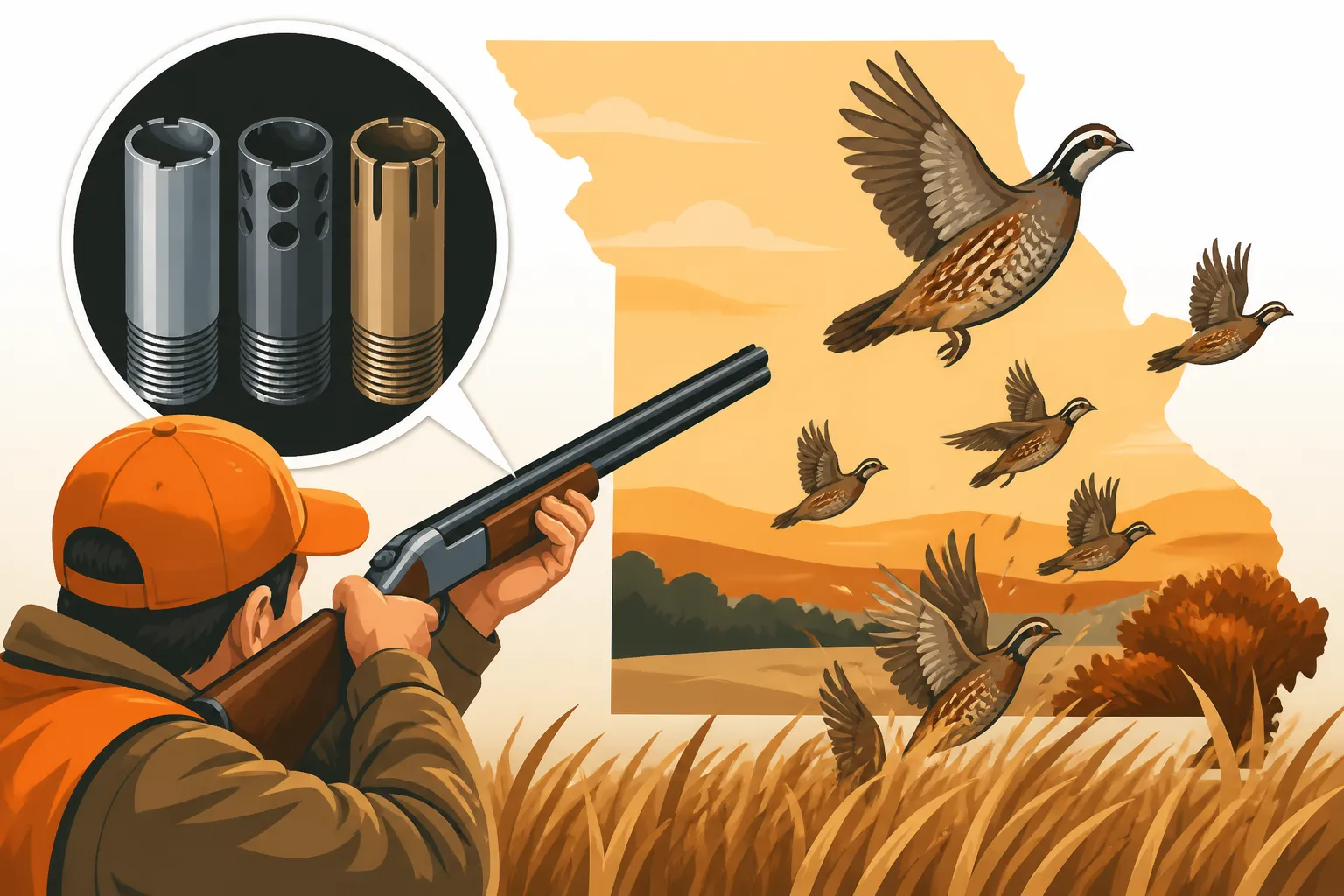
Choke Choice for Covey Rises
The electrifying rush of a covey rise in a Missouri CRP field or along a timber edge is one of hunting's great thrills, but it can quickly turn into frustration if your shotgun isn't set up correctly. Many hunters find themselves swinging wildly, their shot pattern too tight or too loose for the close-quarters, unpredictable chaos of a dozen bobwhites exploding into the air. This guide will walk you through the nuances of choke selection specifically for those heart-pounding moments, ensuring you have the best chance to connect with those fast-flying birds.
Understanding the Chaos of a Covey Rise
A quail covey rise isn't like a pheasant flushing out of a ditch, or a solitary duck lifting off a pond. It's an eruption, a symphony of whirring wings and scattering targets that can overwhelm a hunter in mere seconds. This unique challenge demands a specific approach to your shotgun setup, especially when it comes to choke constriction.
The Dynamics of a Flushing Covey
Imagine you're walking a brushy fencerow in northern Missouri, your setter locked on point. The anticipation is palpable. Then, with a sudden burst, a dozen quail erupt from the cover, fanning out in every direction. Some fly low and fast, others climb steeply, and almost all of them are within 15 to 25 yards of your muzzle. This isn't a scenario where you're picking out a single bird at 40 yards; it's about putting enough pellets into a wide enough area to catch a bird or two as they make their escape. The window of opportunity is incredibly brief, often less than two seconds for your first shot. The birds aren't flying a predictable line; they're zigging and zagging, creating a dynamic, multi-directional challenge.
The primary problem here is that if your choke is too tight, your pattern will be small and dense. While this might be fantastic for a long shot on a passing duck or a late-season goose, it becomes a literal pinpoint in the chaos of a covey rise. You might entirely miss a bird that's just a foot or two outside your concentrated pattern, even if your lead was perfect. Conversely, a pattern that's too open might lack the density to consistently bring down a bird at the edge of the effective range, leading to more cripples or clean misses, especially if you're using smaller shot sizes. It’s a delicate balance, and understanding these dynamics is the first step toward making an informed choke choice.
Why Tight Chokes Often Fail on Close Flushes
Many new quail hunters, or those accustomed to other forms of bird hunting, default to a Modified or even Full choke, thinking "tighter is better." However, for the typical Missouri covey rise, this can be a significant disadvantage. When quail bust out at 15 yards, a Full choke might produce a pattern only 15-20 inches in diameter. That means you've got to be incredibly precise, almost rifle-like, in your aim. In the split-second decision-making of a covey rise, where your adrenaline is pumping and targets are everywhere, achieving that level of precision is exceptionally difficult.
The small target area means less room for error in your swing and lead. It also means that the "spread" you get from your pattern is minimal, reducing your chances of catching a bird that might be slightly off your intended aim point. Think of it like trying to hit a moving baseball with a needle versus a tennis racket. A tighter choke also tends to "blow through" a close bird, leaving a gaping hole in the pattern immediately around the point of aim, where the shot hasn't fully spread out yet. This can result in spectacular misses even when you felt you were right on target. For the vast majority of covey rise shots, which occur under 30 yards, a much more open pattern is not just beneficial, it’s practically essential for consistent success. This is especially true for the first shot, which is usually the closest. Many experienced quail hunters even prefer the forgiveness that an open choke provides.
Common Choke Options and Their Performance
When it comes to breaking clay targets or bringing down game birds, the choke tube in your shotgun barrel plays an outsized role in determining the spread and density of your shot pattern. For those unpredictable covey rises, selecting the right choke is paramount.
The Open Choke Advantage: Cylinder, Skeet, and Improved Cylinder
For the unique challenge of a covey rise, where birds are often flushing close and scattering quickly, open chokes are your best friends. These chokes provide the widest patterns, giving you a greater margin for error and a better chance of connecting with those fast-moving, close-range targets.
- Cylinder (CYL): This is essentially no constriction at all. Your shot leaves the barrel with the maximum spread, making it ideal for extremely close-range shots, typically under 15-20 yards. While it offers the broadest pattern, the density can drop off quickly at slightly longer distances. For a first shot on a covey that blows up at your feet, it can be incredibly effective, but it offers little versatility if you need to take a follow-up shot on a bird that's put some distance between itself and the flush point. It's often favored by hunters who pursue quail in exceptionally thick cover where shots are guaranteed to be within spitting distance.
- Skeet (SKT): A very slight constriction, just a hair tighter than Cylinder. Skeet chokes are designed for skeet shooting, which involves clay targets at very close ranges. This choke will typically keep about 50-55% of your pellets in a 30-inch circle at 25 yards. For quail, it provides an excellent balance of pattern spread and density for those explosive 15-25 yard shots. It's often cited as an ideal first choke in a double-barreled shotgun for quail. The pattern is wide enough to be forgiving, but dense enough to deliver a lethal payload.
- Improved Cylinder (IC): This is arguably the most popular all-around choke for upland bird hunting, and for good reason. It offers a slightly tighter constriction than Skeet, typically putting 55-60% of its pellets in a 30-inch circle at 25 yards. For a covey rise, an Improved Cylinder choke strikes an excellent balance. It gives you a wide enough pattern for the immediate flush, covering a good area, yet maintains sufficient density to cleanly kill birds out to about 30-35 yards. If you're running a single-barrel pump or semi-auto, and want a versatile choke for quail, Improved Cylinder is often the recommendation you'll hear. It’s forgiving for those initial close shots but still has enough punch for a slightly longer follow-up. When researching what works for different upland scenarios, sites like GoHunt often highlight the versatility of IC for fast-flushing birds.
Moderately Constricted Chokes: Light Modified and Modified
While the most open chokes shine for the initial chaos of a covey rise, there are situations where a slightly tighter pattern might come into play, particularly for follow-up shots or if you anticipate slightly longer flushes. These chokes offer a compromise between wide spread and tighter patterns.
- Light Modified (LM): This choke sits right between Improved Cylinder and Modified, offering a nice bridge for hunters looking for a bit more range without sacrificing too much spread. Typically, it will deliver about 55-60% of your pellets in a 30-inch circle at 30 yards. For quail, this could be a good choice if you're hunting more open cover where birds tend to flush a bit further out, or as a second barrel in a double gun, to handle the slightly longer second shot on a departing bird. It's not as forgiving for those 15-yard eruptions, but it extends your effective range a few extra yards with reasonable pattern density.
- Modified (MOD): A Modified choke offers a pattern that's tighter than Improved Cylinder, usually putting 60-65% of its pellets in a 30-inch circle at 30 yards. For dedicated quail hunting, especially the first shot on a covey rise, Modified is often considered too tight by many experienced hunters. The pattern is simply too small for the close, chaotic flushes that are characteristic of bobwhites. However, it can be an excellent choice for the second barrel of a double gun, or for a follow-up shot on a bird that has already gained some distance and is now 35-40 yards out. If you're hunting a mixed bag of birds, perhaps pheasant and quail, a Modified choke might be a compromise, though it still errs on the side of tightness for those initial quail flushes. Understanding Working Field Edges and Draws for Quail and how birds might flush in different cover types can help you decide if a Modified choke has a place in your setup for a follow-up shot.
Matching Choke to Gauge, Load, and Conditions
Choosing the right choke isn't just about the constriction itself; it's a dynamic interplay with your shotgun's gauge, the specific shot shell you're using, and the actual conditions you'll encounter in the field. Ignoring these factors can negate the benefit of even the "perfect" choke.
Gauge Considerations: 12 Gauge Versus 20 Gauge
The gauge of your shotgun definitely plays a role in how you think about choke selection, though perhaps not in the way some might assume. Both 12 gauge and 20 gauge shotguns are incredibly popular for quail hunting in Missouri, and each has its loyal following. The key difference often boils down to payload. A 12 gauge typically carries a heavier shot charge (more pellets) than a 20 gauge. This means that a 12 gauge, even with a more open choke like Improved Cylinder, can still deliver a very dense pattern due to the sheer volume of pellets. For example, a 12 gauge with 1 1/8 oz of #7.5 shot will have significantly more pellets than a 20 gauge with 7/8 oz of the same shot size.
What this translates to for choke choice is that a 12 gauge can often get away with a slightly more open choke for effective killing power at a given range compared to a 20 gauge. A 12 gauge with a Skeet or Improved Cylinder might have the same pattern density at 25 yards as a 20 gauge with an Improved Cylinder or even Light Modified, simply because the 12 gauge started with more pellets. If you're shooting a 12 Gauge Versus 20 for Quail, and you value that wider, more forgiving pattern for covey rises, a 12 gauge gives you a little extra wiggle room in pattern density. For 20 gauge users, while still very effective, it might be even more critical to stick to the most open chokes (Skeet or Improved Cylinder) to ensure you're getting a broad enough pattern without compromising pellet density on those close-range flushes. The lighter payload of a 20 gauge means every pellet in that pattern counts even more.
Shot Size and Shell Performance
The shot size you choose is inextricably linked to your choke selection and overall effectiveness. For Missouri bobwhites, smaller shot sizes like #7.5, #8, or even #9 are common. These smaller pellets offer a higher pellet count per ounce, which translates to a denser pattern. This density is crucial for ensuring multiple pellets hit a small bird like a quail, increasing the likelihood of a clean kill. However, smaller pellets also lose energy and penetration faster than larger ones. This is where the choke comes in.
If you're using a very open choke (Cylinder or Skeet) with smaller shot, the pattern will spread very quickly. While great for extremely close shots, the density can drop off rapidly beyond 20-25 yards, potentially leading to insufficient hits for a clean kill. Conversely, if you pair small shot with a tight choke (Modified or Full), the pattern becomes incredibly dense and small at close ranges, making it difficult to hit anything in a covey rise. The ideal combination often involves an Improved Cylinder choke with #7.5 or #8 shot. This balance provides a wide enough spread for forgiveness, coupled with enough pellet count and energy for clean kills out to a reasonable range. When thinking about Shot Size for Missouri Bobwhites, always consider how it will interact with your choke to produce the desired pattern density at the range where you expect to connect with birds. Don't forget that different brands and types of shells can also pattern differently through the same choke, which brings us to the next critical step.
The Importance of Patterning Your Shotgun
This is, hands down, the most overlooked and yet most critical step in optimizing your choke choice for covey rises. Buying a box of shells and screwing in an "Improved Cylinder" choke doesn't guarantee you'll get the pattern you expect. Every shotgun, every choke, and every shell combination is a unique system. What patterns beautifully in your buddy's gun might be mediocre in yours.
Patterning involves shooting your chosen shotgun, choke, and ammunition at a large sheet of paper (like butcher paper or a dedicated patterning target) at various distances relevant to quail hunting (e.g., 20, 25, 30, and 35 yards). Draw a 30-inch circle around the densest part of the pattern and count the pellet holes. What you're looking for is a pattern that is evenly distributed, without large holes or "gaps" that a quail could fly through, and with sufficient density (typically 50-60% of your total pellets) within that 30-inch circle at your primary shooting distance. A good resource like GoHunt might offer articles on how to conduct proper patterning tests. If you find your IC choke is still too tight with your chosen load, consider a Skeet or even Cylinder. If it's too sparse, try a slightly tighter choke or a shell with a higher pellet count (smaller shot size or heavier payload). Until you see your actual patterns on paper, you're just guessing in the field. This step is non-negotiable for serious quail hunters.
Practical Tips for Patterning and Field Use
Once you understand the theory behind choke choice and its interaction with your gauge and load, it’s time to put that knowledge into practice. The real test comes on the patterning board and, ultimately, in the field when the birds flush.
Setting Up Your Patterning Session
Patterning your shotgun doesn't have to be a complicated scientific experiment, but it does require a systematic approach to be effective. First, choose a calm day with little to no wind, as even a slight breeze can affect your shot pattern. Set up a large target, ideally 40×40 inches or larger, at a range where you anticipate most of your shots will occur. For quail, this means 20 to 30 yards is a great starting point, but it's wise to also check at 15 and 35 yards. Use an aiming point on the target, but remember you're evaluating the spread, not just the bullseye.
Shoot at least three to five rounds of your chosen ammunition through each choke you want to test. This will give you an average and help you identify any inconsistencies. After each shot, walk down to the target and evaluate the pattern. Draw a 30-inch circle around the densest part of the pattern (not necessarily the exact center of the target, as point of impact can vary slightly from point of aim). Count the pellet holes within that circle and look for even distribution. Are there any large holes that a quail could slip through? Is the pattern too tight or too wide for your intended range? This feedback is invaluable. You might discover that your "Improved Cylinder" patterns more like a Light Modified with a particular brand of shell, or that your Skeet choke is surprisingly dense. This empirical data will guide your decision far better than any chart or label on a choke tube.
Choke Choices for Different Hunting Scenarios
While Improved Cylinder is a fantastic all-around choke for many quail situations, slight adjustments can be made depending on the specific cover you're hunting. Missouri offers diverse quail habitat, from dense plum thickets and woody draws to more open grasslands and CRP fields.
- Dense Cover: If you're walking through incredibly thick stuff – heavy brush, thorny briars, or dense multiflora rose – your shots are almost guaranteed to be very close, often under 20 yards. In these situations, a Skeet or even a Cylinder choke might be your best bet. The ultra-wide pattern will be forgiving in tight quarters where precise gun mounting and swinging are difficult. You're sacrificing some range, but maximizing your chances on those explosive, in-your-face flushes. This strategy pairs well with techniques like Still-Hunting After a Fresh Snow where visibility and shot distances can be limited.
- Moderate Cover: This is where the classic Improved Cylinder choke truly shines. For typical fencerows, timber edges, moderate CRP, or field borders, birds will often flush between 15 and 30 yards. IC offers that perfect blend of spread and density to handle these common scenarios. It's forgiving enough for the initial flush, but still has enough pellets to reliably bring down a bird taking flight a little further out. It's often the single choke most hunters leave in their gun for all-around quail hunting.
- Open Cover / Follow-Up Shots: If you're hunting very open country, like vast expanses of native grass where quail might run a bit before flushing further out, or if you're using a double-barreled shotgun, you might consider a Light Modified or Modified choke for your second barrel. This allows you to take a slightly longer follow-up shot on a bird that has already put 30-40 yards between you. For the initial shot in these conditions, however, most hunters still opt for an IC or Skeet to maximize their chances on the first, closest opportunity. Remember, the first shot is often your best and closest chance on a covey rise. Understanding the specific characteristics of Missouri Quail Restoration Landscapes and how birds behave there can also inform your choice.
Considering Two Chokes for Double Guns
For those who hunt with a double-barreled shotgun (side-by-side or over/under), you have the distinct advantage of being able to choose two different chokes, effectively giving you two distinct shot patterns at your disposal. This is often considered the ideal setup for quail hunting.
The most common and highly effective combination for covey rises is an open choke in the first barrel (typically Skeet or Improved Cylinder) and a slightly tighter choke in the second barrel (Light Modified or Modified). When a covey erupts, you lead with the open choke to maximize your chances on the closest, most chaotic birds. If you miss, or if a second bird offers a shot as it flies further away, you quickly transition to the second, tighter barrel. This allows you to cover a wider range of distances and situations within a single covey rise. For example, your first shot with a Skeet choke might be perfect for a bird at 20 yards, while your second shot with a Light Modified could cleanly take a bird at 35 yards. This versatility can dramatically increase your success rate and minimize cripples. This strategy perfectly complements the unpredictable nature of a covey rise, giving you options for Covey Rise Shooting Discipline when multiple birds are in the air.
| Choke Constriction | Percentage of Pellets in 30" Circle at 25 yds | Ideal Range for Quail (yards) | Primary Use for Covey Rises | Pros | Cons |
|---|---|---|---|---|---|
| Cylinder (CYL) | 40-45% | 10-20 | Extremely close-range, very dense cover first shot | Widest pattern, very forgiving at close range | Rapid loss of pattern density beyond 20 yards, limited versatility |
| Skeet (SKT) | 50-55% | 15-25 | Primary first barrel choice, close-range flushes | Excellent forgiveness, good pattern density up close | Density may be insufficient for birds beyond 25-30 yards |
| Improved Cylinder (IC) | 55-60% | 15-30 | All-around best first barrel for most coveys | Great balance of spread and density, forgiving and effective | Can be too tight for very close (10-15 yd) flushes, not ideal for distant follow-ups |
| Light Modified (LM) | 55-60% at 30 yds (approx) | 25-35 | Second barrel, slightly longer flushes | Extends effective range slightly beyond IC | Less forgiving for initial close flushes |
| Modified (MOD) | 60-65% at 30 yds (approx) | 30-40 | Second barrel for longer follow-up shots | Good for distant singles or second shots | Often too tight for typical covey rise range (first shot) |
Disclaimer
This article is for general informational purposes only and does not constitute professional advice. Laws, prices and regulations vary by location and change over time. Consult a qualified professional for guidance on your specific situation.