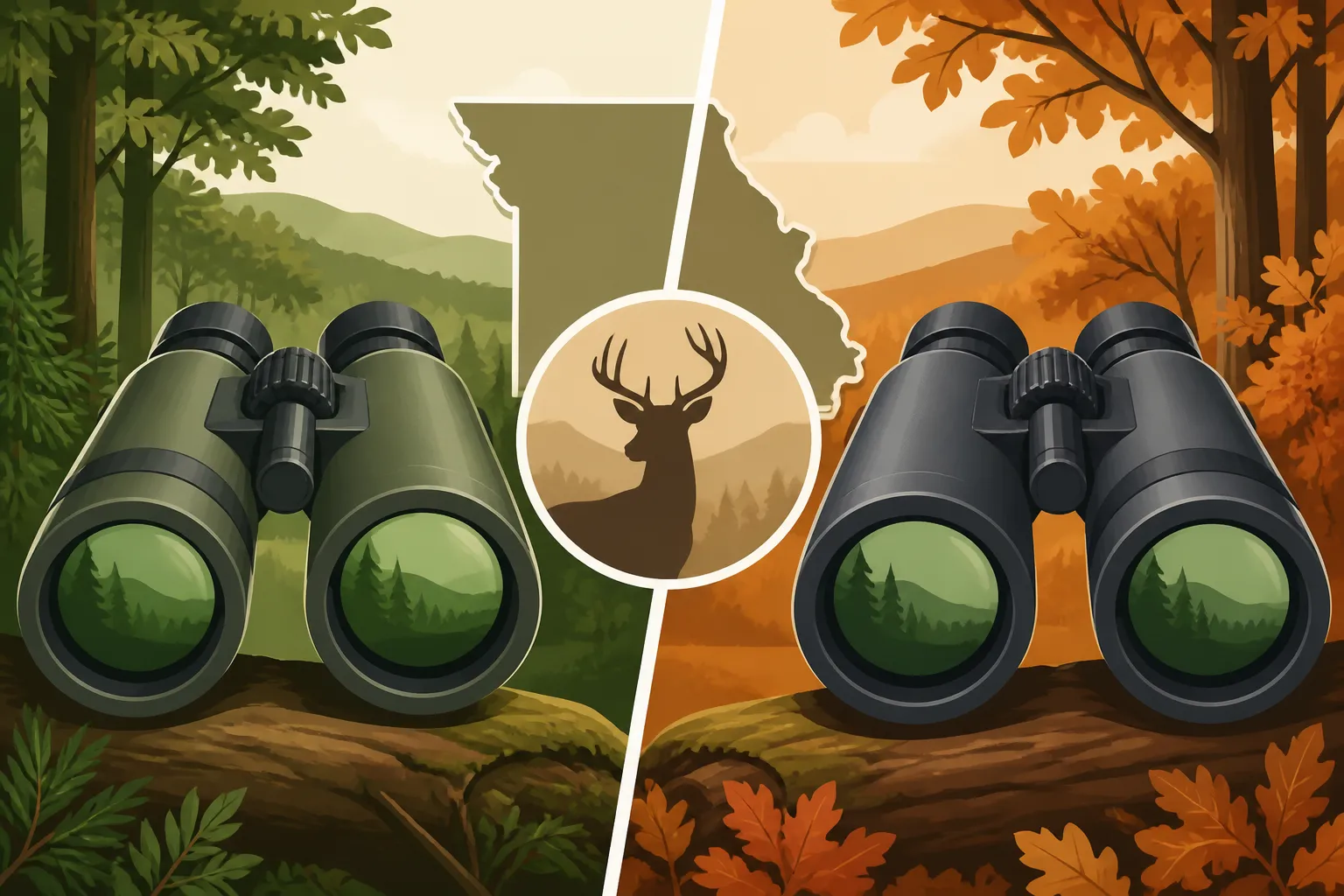
8×42 Versus 10×42 in the Woods
Picking out the right pair of binoculars for hunting here in Missouri can feel like trying to choose a favorite child – they all have their strengths, and the wrong choice can leave you feeling frustrated when that big buck slips away unseen. One of the most common dilemmas hunters face is whether to go with 8×42 or 10×42 binoculars. This isn't just about bigger numbers meaning better; it's about matching your glass to the diverse landscapes we hunt, from the dense hardwoods of the Ozarks to the expansive farm fields up north. This guide will walk you through the nuances of each option, helping you decide which optic truly fits your Missouri hunting style.
Understanding Binocular Magnification and Light Gathering
Before we dive into the specific merits of 8×42 versus 10×42, let's break down what those numbers actually mean. It's not just optics jargon; these figures tell you a lot about how you'll experience the field of view, brightness, and stability of the image you see. Understanding this foundation is key to making an informed decision that will serve you well, whether you're trying to pick apart thick brush for a hidden turkey or scan a distant field edge for a deer at first light.
Deciphering the Numbers: Magnification and Objective Lens
When you see "8×42" or "10×42" on a pair of binoculars, each number has a specific purpose. The first number, "8x" or "10x", refers to the magnification power. An 8x magnification means that an object viewed through the binoculars will appear eight times closer than it does with the naked eye. Similarly, 10x makes things appear ten times closer. It sounds straightforward, but higher magnification isn't always superior, especially in our varied Missouri terrain.
The second number, "42," indicates the diameter of the objective lens in millimeters. This is the big lens at the front of the binoculars, the one furthest from your eyes. The objective lens's primary job is to gather light. A larger objective lens gathers more light, which can be a huge advantage, particularly in low-light conditions like dawn and dusk when game animals are most active. For both 8×42 and 10×42, the 42mm objective lens size is a great all-around choice, offering a good balance between light-gathering capability and manageable size and weight.
The Importance of Exit Pupil and Field of View
Beyond magnification and objective lens size, two other critical factors heavily influence your binocular experience: exit pupil and field of view. The exit pupil is the diameter of the light beam that exits the eyepiece and enters your eye. You can calculate it by dividing the objective lens diameter by the magnification. For an 8×42 binocular, the exit pupil is 42mm / 8 = 5.25mm. For a 10×42, it's 42mm / 10 = 4.2mm.
Why does this matter? In low light, your pupils dilate, typically to 5-7mm for an adult. If the binocular's exit pupil is smaller than your dilated pupil, you're essentially losing light, and the image will appear dimmer. An 8×42, with its larger exit pupil, generally provides a brighter image in twilight or heavily shaded timber, which can be invaluable when trying to identify a deer's antler tine or a turkey's head in deep shadows.
Field of view (FOV) refers to the width of the area you can see through your binoculars at a specific distance, usually expressed in feet at 1,000 yards. Generally, lower magnification binoculars (like 8x) have a wider field of view than higher magnification ones (like 10x), assuming the objective lens size remains constant. A wider FOV means you can scan a broader area without moving the binoculars, making it easier to spot movement, track a running animal, or locate your target in dense cover. In the thick Missouri woods, where shots can be close and action fast, a wide FOV can be a real game-changer. When you're trying to locate a gobbler that's just sounded off in front of you, a wider view means less frantic sweeping and a better chance of seeing him step out from behind a tree.
The Case for 8×42 Binoculars in Missouri's Timber
When I think about the majority of hunting I do here in Missouri, especially for deer and turkeys, it often happens in timbered settings. Whether it's the sprawling Mark Twain National Forest Hunting or one of the many state Missouri Conservation Areas Explained, we're often working in a world of trees. This is where the 8×42 binocular truly shines, offering a balance of attributes that perfectly suit the challenges of hunting in denser cover.
Brighter Image and Superior Low-Light Performance
One of the most compelling arguments for an 8×42 is its inherent ability to deliver a brighter image, especially when light is scarce. As we discussed with the exit pupil, the 8×42 simply allows more light to reach your eye compared to a 10×42, assuming the same objective lens size and glass quality. For a hunter sitting in a Treestand Setups in Hardwood Timber an hour before sunrise or patiently waiting for a deer to step out at last light, this difference can be profound.
Imagine you're tucked into a stand on a frosty November morning, the sky just beginning to show hints of purple and gray. The woods are still dark, but you know deer are moving. With an 8×42, the edges of the timber, the dark shadows under cedars, and the subtle flick of an ear or tail seem just a little clearer, a little more defined. That extra bit of light can mean the difference between identifying a legal buck or letting a spike walk by because you couldn't quite make out his antlers in the gloom. This advantage is critical during prime hunting hours, allowing you to maximize your effective hunting time when deer and turkey are most active.
Wider Field of View for Dense Cover
The wider field of view offered by 8×42 binoculars is an undeniable asset when you're hunting in Missouri's typically dense and broken terrain. When you're trying to Still-Hunting a Missouri Ozark Hollow, picking apart individual trees and scanning for movement, a broader perspective makes a huge difference. You're not just looking at a tiny sliver of the woods; you're taking in a more expansive scene.
This means less frantic panning and more efficient scanning. If a deer slips through a thicket or a turkey sneaks in from the side, a wider FOV makes it much easier to acquire and follow them. It reduces the "tunnel vision" effect that higher magnification can sometimes induce, allowing you to react quicker to unexpected game movement. For bowhunters, especially, who often find themselves with shorter shooting lanes and quicker shot opportunities, the ability to rapidly acquire and track a target through an 8×42 can be invaluable. It truly shines when you're glassing a logging road for a scrape line or picking apart a fencerow where deer might be feeding.
Steadier Image and Reduced Hand Shake
Holding binoculars perfectly still is harder than it looks, especially after a long walk, on a cold morning, or when you're pumped full of adrenaline. With an 8x magnification, any natural hand tremor or wobble is magnified eight times. With a 10x, it's magnified ten times. This might not sound like a huge difference, but it significantly impacts the steadiness and clarity of the image you perceive.
An 8×42 binocular provides a noticeably steadier image, which is incredibly beneficial when you're trying to discern fine details like antler points, identify subtle feather patterns on a turkey, or simply hold the binoculars steady long enough to verify what you're seeing. This steadiness reduces eye strain over prolonged glassing sessions, making it more comfortable to use your binoculars for extended periods. When you're trying to Scouting Missouri Public Land Before Season, you'll be doing a lot of glassing, and that steadier image helps prevent fatigue. For those of us who hunt the rough and often steep Deer Hunting the Missouri Ozarks, where a stable rest might not always be available, the 8×42 often offers a more practical and user-friendly experience, allowing for quick, effective scans without needing a tripod or a solid brace every time.
The Case for 10×42 Binoculars for Missouri's Varied Terrain
While the 8×42 has its strong points, especially in thick cover, the 10×42 isn't just a bigger number for show. For hunters who venture into more open country or prefer to keep a greater distance from their quarry, the increased magnification offers distinct advantages. Missouri isn't all thick timber; we have plenty of open fields, CRP, and river bottoms where longer glassing ranges come into play.
Increased Magnification for Greater Detail
The primary benefit of a 10×42 binocular is, of course, that extra magnification. Ten times closer, compared to eight, might not seem like a massive jump, but it significantly enhances your ability to pick out fine details at longer distances. When you're Hunting North Missouri's Big-Buck Farm Country, overlooking vast expanses of cut corn or bean fields, this magnification becomes a critical asset.
Being able to see that subtle flick of an ear from 500 yards, or discern if that dark lump under a distant fencerow is a bedded deer or just a stump, can make or break a hunt. It allows you to really dissect a distant wood line or a field edge, identifying game that might be completely missed with lesser magnification. For folks who enjoy Field Hunting Geese in North Missouri or trying to spot ducks from afar, the extra power can help you identify species and make decisions long before you get close enough to spook them. This means you can evaluate a target more thoroughly, judge its size, and determine its travel direction without having to move in closer and risk blowing your cover.
Longer Effective Reach for Open Landscapes
Missouri offers more than just dense forests. We have the wide-open spaces of northern and western Missouri, large river bottoms like those along the Missouri River and Big Muddy Access, and expansive prairies. In these environments, higher magnification truly extends your effective reach. If you're Hunting a Missouri Fencerow Between Fields that's hundreds of yards long, or trying to pick out a turkey strutting in a distant pasture, the 10×42 brings that action closer.
This longer reach is invaluable for scouting, too. You can Scouting Missouri Public Land Before Season from a greater distance, minimizing your disturbance on the land while still being able to identify pinch points, food sources, and travel corridors. For hunters using platforms like GoHunt to plan their routes and identify potential hot spots, having optics that allow you to effectively glass these large areas is paramount. It means you can cover more ground visually, saving precious boot leather and reducing your scent footprint. This capability is also critical for spotting game across CRP fields or identifying movement in distant draws where game might be holding tight.
Ideal for Spot-and-Stalk Tactics and Elevated Positions
If your hunting style leans towards spot-and-stalk, or if you frequently hunt from elevated positions overlooking large areas (think a bluff overlooking a river bottom or a tall box blind on a food plot), the 10×42 is often the preferred choice. The ability to scan a broad landscape, locate game, and then meticulously plan your approach based on what you've observed from a distance is where this magnification excels.
When using a Ground Blinds on Crop Field Edges, you might be glassing for hundreds of yards in multiple directions. The 10×42 allows you to stay put, minimize movement, and thoroughly scrutinize every shadow and anomaly in your peripheral view. While it can be a bit more challenging to hold steady by hand, especially if you're out of breath from hiking, many hunters mitigate this with shooting sticks, tripods, or by simply bracing against a tree or a blind window. The payoff is a significantly clearer view of distant objects, giving you the critical intelligence needed to execute a successful hunt without rushing in prematurely.
Making Your Choice: Matching Binos to Your Missouri Hunting Style
Deciding between 8×42 and 10×42 isn't about one being definitively "better" than the other; it's about aligning the binocular's strengths with your personal hunting habits, the typical terrain you frequent, and even your physical capabilities. There are pros and cons to each, and understanding these trade-offs in the context of Missouri's varied hunting opportunities is crucial.
Consider Your Primary Hunting Habitat
This is perhaps the most important factor. Think about where you spend the vast majority of your hunting time in Missouri.
- Dense Timber and Thick Brush: If you're primarily hunting the thick woods of the Ozarks, such as Hunting the Missouri Ozarks, or navigating the dense river bottom cover, the 8×42 is likely your best bet. The wider field of view helps immensely when searching for movement in tight spaces, and the brighter image excels in the perpetual shade of the timber. Your typical shot distances are probably shorter, making extreme magnification less necessary. In these areas, game often appears quickly and relatively close, so quick target acquisition and a steady image are prioritized over sheer magnifying power.
- Open Fields and Rolling Farmland: Conversely, if you hunt the agricultural country of northern Missouri, perhaps scouting Where North Missouri Bucks Bed or waiting on a Hunting Standing Corn Before Harvest field, the 10×42 will serve you better. The ability to glass distant treelines, pick apart brush rows, or scrutinize far-off creek bottoms for deer movement makes the added magnification invaluable. In these open environments, game can be spotted from much further away, and the extra detail from 10x can help you make decisions on whether to make an approach or simply observe.
- Mixed Habitat: Many Missouri hunters encounter a mix of both. If you hunt areas with large blocks of timber interspersed with fields, you might lean towards the 10×42 if your primary objective is long-range spotting before making a move into the timber. However, if you often still-hunt or prefer to be deep in the woods, the 8×42's advantages in low light and close quarters are hard to beat.
Evaluate Your Hunting Style and Physicality
Your personal hunting preferences and even how steady you can hold binoculars play a role.
- Active vs. Stationary Hunting: If you're a run-and-gun turkey hunter or someone who likes to still-hunt actively through the timber, the 8×42's lighter weight (generally) and steadier image might be more appealing for quick, on-the-go glassing. For those who prefer to sit in a fixed position, like a treestand or ground blind for deer, and glass for extended periods, the 10×42 might be fine, especially if you're using a rest like shooting sticks.
- Hand Steadiness: Be honest with yourself. If you find your hands tend to shake, or if you're often glassing after exertion (like climbing a steep ridge), the 8×42 will provide a more comfortable and clear viewing experience. The extra magnification of a 10x will only amplify any unsteadiness, making the image harder to resolve. If you plan to use a tripod or other stabilization regularly, this becomes less of an issue for 10x42s.
- Light Conditions: Do you often find yourself hunting in the deepest, darkest parts of the timber right at legal shooting light? Or do you primarily hunt midday in more open conditions? If low light performance is paramount to your strategy, especially during those critical first and last minutes of the day, the 8×42 often has the edge.
The Trade-Offs at a Glance
Let's summarize the key differences to help you visualize the comparison.
| Feature | 8×42 Binoculars | 10×42 Binoculars | Considerations for Missouri Hunting |
|---|---|---|---|
| Magnification | 8x (Appears 8 times closer) | 10x (Appears 10 times closer) | Higher for open country, lower for dense timber. |
| Objective Lens | 42mm | 42mm | Same light gathering potential from the front lens. |
| Exit Pupil | 5.25mm | 4.2mm | Larger means brighter image in low light (key for dawn/dusk). |
| Field of View | Wider (More area visible at 1000 yds) | Narrower (Less area visible at 1000 yds) | Wider is better for quick scanning in thick cover. |
| Low-Light Perf. | Generally superior (Brighter image) | Good, but often slightly dimmer than 8×42 | Crucial for spotting game during prime activity times. |
| Image Stability | Steadier (Less hand shake apparent) | Less steady (More hand shake apparent) | Steadier is better for long glassing or after exertion. |
| Detail at Range | Good at moderate ranges (under 300-400 yds) | Excellent at longer ranges (over 400 yds) | 10x excels for long-distance observation in open areas. |
| Size/Weight | Often slightly lighter and more compact | Often slightly heavier, similar size overall | Minor difference, but can matter on long treks. |
| Typical Use Case | Dense timber, thick cover, bowhunting, active hunting | Open fields, long-range glassing, spot-and-stalk | Match to your dominant hunting environment and style. |
Ultimately, if you find yourself spending most of your time in Missouri's dense timber, whether it's hunting Spring Turkey Calling in Missouri Timber or deer in the hardwoods, the 8×42 often provides a more user-friendly and effective experience. Its superior low-light performance and wider, steadier field of view give you an edge where game often appears quickly and relatively close.
However, if you're primarily hunting the big crop fields and rolling prairies of northern Missouri, or if you frequently set up overlooking vast expanses where long-range spotting is key, the added magnification of a 10×42 will allow you to pick apart distant details that an 8x might miss. Many hunters who meticulously plan their hunts using resources like GoHunt, considering the specific topography and likely engagement distances, will often find themselves leaning towards the 10×42 for those open country scenarios.
Consider visiting a local outdoor retailer and trying out both magnifications. Hold them steady, look across the store, and get a feel for the image stability and field of view. What feels comfortable to your hands and your eyes will give you the best indicator. Remember, the goal is to enhance your hunting experience, not detract from it. The right binoculars will become an indispensable tool in your Missouri hunting arsenal.
Disclaimer
This article is for general informational purposes only and does not constitute professional advice. Laws, prices and regulations vary by location and change over time. Consult a qualified professional for guidance on your specific situation.