Treestand Setups in Hardwood Timber
There’s nothing quite like the crunch of leaves underfoot as you head into the Missouri timber before dawn, or the chill that bites your nose from a treestand in late October. But let's be real, finding that perfect tree in a vast hardwood forest and setting up a stand effectively can feel like an impossible puzzle. It’s not just about getting off the ground; it’s about understanding the entire ecosystem around you, from the deer's perspective to the shifting winds. This comprehensive guide is here to walk you through the nuances of treestand setups in Missouri's diverse hardwood timber, helping you unlock better hunting opportunities and, most importantly, stay safe while you're at it.
Understanding Hardwood Timber Dynamics for Treestand Success
Missouri's landscape is incredibly varied, but much of our best deer habitat is found within its sprawling hardwood forests. These aren't just collections of trees; they are living, breathing ecosystems that dictate how deer move, feed, and bed. To truly excel at treestand hunting, you need to understand the characteristics of these woods.
Identifying Key Tree Species for Stands
When you're out scouting, not all trees are created equal for hanging a treestand. You're looking for a combination of strength, longevity, and natural concealment.
Here in Missouri, you'll encounter a wide array of hardwood species. Oak trees, for instance, particularly white oaks, are absolute magnets for deer in the early to mid-fall because of their acorn production. Their bark can be quite rough and textured, which offers excellent grip for climbing sticks and can help break up your silhouette. However, older oaks can sometimes have dead limbs that are risky, and their broad crowns might limit your vertical visibility if you're not careful. Hickory trees are another common sight, known for their incredibly tough wood and often shaggy bark. They're usually strong and reliable, but their branching patterns can sometimes interfere with stand placement or shooting lanes.
Then you have maples, walnuts, and sycamores. Maples, especially younger ones, often have smoother bark, which can make climbing a bit trickier, but their dense canopy provides fantastic cover as long as the leaves are on. Walnut trees are also sturdy, but you'll want to be mindful of their value as timber – you don't want to damage a prime walnut tree if you can avoid it. Sycamores, with their distinctive patchy bark, are often found along creek bottoms. They're strong, but their large, often smooth trunks can be a challenge for certain stand types. The key is to pick a tree that's not only robust enough to hold your weight and gear safely but also offers the right blend of cover from deer eyes and a clear shot opportunity. Think about how the tree's natural growth will hide you, not just from the ground but from above as a deer approaches.
Reading Timber Topography and Deer Movement
Deer are creatures of efficiency and safety, and they use the lay of the land to their advantage. In hardwood timber, understanding topography is paramount. Ridges, draws, benches, and saddles aren't just geographical features; they are superhighways and hideouts for whitetails.
Imagine a long ridge winding through the timber. Deer will often travel just below the crest on the downwind side, using the elevation for a vantage point while keeping their scent from blowing directly over the top to anything ahead. A saddle, which is a low point between two ridges, acts as a natural funnel, compressing deer movement into a predictable corridor. Setting up a stand in a spot like this, particularly if it connects bedding to feeding areas, can be incredibly effective. You can learn more about finding these key areas in our guide on Hunting Missouri Ridge Saddles and Benches.
Similarly, draws – those small valleys or depressions in the terrain – provide sheltered travel routes, especially when the wind is howling across the exposed ridge tops. Deer will often follow the contours of these draws to stay out of the wind and move unobserved. Benches, which are flat spots on the side of a ridge, are often staging areas or even bedding sites. A deer might pause on a bench before heading into a food source or after leaving a bedding area. Understanding these micro-features allows you to predict where deer are likely to travel, bed, and feed, and therefore, where to place your stand. It’s a bit like playing chess; you’re trying to think several moves ahead of the deer. And don't forget how these features influence the wind and thermals, which can make or break your hunt, especially when trying to pinpoint where deer will move within an Ozark hollow, as discussed in our piece on Reading an Ozark Hollow for Deer Movement.
Strategic Placement: Maximizing Your Treestand Advantage
Once you understand the timber itself, it's time to think about the "where" and "when" of your stand placement. This goes beyond just finding a good tree; it's about anticipating deer behavior, managing your presence, and leveraging environmental factors.
Entry and Exit Routes: The Hunter's Stealth Mission
This is probably one of the most overlooked, yet critical, aspects of treestand hunting, especially in hardwoods. You can have the best stand in the world, perfectly camouflaged, overlooking a major deer trail, but if you spook deer walking in or out, it’s all for naught. Deer are incredibly sensitive to intrusion, and a noisy, scent-laden walk to your stand can alert every deer in the vicinity that something isn't right.
Your entry and exit routes must be as quiet and scent-free as humanly possible. Think about using natural features that hide your movement and muffle your sound. Creek beds, deep drainage ditches, thickets, or fence rows on the edge of a field can provide excellent cover for an approach. Ideally, your route should avoid known bedding areas or major feeding zones where deer might be already present, especially in the early morning or late evening. If you're hunting crop fields, considering your Entry Routes on Rolling Farm Ground becomes even more critical. Always approach with the wind in your face or crosswind, never blowing directly into the area you intend to hunt. This minimizes the risk of your scent contaminating the area before you even climb into your stand. When you're exiting, the same rules apply. Try to wait until shooting light is completely gone, or until you're absolutely sure the area is clear of deer. A loud or careless exit can ruin your hunt for the next several days by pushing deer out of the area or making them nocturnal.
Wind Direction and Scent Control in Hardwoods
The wind is your most important hunting tool, and also your biggest enemy. No matter how much you try to eliminate your scent through special sprays, clothing, or even ozone generators, the wind will ultimately carry your odor. Ignoring it is a recipe for an empty deer hanger.
In hardwood timber, the wind can be particularly tricky. Unlike open fields, the canopy and terrain can create swirling currents, eddies, and thermal drafts that make consistent wind direction challenging to predict. This is where a reliable weather app or a simple puff bottle (the kind that releases powder to show wind direction) becomes indispensable. Before every hunt, check the detailed wind forecast for your specific location and elevation. If the wind is even remotely wrong for your stand, choose another stand or another spot, or don't hunt at all. Many experienced hunters will have multiple stand locations for different wind directions, especially when hunting specific features like those discussed in Wind and Thermals in Ozark Hills.
Beyond checking the forecast, you must practice meticulous scent control. This includes showering with scent-free soap, washing your hunting clothes in scent-free detergent, storing them in airtight containers, and dressing once you're near your hunting area rather than driving around in your hunting clothes. While in your stand, remember that your elevated position helps disperse your scent over a wider area, but it doesn't eliminate it. A deer downwind of you will eventually pick up your scent. This is where tools like the GoHunt app can be a real asset, allowing you to plot stand locations and view predicted wind directions and thermals for specific points, helping you make smarter, wind-informed decisions.
The Art of Tree Selection and Stand Setup
Alright, you’ve done your homework on deer movement and wind. Now it’s time to get down to the brass tacks: picking the right tree and physically setting up your stand. This isn’t just about finding any tree that looks strong enough; it’s about strategic placement for maximum concealment and shooting opportunity.
Choosing the Right Tree: Cover, Concealment, and Safety
Selecting the perfect tree for your treestand involves a delicate balance of factors. First and foremost is safety. You absolutely must choose a live, healthy tree with a solid trunk. Avoid any trees with visible signs of rot, large dead limbs overhead that could fall, or severe cracks. If you're unsure about a tree's integrity, move on. No deer is worth a serious injury.
Once safety is assured, focus on concealment. Look for a tree that offers natural background cover, ideally something that breaks up your outline. A tree with a denser canopy, or one nestled amongst a cluster of other similar trees, is far better than a solitary tree against a clear skyline. Consider the tree’s bark texture and color; a tree with rough, dark bark can help you disappear, especially if you're wearing camouflage that blends in with the local hardwoods. Some hunters prefer to hang stands in oak trees where they can blend with the rough bark, and sometimes even utilize the higher branches for additional natural cover. When considering a stand, think about the prevailing sunlight during shooting hours. Will the sun be at your back, silhouetting you, or will it be in the deer's eyes, making you harder to spot? Finally, observe the tree's surroundings. Are there any smaller trees or saplings that can be strategically trimmed (if on private land and permitted) to create natural shooting lanes without drawing undue attention to your setup? Remember, the goal is to become part of the forest, not an anomaly sticking out like a sore thumb.
Proper Stand Height and Shooting Lanes
The age-old question for treestand hunters: how high is high enough? The answer isn't always simple, as it balances concealment with effective shot angles. Generally, a stand height of 15 to 25 feet is common in Missouri hardwoods. In areas with dense undergrowth or rolling terrain, you might get away with being a bit lower, say 12-15 feet. However, in more open timber, or if you're hunting educated deer, pushing that height to 20-25 feet can significantly improve your chances of remaining undetected. Being higher also helps your scent dissipate further before reaching the ground.
However, increasing height can sometimes create steeper shooting angles, especially for bowhunters. A steep shot can reduce the vital area target and increase the chance of poor arrow penetration. Practice shooting from elevated positions before the season to understand your capabilities. As for shooting lanes, this is where many hunters make mistakes by over-trimming. Your goal is to clear just enough space for a clear shot at various distances and angles within your target zone. Don't create a giant tunnel that screams "hunter!" to every deer passing by. Instead, selectively trim small branches that would obstruct an arrow or bullet. When bowhunting, you’ll want to ensure you have lanes at different angles to accommodate a deer walking past, ideally creating several "windows" rather than one large clearing. Remember to think about what the area will look like when you're actually hunting – when the leaves are gone, those seemingly insignificant twigs can become major obstructions. When you're considering Hanging a Stand on a Ridge Saddle, think about how the deer will move along that saddle and plan your lanes accordingly for both sides.
Hardwood Treestand Tactics: Adapting to Conditions
Setting a treestand is just the first step. The true craft comes in understanding when and how to hunt it, adapting your strategy as the season progresses and conditions change. Missouri’s deer season stretches over several months, and the hardwood timber itself transforms dramatically.
Early Season vs. Late Season Adjustments
The hardwood timber in early archery season is a completely different beast than in the late firearms or alternative methods portions. In September and early October, the leaves are still thick and green, providing incredible natural cover. Deer are largely focused on summer food sources transitioning into early fall, with white oak acorns being a prime target. Your treestand setups during this time should prioritize areas with abundant acorn crops, often near water sources, and where thick cover provides shade and security. You can get away with a bit less height due to the dense canopy, and visibility will naturally be more limited. This means you might need to place your stand closer to trails or feed trees.
As the season progresses into late October and November, the leaves begin to fall, especially after a hard frost or strong winds. This changes everything. Your once-perfectly-concealed stand might now be exposed. This is the time to utilize trees with more complex branch structures or those situated against a dark background of other timber to break up your outline. Deer behavior also shifts dramatically as the rut approaches, moving from strictly food-driven to seeking out does. Your stand locations should reflect this, moving from feed trees to funnels, pinch points, and travel corridors along ridges and draws that bucks will use to cruise for estrous does. By late season, especially after firearms seasons, food sources become critical again. Deer will be looking for any available nutrition, often focusing on persistent mast (like red oak acorns) or heading to nearby food plots or agricultural fields. Understanding Late-Season Food Sources for Whitetails is paramount for making these tactical shifts in your stand placement.
Dealing with Pressure and Public Land Hardwoods
Hunting Missouri’s public land hardwoods can be incredibly rewarding, but it also comes with a unique set of challenges, primarily hunter pressure. Deer on heavily hunted public ground are savvy; they quickly learn to avoid easy access points and predictable travel routes. If your stand is visible from a parking lot or a main trail, you're likely hunting an area that's already seen too much human activity.
To find success in these pressured hardwoods, you need to think differently. First, consider walking further than most hunters. While others stick close to the road, pushing a mile or two back into the timber, especially into areas with steep terrain or thickets, can put you in front of deer that rarely see human intrusion. These are often the spots that other hunters walk past, as highlighted in our discussion on Finding Ground Others Walk Past. Utilize mapping tools like GoHunt to identify these overlooked pockets of timber, steep ravines, or dense cover that might deter less determined hunters. Look for natural barriers like creeks, rock bluffs, or tangled briar patches that make access difficult but create secure havens for deer.
Second, think about temporary setups. Rather than leaving a stand hanging all season, consider using mobile setups – hang-ons with climbing sticks – that you can put up and take down each hunt. This minimizes your impact and prevents deer from patterning your location. If you do leave a stand, brush it in thoroughly to help it disappear. Finally, be flexible. If you arrive at your chosen public land spot and see multiple vehicles or hear other hunters, have a backup plan. Being able to adapt on the fly, perhaps heading to a less pressured area identified through GoHunt’s public land layers, can make all the difference between a frustrating day and a successful hunt. Learning how deer react to Hunting Pressure on Missouri Public Ground is key to mastering these areas.
Essential Gear and Safety for Hardwood Treestands
No matter how well you scout or how perfectly you execute your setup, the wrong gear or, worse, a lapse in safety can ruin your hunt, or your life. Investing in quality, reliable equipment and adhering strictly to safety protocols are non-negotiable for anyone hunting from a treestand in Missouri’s hardwoods.
Treestand Types and Climbing Systems for Hardwoods
The diverse nature of Missouri’s hardwood trees means that different treestand types excel in various situations. Understanding these differences will help you choose the right tools for your specific hunting grounds.
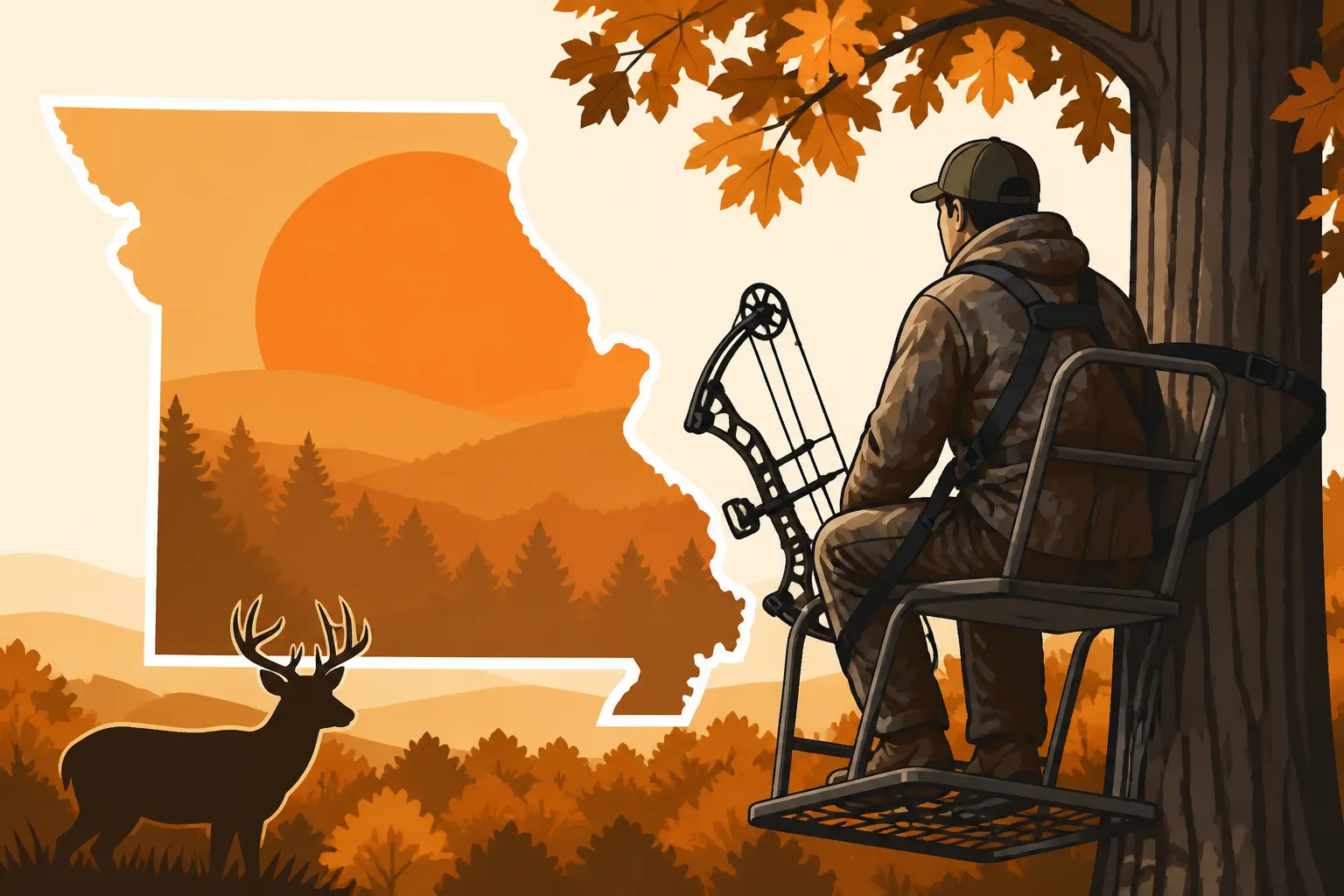
Hang-on stands are arguably the most versatile option for hardwood timber. They consist of a platform that attaches directly to the tree, requiring separate climbing sticks or a climbing aid to reach your desired height. Their biggest advantage is their adaptability; you can hang them in almost any straight tree that can support your weight, regardless of its diameter, and they work exceptionally well in crooked or branched trees where other stands simply won't fit. This flexibility is fantastic for those gnarly old oaks or shagbark hickories often found in Missouri. They're also relatively lightweight, making them ideal for carrying deep into public land. However, they require more physical exertion to set up each time, especially if you’re using multiple Climbing Sticks for Missouri Hardwoods.
Climber stands are popular for their self-contained design. They consist of two sections – a seat and a platform – that you "walk" up the tree. Climbers are fast, efficient, and quiet once mastered, making them great for run-and-gun tactics. The catch? They require a relatively straight, limb-free trunk from the ground all the way to your desired height. This limits their use in many of Missouri’s hardwoods, especially older trees with low-hanging branches or those with significant leans. They excel on the straighter trunks of pines or younger, straighter oaks, but aren't always the best choice for dense, mature hardwood stands. For those perfectly straight trees, however, they are incredibly efficient, as detailed in our guide on Climber Stands on Straight Trunks.
Ladder stands are fixed-position stands with a built-in ladder, making them the easiest and safest to access once installed. They are stable and comfortable, often featuring larger platforms and seats. The downside is their bulk and weight, making them best suited for private land where you can leave them up all season and don't have to carry them far. They also require a relatively straight tree and can be difficult to set up alone. For hunters who value comfort and easy access, especially on private property, they can be an excellent choice.
Many mobile hunters are also turning to saddle hunting systems. These involve a lightweight harness-like saddle worn by the hunter, combined with climbing sticks or other aids. Saddles allow for 360-degree shooting around the tree, provide excellent concealment by allowing the hunter to move with the tree, and are incredibly packable. They offer a unique blend of mobility and adaptability that is gaining popularity among those hunting pressured areas or deep in the Ozarks, providing a great alternative for Saddle Hunting in Missouri Oaks.
Safety Harnesses and Best Practices
Let me be absolutely clear: if you hunt from a treestand without a full-body safety harness, you are taking an unacceptable risk. Every year, hunters are seriously injured or killed from falls out of treestands. It's not a matter of "if," but "when" an accident might happen. Modern full-body harnesses are lightweight, comfortable, and easy to use; there's simply no excuse not to wear one.
Always wear your full-body harness from the moment your feet leave the ground until they return. This means attaching your harness tether to the tree before you even begin climbing, using a safety line or "lifeline" that extends from the base of the tree to above your stand. This ensures you are always connected to the tree, even when transitioning from climbing sticks to your stand platform. For a deep dive into this crucial gear, check out our guide on Safety Harnesses and Lifelines.
Before each use, inspect your harness, straps, and stand for any signs of wear, fraying, or damage. Never use old, brittle straps or ropes. If you find any issues, replace them immediately. Practice using your harness and its tether at a low height to understand how it feels and how to recover if you were to fall. It's also a smart idea to carry a small signaling device, like a whistle or cell phone, and let someone know exactly where you are hunting and when you expect to return. The GoHunt app, in addition to its mapping features, often integrates safety reminders and allows for sharing your location with trusted contacts, which can be a valuable tool for solo hunters. Hunt smart, hunt safe, and make it home to tell your hunting stories.
Treestand Comparison Chart
To help visualize the best uses for different treestand types in Missouri's hardwood timber, here's a quick comparison:
| Treestand Type | Key Characteristics | Best Use Cases in Hardwoods | Pros | Cons |
|---|---|---|---|---|
| Hang-on Stand | Platform and seat attach to tree; requires separate climbing sticks. | Versatile for various tree diameters, crooked trees, deep woods. | Highly adaptable, lightweight for packing, great for pressured areas. | Requires climbing sticks, more setup time per hunt, typically less comfortable than ladder stands. |
| Climber Stand | Two-piece unit "climbs" the tree. | Straight, limb-free trees; quick and quiet setup for mobile hunters. | Fast to deploy, self-contained, excellent for quick moves. | Limited to specific tree types (straight, limbless), can be noisy if not used correctly. |
| Ladder Stand | Fixed platform with built-in ladder. | Private land, permanent setups, easily accessible locations. | Very stable, comfortable, easy access once installed. | Bulky, heavy, difficult to move, limited to trees near accessible points. |
| Saddle Hunting | Harness-like system worn by hunter; uses climbing sticks. | Mobile, stealthy, 360-degree shooting, deep woods, pressured areas. | Extremely versatile, lightweight, ultimate concealment, packable. | Learning curve, less comfortable for long sits for some, requires practice. |
Disclaimer
Hunting is an inherently dangerous activity. The information provided in this guide is for informational purposes only and should not replace proper training, safety precautions, or local regulations. Always follow all Missouri Department of Conservation (MDC) rules and regulations. Consult your treestand and harness manufacturer's instructions, and always practice safe climbing techniques. The author and publisher are not responsible for accidents or injuries that may occur.