Reading an Ozark Hollow for Deer Movement
Hunting the steep, rugged, and often unforgiving Ozark hollows can feel like trying to solve a puzzle with half the pieces missing. Many hunters get frustrated, walking for miles only to find old sign or spook deer they never even saw. This comprehensive guide is here to unravel the mysteries of these unique terrains, showing you how to read the landscape, interpret deer movement, and set yourself up for success where others just get lost.
Understanding the Ozark Landscape and its Challenges
Missouri’s Ozark region is a beast all its own. It's not the rolling farm country of the north, nor the flat river bottoms where deer move predictably from bedding to feed. Here, the land is a jumbled mosaic of steep bluffs, deep ravines, rocky creeks, and dense timber, making it both incredibly challenging and immensely rewarding for the dedicated deer hunter.
The Unique Terrain of Missouri's Ozarks
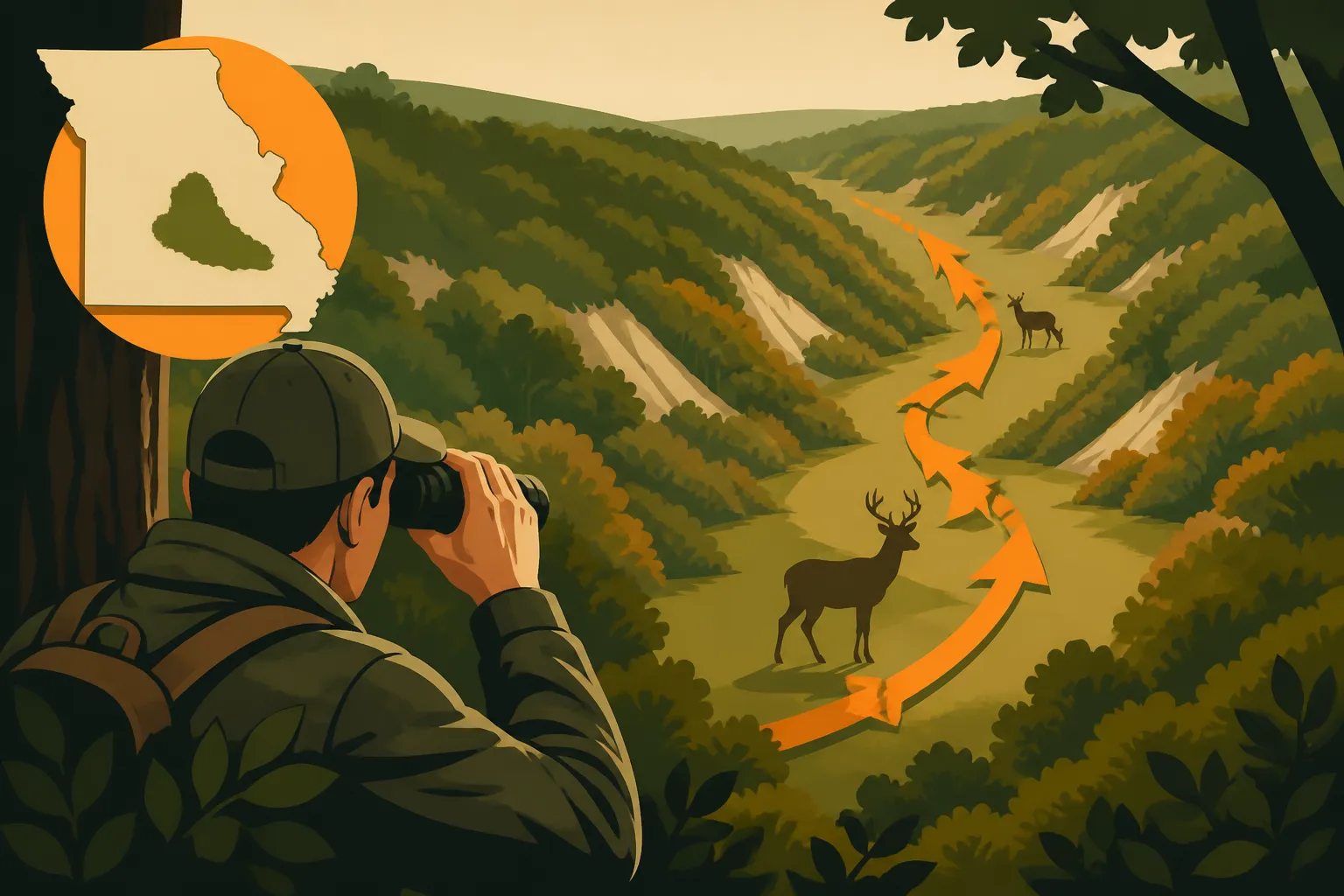
When you step into an Ozark hollow, you're immediately struck by the sheer wildness of it all. The ground beneath your feet is often a mix of loose rock, slippery leaves, and exposed limestone, making quiet movement a real art form. Timber stands can vary dramatically, from mature oak and hickory forests on the ridges to dense cedar thickets and tangled briar patches clinging to the slopes. Water is also a constant presence, with numerous springs, seeps, and small creeks carving their way through the drainages. This isn't flat ground; it's a three-dimensional chessboard where every contour and cut provides cover or a travel advantage for a whitetail. It’s easy to feel overwhelmed, like you're just wandering aimlessly, but understanding these fundamental characteristics is the first step to unlocking their secrets.
Why Hollows are Both Difficult and Rewarding
Let's be honest, hunting an Ozark hollow can be downright frustrating. You can bust your lungs climbing a steep hillside, only to find the deer were on the other side, or worse, you hear them crashing out ahead of you, never getting a shot. The thick cover that provides sanctuary for deer also hides them incredibly well, and the swirling winds can make scent control a nightmare. It takes a certain grit and a whole lot of patience. However, this same difficulty is precisely what makes them so rewarding. Hollows often act as natural sanctuaries for older, wiser bucks, especially once hunting pressure starts to mount during the firearms portions of the season. Deer that are used to being bumped around on more accessible public ground will often seek refuge in these rugged, remote areas. If you can learn to read these hollows, you’re often finding deer that others just can’t touch. They offer unparalleled opportunities for a truly challenging and fulfilling hunt, often leading to encounters with mature deer that have learned to thrive in this tough environment.
Key Elements to Look for in an Ozark Hollow
Success in Ozark hollows hinges on your ability to decipher the subtle clues the land provides. You’re essentially learning to speak the language of the landscape, translating hills and drainages into deer highways and bedrooms.
Topography is Your Map
Think of the topography not just as a pretty picture on a map, but as a blueprint for deer movement. Every dip, rise, and flat spot influences how deer navigate the terrain.
- Benches and Terraces: These are probably one of the most crucial features to identify. Benches are relatively flat strips of land that run horizontally along a hillside, breaking up an otherwise steep slope. Deer absolutely love to travel these benches. They offer easier walking than traversing directly up or down a steep grade, and often provide better visibility and scenting conditions. They’ll also bed on these benches, especially those that offer a good vantage point down into the hollow or out across a ridge. If you can find a subtle bench, especially one with good cover, you've likely found a major travel corridor or a bedding area. Knowing Setting Up on a Bench Above a Creek is vital for ambushing deer moving along these pathways.
- Ridge Saddles and Necks: While not strictly in a hollow, saddles and necks that connect ridges are often the easiest way for deer to cross from one major drainage system to another. Hollows frequently funnel up into these saddles. A saddle is a low spot in a ridge, like a dip between two higher points. Deer will almost always take the path of least resistance when crossing terrain, and a saddle provides just that. These become major pinch points, especially during the rut when bucks are cruising for does. Learning Hanging a Stand on a Ridge Saddle can be a game-changer when bucks are actively searching.
- Points and Spurs: These are extensions of ridges that jut down into the hollow. Deer use these points for observation, bedding, and to gain elevation quickly. Often, a point will have a natural "lip" or bench on its side where a deer can lie down and survey the hollow below while being protected from above. They can also serve as escape routes, allowing deer to quickly drop into the hollow or traverse back up to the main ridge system.
- Creek Bottoms and Drainage Floors: The very bottom of an Ozark hollow often contains a creek or at least a seasonal drainage. These areas can be incredibly thick with cover – thorny briars, dense shrubs, and thickets of young trees. While not always a primary travel route due to the difficulty of navigating, they are crucial escape routes and thermal cover during extreme weather. Deer will move through here, especially when transitioning between bedding areas on opposing slopes or accessing water.
- GoHunt and Topographic Overlays: This is where a robust mapping tool like GoHunt truly shines. Before you ever set foot on the ground, use its topographic overlays to meticulously study the contours. Zoom in and look for those subtle changes in elevation, the benches, the saddles, and the points that might not be obvious on a basic map. You can mark potential travel routes and bedding areas, saving you countless hours of unproductive walking. It allows you to "see" the hollow in three dimensions, predicting deer movement patterns before you even arrive.
Water Sources and Travel Corridors
Water is life, and in the Ozarks, it's also a major draw for deer. Understanding how deer utilize water sources is key.
- Springs and Seeps: Unlike ponds or rivers, springs and seeps are often found high up on a hillside or tucked away in a small ravine, providing a constant, reliable water source. Deer will regularly visit these, especially during dry periods or when they're traveling. Look for heavily used trails leading to and from these seeps, and don't underestimate their importance, particularly in the early archery season when temperatures are higher. A fresh, clean spring can act like a magnet for deer.
- Creek Crossings: While deer may not travel extensively in the main creek bed, they will certainly cross them. Identify narrow spots, fallen logs, or areas with less rocky bottoms that make for easy crossing points. These pinch points become major funnels, especially if they connect two desirable areas like a bedding thicket on one side and a food source on the other.
- Defining Trails: Deer trails in Ozark hollows can be subtle. They might not be wide, beaten paths like you see in agricultural fields. Instead, look for faint depressions in the leaves, broken twigs, or scuffed earth. Follow these trails – they will almost always lead you to a water source, a bedding area, or a natural funnel in the terrain. Remember, deer will always opt for the path of least resistance unless pressured.
Food Sources Throughout the Season
Food is another primary driver of deer movement, and Ozark hollows offer a diverse menu that changes with the seasons.
- Oak Varieties: Missouri's Ozarks are dominated by oak forests, making acorns a critical fall food source. White oaks drop their acorns earlier (late August to September) and are preferred by deer due to lower tannin content. Red oaks drop later (October to November) and provide a consistent food source deeper into winter. Identify different oak species and look for fresh cuttings under them. This indicates where deer are actively feeding. You can even find clues from other animals like Squirrel Hunting in Hickories, as squirrels will also be feasting on acorns, providing visual cues to mast production.
- Persimmon and Other Soft Mast: Don't overlook soft mast trees like persimmon, wild grape, or even hackberry. Persimmon trees, in particular, are common in the Ozarks and when their fruits drop in late fall, they are an absolute candy treat for deer. Locate these trees and look for fresh fruit on the ground and accompanying deer tracks.
- Browse and Forbs: Even without a heavy mast crop, deer constantly browse on various shrubs, young trees, and forbs (broad-leafed plants). Look for nipped branches on saplings, especially cedar, greenbrier, and honeysuckle. These are year-round food sources and indicate areas where deer spend a lot of time just passively feeding as they move.
- Agricultural Edges: While hollows are often remote, some may border small fields, old food plots, or even abandoned homesteads where deer can access agricultural crops. If a hollow opens up into a field edge, deer will use the hollow's cover to access these food sources under the cover of darkness. This creates predictable movement patterns from bed to feed.
Interpreting Deer Sign and Movement Patterns
Reading the physical sign deer leave behind is like reading a secret journal. It tells you where they've been, where they're going, and what they're doing. But in the Ozarks, you need to be particularly discerning about fresh sign.
Rubs, Scrapes, and Trails
Not all sign is created equal. A rub from last year might look impressive, but it won't help you harvest a deer this season.
- Rubs: Bucks rub their antlers on trees for several reasons: to mark territory, to remove velvet, and as a display of dominance. Fresh rubs will have splintered wood and exposed cambium (the living layer under the bark) that is light in color. Older rubs will be darker and weathered. Look for strings of rubs, known as rub lines, which indicate a buck's travel route, often connecting a bedding area to a feeding area or along a dominant ridge.
- Scrapes: Scrapes are patches of bare earth where a buck has pawed away the leaves, often under an overhanging branch (the "licking branch"). Bucks will urinate in the scrape and rub their preorbital glands on the licking branch, depositing scent. Fresh scrapes will have moist earth and a distinct smell, with torn leaves around the edges. Like rubs, look for lines of scrapes, or "scrape lines," especially near natural funnels or along benches. These are hotbeds of activity during the rut. While you might typically associate these with Scrape Lines Along a Logging Road, they are just as prevalent along game trails in the quiet hollows.
- Trails: As mentioned before, trails in the Ozarks can be subtle. Focus on identifying active trails by looking for fresh tracks, disturbed leaves, and broken twigs. Pay close attention to trails that intersect, merge, or lead to specific features like water sources, dense bedding thickets, or escape routes. These intersections are prime ambush points.
Wind and Thermals: Your Invisible Guides
This is arguably the most critical factor when hunting Ozark hollows. The hilly terrain creates unpredictable air currents that can foil even the most meticulous scent control efforts. Understanding Wind and Thermals in Ozark Hills is essential.
- Daytime Thermals (Rising): As the sun warms the earth, the air in the hollows begins to warm and rise. This means that during the morning hours, your scent will generally be carried up the hillside and out of the hollow. If you're hunting an early morning stand low in a hollow, deer on the slopes above you might catch your scent.
- Nighttime/Evening Thermals (Falling): As the sun sets and the air cools, the denser, cooler air sinks down into the hollows. This means your scent will generally be carried down the hillside and into the bottom of the hollow. If you're on an evening stand on a ridge top, your scent could be dropping directly into the hollow below.
- Swirling Winds: Ozark hollows are notorious for swirling winds, especially on windy days. The steep contours can deflect and channel wind in unpredictable ways, creating eddies and unpredictable gusts. Always assume the wind will swirl. Carry a wind checker (a small bottle of powder or milkweed down) and use it constantly, not just when you get to your stand. The wind direction at your stand might be completely different just 50 yards away.
- Planning Entry/Exit: Always plan your entry and exit routes based on prevailing winds and anticipated thermal shifts. Try to approach your stand in a way that your scent is carried away from known bedding or feeding areas. This might mean taking a longer, more circuitous route.
How Deer Use Hollows for Bedding and Sanctuary
Deer are masters of using the terrain to their advantage, and Ozark hollows offer prime real estate for bedding and escaping pressure.
- Thick Cover and Elevation: Deer will often bed on benches or points along the side of a hollow, particularly those with dense cedar thickets, brush piles, or tangled briars. They prefer locations that offer a good view of their back trail and down into the hollow, allowing them to see or hear danger approaching from below. The thick cover provides security from predators and protection from the elements.
- Thermal Regulation: During hot early seasons, deer might bed lower in the hollow near cool springs or dense shade. In colder late seasons, they might seek sun-drenched south-facing slopes higher up to catch warmth. They use the terrain and cover to regulate their body temperature.
- Pressure Sanctuaries: When hunting pressure increases, especially during firearms seasons, deer will retreat into the deepest, thickest, and most inaccessible parts of the hollows. These become their ultimate sanctuaries. Hunters who are willing to put in the effort to penetrate these areas, often by still-hunting or carefully placed stands, can find unpressured deer.
Strategies for Hunting an Ozark Hollow Effectively
Now that you know what to look for, it's time to put it all together into a practical hunting strategy. Hunting Ozark hollows requires careful planning, stealth, and adapting to the dynamic environment.
Entry and Exit Routes
Your approach to and departure from your hunting area can make or break your hunt, especially in the tight confines of a hollow.
- Stealth is Paramount: Every crunch of a leaf, every rock kicked, resonates loudly in a hollow. Move slowly, deliberately, and quietly. Pick up your feet, avoid dragging them, and choose your steps carefully. Consider wearing softer-soled boots.
- Play the Wind and Thermals: As discussed, always factor in the wind and thermal currents for both your entry and exit. Ideally, your route should keep your scent blowing away from any potential deer bedding or travel areas. This might mean starting your hunt well before daylight to allow thermals to settle before you get to your stand, or waiting until mid-morning for rising thermals to carry your scent upward if you're hunting lower in a hollow.
- Use Natural Features for Cover: Utilize ridges, creek beds (if dry and quiet), and dense vegetation to conceal your movement. Walk with a purpose, but remain observant. Sometimes the best entry might be a long, circuitous route that avoids known deer hotspots until you're close to your stand. Remember, spooking a deer on your way in can ruin your entire hunt.
Stand Placement and Ground Blind Considerations
Choosing the right location for your stand or blind is crucial for ambushing deer moving through a hollow.
- Treestands on Benches and Points: Look for sturdy trees on those critical benches or points that offer a clear shooting lane down into the hollow or along a travel corridor. Aim to be above the deer's line of sight and upwind, if possible. Consider Climbing Sticks for Shagbark Hickory or other portable climbing aids if the trees are suitable. Often, you'll need to be higher than you might think to clear the understory and gain a good view.
- Ground Blinds in Thick Cover: If the terrain makes a treestand impossible, or you prefer hunting from the ground, a ground blind can be incredibly effective. The thick cover found in many hollows provides natural concealment. Place your blind in a natural funnel, near a water source, or overlooking a major trail. Remember to brush it in thoroughly to break up its outline. While you might think of Brushing In a Blind on a Field Edge, the same principles apply within a hollow – use natural materials to make it disappear. Be mindful of the wind direction and thermals, as your scent cone will be lower to the ground. Using a mapping tool like GoHunt can help identify ideal blind locations by pinpointing areas with good cover near predicted deer movement.
- Safety First: When hanging treestands in steep terrain, safety is paramount. Always use a safety harness and a lifeline. The ground can be uneven and rocky, making falls more dangerous. Consider a saddle hunting setup, which can be highly adaptable to varied Ozark timber and provides excellent concealment and a 360-degree shooting radius.
Still-Hunting and Scouting Techniques
Sometimes, sitting still isn't the most effective strategy in an Ozark hollow. Still-hunting, a slow and methodical approach, can be incredibly productive.
- Slow and Deliberate: Still-hunting means moving at a snail's pace, often taking only a few steps every few minutes. Stop frequently, scan the woods ahead, and use your binoculars to pick apart potential cover. Look for horizontal lines (a deer's back) in a vertical world (trees). This is where Still-Hunting a Missouri Ozark Hollow really pays off.
- Utilize the Wind: Always still-hunt into the wind or with a quartering wind to your advantage. This helps keep your scent from blowing ahead of you and allows you to detect deer by scent if they're close.
- Walk the Contours: Instead of busting straight up or down hills, try walking along benches or just below ridges. This makes for quieter movement and often puts you on established deer travel routes.
- Pre-Season Scouting with Technology: Before the season, use GoHunt or a similar mapping application to identify potential bedding areas, funnels, and food sources. Mark these waypoints, then physically go in and scout. Look for fresh sign, identify water sources, and pinpoint suitable stand locations. Using tools like Scouting With the Missouri Conservation Atlas can provide additional context and reveal access points to public land that might be less pressured. The more intel you gather beforehand, the less "blind" hunting you'll do.
| Feature | What to Look For | Deer Behavior Indication | Best Hunting Strategy |
|---|---|---|---|
| Benches | Flat strips along steep hillsides | Major travel corridors, bedding sites, escape routes | Treestand/saddle on bench, overlooking trails on bench |
| Saddles | Low dips in ridges | Primary crossing points between hollows/ridges | Treestand on the saddle or approach trails, especially during rut |
| Water Sources | Springs, seeps, creek crossings | Frequent visits for hydration, especially in warm weather | Stand near trails leading to water, ambush crossing points |
| Oak/Persimmon Trees | Acorn/fruit cuttings, fresh drops | Active feeding areas, concentrated deer activity in fall | Stand overlooking clusters of productive trees |
| Thick Cover | Cedar thickets, briar patches | Bedding sanctuaries, escape cover, security from pressure | Still-hunt slowly through/around, set blinds on edges |
| Fresh Tracks/Rubs/Scrapes | Clear prints, light wood, moist earth | Recent deer activity, indicates active travel/rutting behavior | Focus efforts in areas with abundant, fresh sign |
| Wind & Thermals | Swirling air currents, predictable shifts | Dictates deer movement & detection, impacts hunter approach | Hunt with wind in face/quartering, plan routes around thermals |
Hunting the Missouri Ozarks, particularly its challenging hollows, is a journey of continuous learning and adaptation. It demands patience, keen observation, and a willingness to embrace the wild, rugged nature of the land. It’s not always easy, and sometimes you’ll get humbled, but the satisfaction of successfully Deer Hunting the Missouri Ozarks by truly understanding a hollow is immense. Take your time, study the land, learn from every outing, and you’ll find that these formidable hollows offer some of the most rewarding deer hunting experiences Missouri has to offer.
Disclaimer
Always consult the latest Missouri Department of Conservation (MDC) regulations before heading afield. Hunting laws and regulations can change, and it is the hunter's responsibility to stay informed and compliant. This guide is for informational purposes only and should not be considered a substitute for official MDC publications or hunter education courses.