Fixed Versus Mechanical Broadheads
Choosing the right broadhead for your archery setup can feel like navigating a maze, and when you’re hunting Missouri whitetails, those choices feel even more critical. There's nothing worse than making a perfect shot, only to wonder if your broadhead did its job. This guide will cut through the noise, breaking down the fundamental differences between fixed-blade and mechanical broadheads to help you decide what's best for your bow and your next hunt in the Show-Me State.
The Fundamental Differences Between Broadhead Types
When you're standing in the aisle of your local pro shop or scrolling through options online, the sheer variety of broadheads can be overwhelming. But at their core, they really boil down to two main categories: fixed-blade and mechanical. Understanding what sets them apart is the first step in making an informed decision for your Missouri deer hunt.
Fixed-Blade Broadheads: Simple, Stout, and True
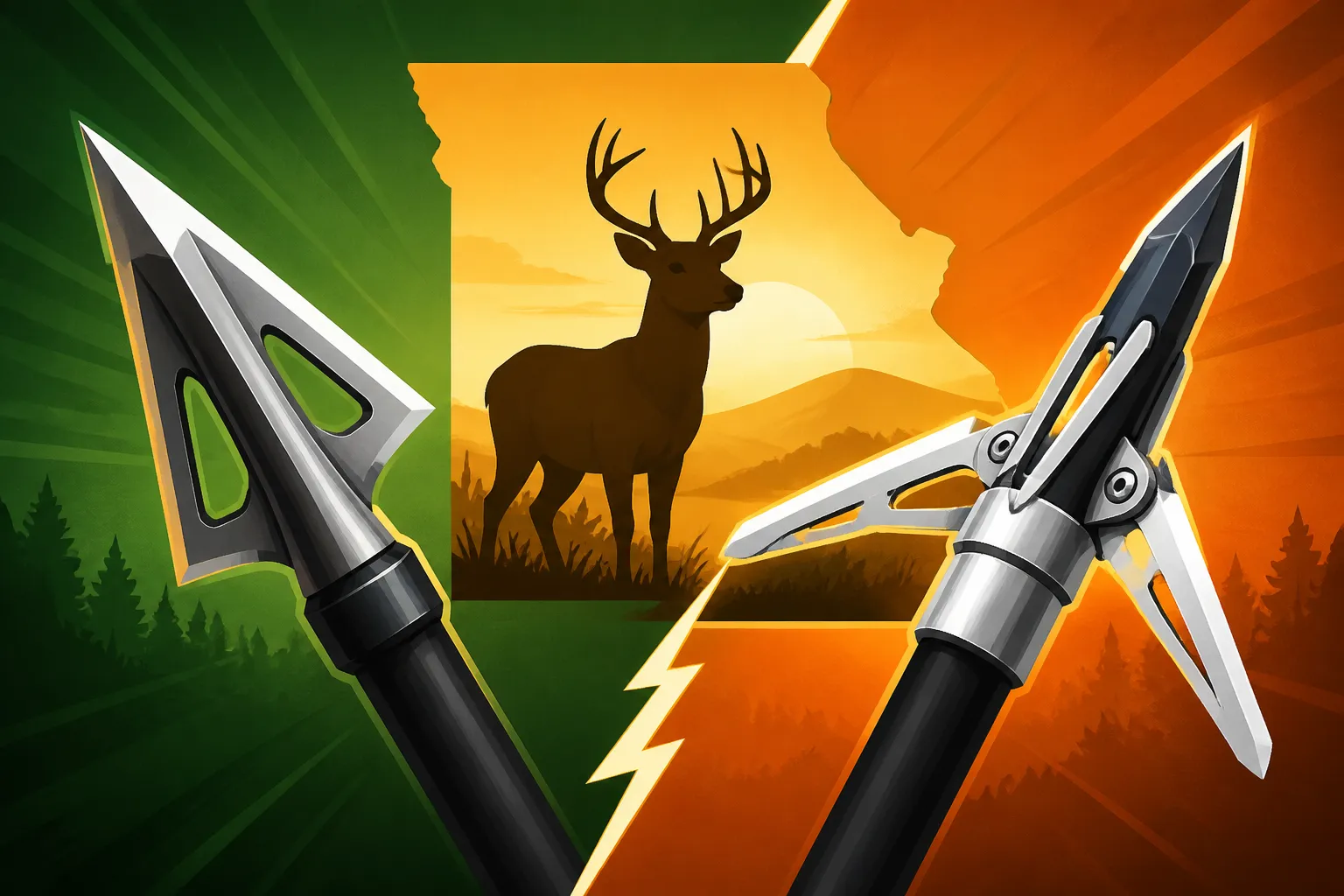
Fixed-blade broadheads are, as the name suggests, built with blades that are rigidly attached to the ferrule (the body of the broadhead). There are no moving parts; what you see is what you get. These have been the workhorses of bowhunting for generations, and for good reason. They're typically known for their robust construction, often featuring two, three, or even four sharpened blades that are fixed in position. This simple design means there's less to go wrong, which is a huge comfort when you're perched in a Treestand Setups in Hardwood Timber on a crisp November morning.
The primary advantage of a fixed-blade broadhead lies in its reliability and penetration. Because the blades don't have to deploy, all of your arrow's kinetic energy is concentrated directly into driving those blades through the animal. This makes them incredibly effective at punching through tough hide, muscle, and even bone, which is a significant factor when you're after a mature Missouri buck. Their sturdy design also means they're less prone to deflection if you happen to clip a small twig or brush on the way to your target—a common occurrence in the dense timber and thickets we often hunt here. While their cutting diameter might appear smaller than some mechanicals when looking at the ferrule, many hunters prefer the deep, consistent penetration fixed blades offer, believing it contributes to a more ethical and quicker harvest. They're also simple to clean and resharpen if you practice with them, making them a cost-effective option in the long run.
However, fixed-blade broadheads aren't without their quirks. Their biggest challenge, for many archers, is tuning. Because the blades present more surface area and can act like miniature fletchings, they can interact with the air differently than your field points. This often means that your bow needs to be perfectly tuned for fixed-blade accuracy. If your bow isn't shooting bullet holes through paper with field points, it's going to be even more noticeable with fixed blades. This can lead to frustration and a lot of extra practice to get them flying true. They can also be more susceptible to wind drift on longer shots compared to their mechanical counterparts. For some hunters, especially those with bows that are difficult to tune or who prefer a flatter trajectory, this can be a real consideration, particularly if you're hunting in more open areas like field edges where longer shots are possible.
Mechanical Broadheads: Expanding for Maximum Damage
Mechanical broadheads, often called "expandable" broadheads, feature blades that remain tucked away during flight and then deploy upon impact. This design typically results in a much larger cutting diameter once deployed compared to what you see on a fixed-blade. The idea is to get field-point accuracy, or very close to it, during flight and then deliver maximum tissue damage and a wide wound channel when the arrow hits its mark. This combination sounds like the best of both worlds to many hunters, and for certain scenarios, it absolutely is.
The biggest draw of mechanical broadheads is their reputation for "field-point accuracy." Because the blades are folded back, they present a much smaller profile during flight, reducing air resistance and theoretically making them fly more like the practice points you've been shooting all year. This can be a huge confidence booster, especially for newer archers or those who struggle with fixed-blade tuning. When you're trying to hit a tight window through limbs from a Ground Blinds on Crop Field Edges, knowing your arrow is flying exactly where your pins are aimed is invaluable. Once deployed, these broadheads can create massive wound channels, sometimes two or even three inches wide. This can lead to profuse blood trails, making recovery easier, especially if you're hunting during Field Dressing and Cooling in Early-Season Heat when tracking can be challenging. Many hunters find that the increased cutting surface helps ensure a good blood trail, even if the shot placement isn't absolutely perfect.
On the flip side, mechanical broadheads introduce a layer of complexity with their moving parts. The main concern for many is the potential for deployment failure. While modern mechanicals are incredibly reliable, there's always a slight chance that a blade might not open fully, or at all, due to impact angle, low kinetic energy, or hitting very tough material. This can drastically reduce penetration. Speaking of penetration, while they create a wide wound channel, they can sometimes struggle with deep penetration on hard bone, like a shoulder blade, especially if your bow's Bow Draw Weight for Missouri Whitetails is on the lighter side. The energy required to deploy the blades and then push a wide cutting surface through an animal can be significant. Some hunters also worry about deflection if the broadhead hits an antler or heavy bone at an angle, potentially causing it to glance off rather than penetrate cleanly. It's a trade-off: the potential for a larger wound channel versus the added mechanical complexity and potential for reduced penetration on challenging shots.
Tuning Your Bow for Optimal Broadhead Performance
Regardless of whether you lean towards fixed or mechanical broadheads, one truth remains: your bow must be properly tuned. A perfectly tuned bow will send an arrow flying consistently and accurately, which is the foundation of ethical hunting. Without it, even the most expensive, highly-rated broadhead won't perform as intended.
Making Fixed-Blades Fly Like Field Points
Achieving true flight with fixed-blade broadheads can sometimes feel like a dark art, but it's really just a matter of precision and patience. The goal is for your fixed-blade arrow to impact the same spot as your field-point arrow at all reasonable hunting distances. If your field points are flying perfectly but your fixed blades are impacting elsewhere, it means your bow needs further tuning. One of the most common methods is paper tuning. You shoot an arrow through a piece of paper a few feet from your bow, and the tear in the paper tells you how your arrow is leaving the string. Adjustments to your rest, nock point, or cam timing can often correct bad tears.
Beyond paper tuning, walk-back tuning is another excellent method. You shoot an arrow at a vertical line on a target at 10, 20, 30, and 40 yards (or further). If your arrow impacts consistently to one side of the line as you walk back, it indicates a horizontal nock travel issue that needs addressing with your rest. Vertical discrepancies might point to a nock point issue. Don't underestimate the role of your fletching, either. Certain fletching styles or helical amounts can help stabilize a fixed-blade broadhead, particularly with larger blades. It really comes down to finding that sweet spot where the arrow is leaving your bow perfectly straight, allowing the fixed blades to guide the arrow without imparting any unwanted steering. Investing the time here before Bowhunting Missouri's Four-Month Archery Season truly opens is crucial. A dedicated range session to get your fixed blades grouping with your field points is time well spent, giving you immense confidence when that big buck walks into range.
The "Field Point Accuracy" of Mechanicals
Mechanical broadheads are often marketed with the promise of "field-point accuracy," and for many setups, this holds true. Because their blades are tucked away during flight, they present a minimal profile, reducing the aerodynamic differences between them and a standard field point. This means that if your bow is already well-tuned for field points, you'll likely find that mechanical broadheads fly very similarly, requiring little to no additional tuning. This is a huge advantage for hunters who might not have the time or expertise for intricate bow tuning, or for those who simply want a consistent point of impact across their practice and hunting arrows. The reduced air resistance also makes them less susceptible to wind drift, which can be a factor when hunting open terrain like a Hunting a Missouri Fencerow Between Fields.
However, even with mechanicals, neglecting proper bow tuning is a mistake. While they are more forgiving, a poorly tuned bow can still cause erratic flight, especially with heavier or lighter mechanicals. It’s always a good idea to shoot a few practice mechanical broadheads to confirm their flight path. Don't just assume they'll fly perfectly because the packaging says so. Check their flight at various distances, simulating the shots you might take. Pay attention to how they group, especially if you're considering shots at the outer limits of your comfortable range. For instance, if you're planning to hunt Hunting Standing Corn Before Harvest where deer might be slightly further out from your blind, confirming that your mechanicals maintain their accuracy at 40 or 50 yards is essential. Some broadheads might also perform differently depending on your arrow speed and length, so a quick check with your actual setup is always the smartest move.
Choosing the Right Broadhead for Your Missouri Hunt
Deciding between a fixed-blade and a mechanical broadhead isn't just about what looks cool or what your buddy uses. It's about matching your equipment, your hunting style, and the specific conditions you'll face in the Missouri woods and fields. Think about the terrain, the shots you expect, and even your bow's capabilities.
When Fixed Blades Shine in Missouri Timber
For many veteran Missouri bowhunters, fixed-blade broadheads are the default choice, especially when hunting the state's rugged timber and dense cover. Imagine yourself tucked into a treestand deep in the Ozarks, where the shots are often close, and the deer might be moving through thick brush. In these scenarios, the robust construction and reliable penetration of a fixed-blade broadhead become invaluable. If your arrow encounters a rib or the scapula of a mature buck, that rigid design is going to maintain its integrity and drive through, maximizing your chances of a clean pass-through. This is particularly important for larger-bodied Missouri bucks that can absorb a lot of punishment.
Furthermore, if you're taking high-angle shots from a treestand, or anticipate shooting through a tight lane with the potential for clipping small branches, the inherent stability and strength of a fixed blade offers a margin of error. There are no moving parts to get hung up or fail to deploy. This simplicity translates to peace of mind, allowing you to focus purely on executing the shot when a deer steps out. For hunters who prioritize deep penetration, maximum kinetic energy transfer, and bulletproof reliability in challenging environments, the fixed-blade broadhead is often the clear winner. Utilizing tools like the GoHunt app to scout public land like sections of Mark Twain National Forest Hunting can help identify areas of thick timber where a fixed blade's penetration advantage might be preferred.
Mechanical Advantages for Open Country and Longer Shots
While fixed blades excel in timber, mechanical broadheads truly come into their own when you're hunting more open country, where longer shots are a real possibility. Picture yourself in a Ground Blinds on Crop Field Edges watching a food plot or a sprawling soybean field in northern Missouri. Here, deer might hang up at 30, 40, or even 50 yards. The "field-point accuracy" of mechanical broadheads means your arrow is likely to fly a flatter, more predictable trajectory, making those extended shots more manageable and increasing your confidence. The reduced drag means less wind drift, which is a major factor when you're shooting across a wide-open expanse.
The massive cutting diameter that mechanicals deliver upon deployment also makes them highly effective in these situations. A wider wound channel significantly increases the likelihood of a strong blood trail, which is crucial for tracking a deer that might run a considerable distance across open fields. This is especially beneficial if you're Hunting a Timbered Draw in Row-Crop Country, where a deer might reach the thick timber quickly. However, it's vital to consider your bow's kinetic energy. If you have a lower draw weight, ensuring you choose a mechanical broadhead designed for lower energy bows is critical to ensure proper deployment and adequate penetration. Many manufacturers provide guidelines on minimum kinetic energy or draw weight for their mechanicals. Make sure your setup meets those requirements to ensure ethical performance. Another use for the GoHunt app is to analyze potential long-shot scenarios and plan your broadhead choice accordingly.
Practice, Confidence, and Ethical Considerations
At the end of the day, no piece of hunting gear can replace skill, practice, and a commitment to ethical hunting. Your broadhead is merely a tool, and its effectiveness is largely dependent on the hand that wields the bow and the mind that makes the shot.
The Critical Role of Practice and Familiarity
This cannot be stressed enough: shoot what you hunt with. Whether you choose fixed or mechanical, you must practice extensively with your chosen broadhead. Don't just sight in with field points and assume your broadheads will fly the same. Take your actual hunting arrows, screw on your hunting broadheads, and send them downrange. Practice from various distances, at different angles, and from simulated hunting positions—whether that's from a treestand or kneeling in a ground blind. If your Bow Sights for Timber Shots are dialed in for field points, confirm they are equally effective with your broadheads.
This practice builds an immense amount of confidence. When that moment of truth arrives during Hunting the Peak Rut Week in Missouri, you want to be thinking about the shot, not second-guessing your broadhead. Familiarity with your broadhead means you understand its flight characteristics, its nuances, and how it performs with your specific bow setup and Arrow Weight for Short Shots. It means you've seen it hit the target where you aimed, time and time again. This confidence translates into a steadier hand, a smoother release, and ultimately, a more accurate shot, which is the cornerstone of responsible bowhunting.
Ethical Harvest and Shot Placement
Ultimately, the choice between fixed and mechanical broadheads boils down to ensuring a swift, humane, and ethical harvest. No broadhead, regardless of its design or cutting diameter, can compensate for poor shot placement. Understanding deer anatomy, knowing where to aim for the vital organs (heart and lungs), and exercising patience to wait for the perfect shot opportunity are paramount. Your broadhead is designed to do its job after you've done yours.
The goal is to deliver a quick and decisive blow that incapacitates the animal rapidly. Both fixed-blade and mechanical broadheads are capable of achieving this when placed accurately into the vitals. The "best" broadhead is the one that you have the most confidence in, that flies true from your bow, and that you trust to perform reliably when it counts. Consider your personal setup, your hunting conditions, and your experience level. Test different options, see what works best for you, and commit to mastering that choice. Because when you're out there chasing Missouri whitetails, what truly matters is your commitment to ethical hunting and your ability to execute a clean, humane shot.
| Feature | Fixed-Blade Broadheads | Mechanical Broadheads |
|---|---|---|
| Blade Design | Blades are rigid and fixed in place. | Blades are tucked during flight, deploy on impact. |
| Flight Accuracy | Requires meticulous bow tuning; can be sensitive to wind. | Often provides "field-point accuracy"; less wind sensitive. |
| Penetration | Excellent, especially through bone; consistent energy transfer. | Can be excellent, but deployment consumes energy; may struggle on hard bone. |
| Cutting Diameter | Generally smaller (1" – 1.5"). | Generally larger (1.5" – 2" or more) once deployed. |
| Reliability | Extremely high due to no moving parts. | Very high with modern designs, but mechanical failure is a slight risk. |
| Durability | Often very robust and reusable with resharpening. | Can be more prone to damage if blades are exposed post-impact. |
| Ideal For | Thick timber, brushy shots, close range, heavy bone. | Open fields, longer shots, lighter draw weights (with proper energy). |
| Ease of Tuning | Can be challenging; requires dedicated practice. | Generally easier to tune; often flies like field points. |
Disclaimer
This article is for general informational purposes only and does not constitute professional advice. Laws, prices and regulations vary by location and change over time. Consult a qualified professional for guidance on your specific situation.