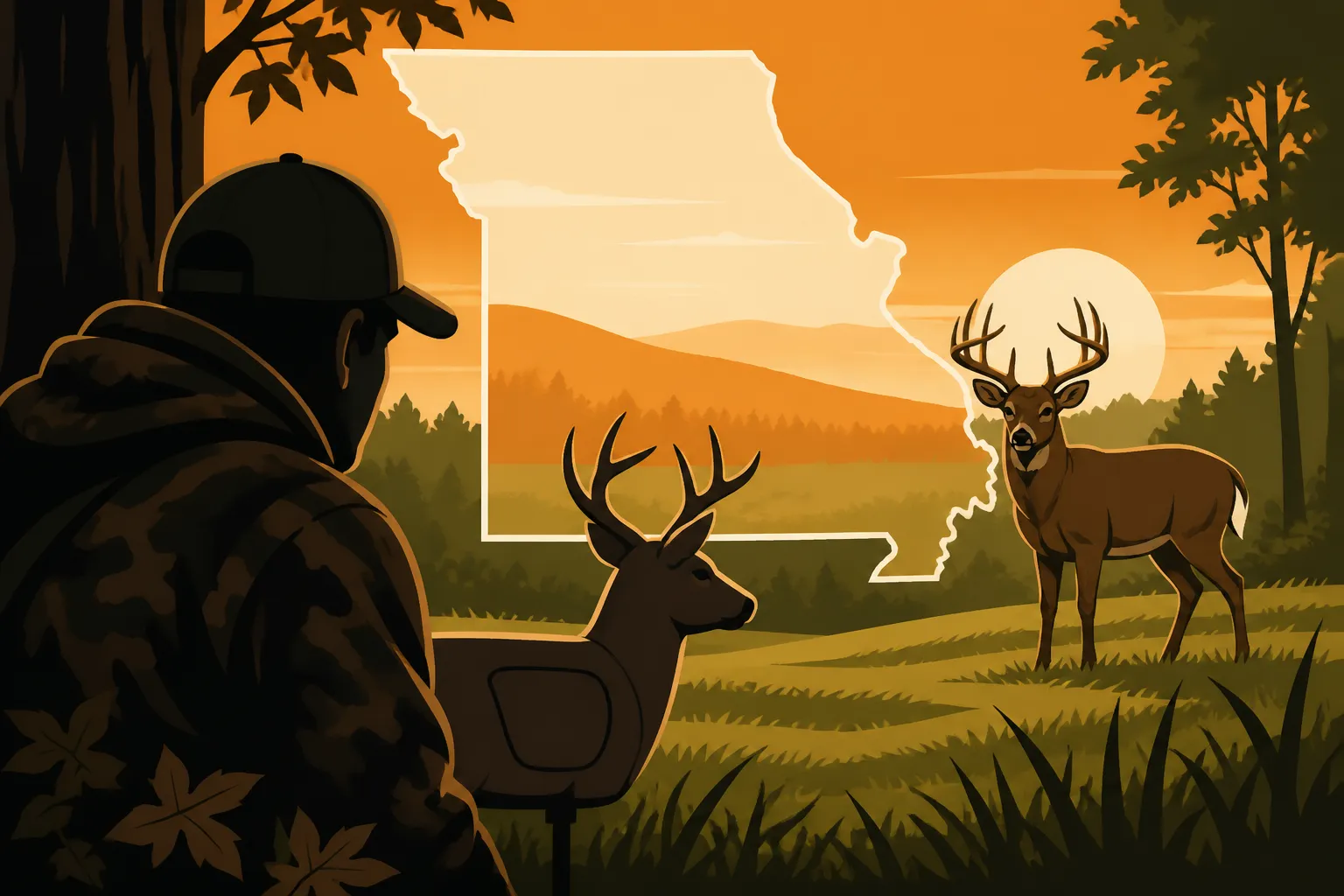
Decoying a North Missouri Buck
Hunting big North Missouri bucks often means watching them skirt your stand, just out of range. That feeling of a missed opportunity is tough. But what if you could pull them closer? This guide dives deep into decoying strategies, showing you how to use deer decoys effectively to bring those cagey whitetails into your shooting lane, even in the most pressured farm country.
Why Decoying Can Be a Game Changer for North Missouri Bucks
Let's be honest, those mature bucks up in North Missouri's rolling farm country are some of the smartest, most elusive animals you'll ever encounter. They've seen it all, and they've perfected the art of staying just out of bow range or using that timbered draw to disappear before you even knew they were there. It's incredibly frustrating when you've done your homework, found the sign, and still can't get that big boy to commit. This is precisely where a well-placed decoy can turn the tide.
Decoying isn't a magic bullet, and it definitely won't work every time, but when conditions are right, it can create a scenario that's simply electrifying. You're essentially tapping into the primal instincts of a whitetail buck, challenging his dominance or appealing to his desire for a hot doe. For a hunter, it’s about presenting a visual lure that says, "Come check me out," in a way that calling alone often can't accomplish in these open landscapes.
Tapping into Buck Aggression and Curiosity During the Rut
The absolute sweet spot for decoying in North Missouri is during the rut, especially as we get into the pre-rut and peak breeding phases. This is when bucks are less cautious and more driven by hormones. They're cruising, looking for does, and ready to challenge any perceived rival. A realistic buck decoy can trigger an aggressive response, making a buck march straight in to confront the intruder. It's a bold play, but for a seasoned hunter trying to bag a truly mature whitetail, it can be the difference-maker.
Think about it: a buck spots what looks like another buck encroaching on his territory or, worse, tending a doe he thinks should be his. That visual stimulus, combined with the right calling, can overcome some of his natural wariness. We've all seen those videos of bucks just plowing into decoys, and while that's the dream scenario, even a cautious approach to investigate is often enough to get a shot opportunity. This is a tactic that truly shines when Hunting the Peak Rut Week in Missouri.
Understanding When Decoys Might Not Work
While the rut is prime time, it’s important to be realistic. Decoys aren't a year-round solution, nor are they foolproof. During the early season, bucks are often still in their bachelor groups, focused on food, and less prone to confrontational behavior. A decoy might just spook them or be completely ignored. Later in the post-rut, bucks are exhausted and wary, focusing on recovery.
Another factor is pressure. If you're hunting heavily pressured public land, bucks might be more accustomed to seeing odd things or have negative associations with anything out of the ordinary. A mature buck that's been decoyed before and had a bad experience might give your setup a wide berth, circling way downwind or simply walking away. Knowing your specific hunting area and the local deer's demeanor is crucial. If the deer are acting unusually skittish, it might be a day to leave the decoy in the truck.
Choosing and Preparing Your Decoy Arsenal
So, you're ready to commit to decoying? Great! Now comes the decision of what kind of decoy to use and how to prepare it. There’s a surprising amount of nuance here, and getting it right can mean the difference between drawing a buck in and sending him running for the next county. From full-body models to simple silhouettes, each has its place, but realism and proper handling are paramount.
Buck Decoys Versus Doe Decoys
The choice between a buck or a doe decoy largely depends on the timing and the message you want to send.
- Buck Decoys: These are your go-to during the pre-rut and peak rut when bucks are aggressively seeking out rivals. An aggressive, horned buck decoy can often provoke a territorial response. Position it to look like it's challenging any approaching buck. Some hunters prefer a smaller, subordinate buck decoy, believing it appears less threatening and more likely to be approached by a dominant buck looking to assert his authority.
- Doe Decoys: A simple doe decoy, especially an estrus doe, can be incredibly effective throughout the rut. Bucks are constantly looking for does, and a lone doe standing in a field or along a timber edge is a beacon. A doe decoy can work well even during the early rut when bucks are still figuring things out, often drawing in curious young bucks or older bucks looking for easy companionship. Combining a doe decoy with some estrus scent can amplify its pulling power significantly.
Some hunters even use a combination: an estrus doe with a smaller buck trailing her, suggesting competition. This can be a very potent setup during the peak of the rut, though it requires more gear and careful positioning.
Scent Control and Realistic Appearance for Deer Decoys
This cannot be stressed enough: scent control is absolutely vital. Those North Missouri bucks have incredible noses, and if they catch a whiff of human odor near your decoy, the game is over. Treat your decoy like you would your hunting clothes. Wash it with scent-eliminating detergent, spray it down with scent killer before heading into the field, and handle it only with clean gloves. Store it in a scent-free bag or tote. The last thing you want is a mature buck circling downwind, catching your scent off the decoy, and blowing out of the area.
Beyond scent, realism matters. While some cheaper decoys can work, the more lifelike your decoy, the better. Look for models with realistic paint schemes, natural texture, and poses. Remove any shiny elements that might reflect sunlight unnaturally. Some hunters even go so far as to add natural elements like mud or dust to make it look even more authentic. When you're carrying it in, cover it up to avoid spooking any deer you might inadvertently pass.
Strategic Placement for North Missouri Success
Now that you've got your decoy ready, the "where" and "how" of placement are absolutely critical, especially in the unique landscape of Hunting North Missouri's Big-Buck Farm Country. This isn't dense timber hunting; you're often dealing with wide-open fields, timbered draws, and fencerows. Understanding the terrain and how deer move through it is key to making your decoy visible and approachable.
Positioning for Visibility and Approach
Your primary goal is to place the decoy where an approaching buck will see it easily, but also where he will be naturally funneled into a good shot angle.
- Visibility: In North Missouri, this often means along a field edge, at the mouth of a timbered draw, or near a prominent fencerow intersection. You want the decoy to be the first thing a cruising buck sees when he enters a new area or crests a rise. The exact distance from your stand depends on whether you're bowhunting or rifle hunting. For archery, 20-30 yards is ideal, making the decoy clearly visible but also ensuring any approaching buck is in bow range. For firearms, you can stretch that out to 50-70 yards.
- Shot Angle: Always position your decoy quartering away from your stand. This encourages an approaching buck to present a broadside or quartering-away shot as he approaches to investigate or challenge. If the decoy is facing you, a buck might approach head-on, giving you only a frontal shot, which is much riskier. If it's facing away, a buck might approach from behind, again limiting your shot options. A quartering-away pose looks natural and offers the best chance at a clean shot.
- Wind and Sun: Always, always, always hunt with the wind in your favor, blowing your scent away from the decoy and any approaching deer. Consider the sun's position throughout the day. You don't want the sun glaring off your decoy, making it look unnatural, or putting the approaching buck directly in your line of sight with the sun behind him.
Reading the Landscape: Fields, Draws, and Fencerows
North Missouri's agricultural landscape offers some fantastic opportunities for decoying. Utilize natural funnels and travel corridors.
- Field Edges: This is a classic setup. Place your decoy 10-20 yards out into a harvested corn or bean field, along the edge where deer commonly travel. This provides clear visibility. Often, deer will skirt the edge of the timber or walk the fencerows. Placing the decoy where it intercepts those travel patterns can be deadly. If you're using a ground blind, ensure it's well-brushed in, similar to what you'd do for Ground Blinds on Crop Field Edges.
- Timbered Draws: These are natural highways for deer, connecting larger blocks of timber or bedding areas. Placing a decoy just inside the mouth of a timbered draw, or where a draw opens into a field, can intercept bucks moving between cover and feeding areas. Understanding Hunting a Timbered Draw in Row-Crop Country is key here.
- Fencerows: Fencerows are often linear strips of cover that deer use to travel discreetly between fields. A decoy positioned near a break or intersection in a fencerow can be very effective, especially if it’s an area bucks routinely cross.
- Bedding and Feeding Transition: Identify routes deer use when leaving Where North Missouri Bucks Bed to head to feeding areas, especially during the late afternoon. Placing a decoy along these transition lines can draw a buck that's on a mission to find food or does. Using a powerful scouting tool like GoHunt can help you analyze topographical maps and satellite imagery to pinpoint these precise locations and plan your Entry Routes on Rolling Farm Ground without disturbing the area.
Here's a quick reference for common North Missouri decoying scenarios:
| Scenario | Decoy Type Preferred | Placement Strategy | Hunter's Advantage | Considerations |
|---|---|---|---|---|
| Open Field Edge | Estrus Doe or Buck | 10-20 yards into field, quartering away from stand | Max visibility, draws cruising bucks | Wind direction is paramount, use cover for stand |
| Timbered Draw Mouth | Estrus Doe or Sub. Buck | Just inside or outside the draw opening | Intercepts bucks in transit | Ensure clear shooting lanes, minimal brush |
| Fencerow Intersection | Estrus Doe | Near a natural break or crossing point | Funnels deer into view | Scent control critical, bucks may circle downwind |
| Standing Crop Field | Estrus Doe or Sub. Buck | Near the edge, where deer enter/exit cover | Appeals to deer in heavy cover | Decoy may need to be elevated slightly for visibility; consider Hunting Standing Corn Before Harvest |
Integrating Calls and Mindful Hunting Practices
Decoys rarely work in isolation. They are a powerful visual aid, but they often need a little auditory encouragement to truly seal the deal. Combining a decoy with strategic calling, along with careful attention to wind and safety, will significantly increase your odds of success.
Grunts, Rattles, and the Decoy Show
Once you've got your decoy set up, it's time to become the conductor of your deer hunting orchestra. A few well-timed calls can draw attention to your decoy and add to its authenticity.
- Grunts: Start with soft social grunts or tending grunts to pique curiosity. If you spot a buck looking in your direction but not committing, a louder tending grunt can make him think there's a doe present. If he's a rival, a challenging grunt can draw him in. Remember that Grunt Calls in Missouri River Bottoms (or any bottomland) can carry well, but you don't need to be overly aggressive with the volume unless the buck is far away.
- Rattling: During the rut, rattling can be incredibly effective, especially when paired with a buck decoy. Light rattling can simulate two bucks sparring, while more aggressive crashing can mimic a full-blown fight. Position your decoy as if it just finished a fight or is about to engage, and then initiate some rattling. The visual of the decoy with the sound of a fight can be irresistible to a dominant buck. You can get more details on effective calling techniques in Rattling and Grunting in the Rut.
- Doe Bleats: A few soft doe bleats can also attract a buck's attention, especially when paired with an estrus doe decoy. The key is to be subtle and realistic. Too much calling, or unnatural sounds, can easily spook a wary North Missouri buck.
The overall goal is to create a believable scenario. A buck sees a decoy, hears a grunt or a rattle, and thinks, "Something's happening over there, and I need to be a part of it."
Wind, Cover, and Exit Strategies for Decoying Success
Even with the best decoy and calling, neglecting wind direction is a recipe for disaster. North Missouri farm country can be surprisingly tricky with swirling winds, especially around timber breaks and hills. You need to understand how Wind and Thermals in Ozark Hills (the principles of which apply to any hilly, timbered country) affect scent dispersal. Always approach your stand and set up your decoy downwind of where you expect deer to approach. You want your scent blowing away from the decoy and the deer's likely travel path. Using a detailed mapping app, many available through GoHunt subscriptions, can provide real-time wind conditions and help you plan your entry and setup.
Having adequate cover for yourself is also non-negotiable. Whether you're in a treestand or a ground blind, you need to be well-concealed. A buck approaching a decoy will be hyper-focused on the decoy, but his peripheral vision is incredible. Any unnatural movement or exposed hunter will blow your chances.
Finally, think about your exit strategy. What happens if a buck comes in and spooks? Or if he circles downwind and busts you? Have a plan for how you'll get out of your stand and retrieve your decoy without further disturbing the area. Decoying is an aggressive tactic, and it often means you're putting yourself closer to deer travel patterns, so be prepared for dynamic situations. It's all part of the thrill of Scouting Missouri Public Land Before Season and putting your plan into action.
Remember, decoying is a powerful tool in the North Missouri hunter's arsenal, but it demands patience, attention to detail, and a deep understanding of deer behavior. When all the pieces come together, watching a mature buck commit to your decoy is an unforgettable experience.
Disclaimer
Hunting involves inherent risks, including injury or death. Always prioritize safety, follow all local and state regulations, and ensure you have proper training and permits. The information provided is for educational purposes and should not replace professional guidance or personal judgment.