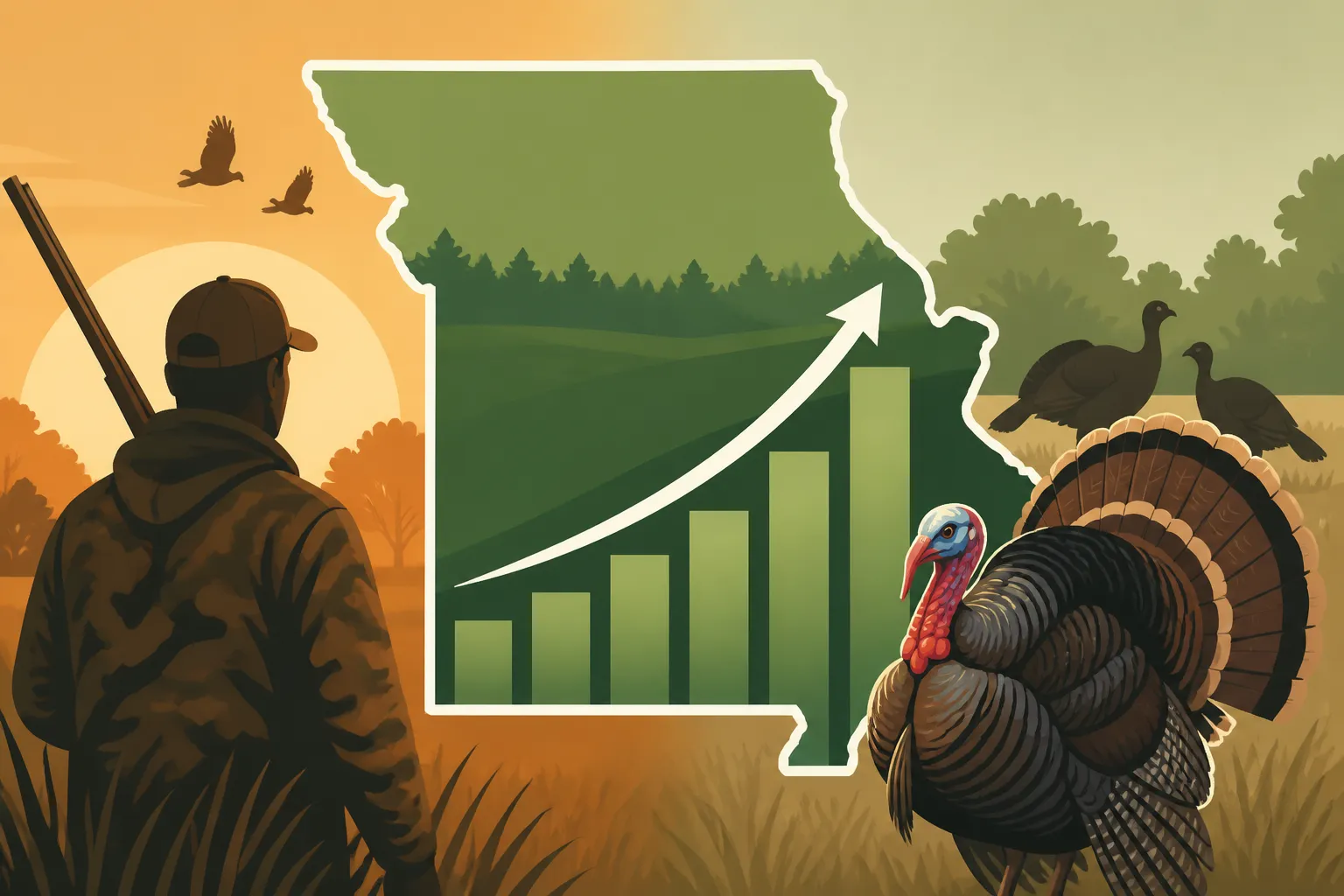
Missouri Turkey Population Trends
It’s a question on every Missouri turkey hunter's mind these days: "Where have all the gobblers gone?" Many of us have noticed the woods feeling quieter, the springtime less boisterous with thunderous drumming. This guide dives deep into the fascinating, sometimes frustrating, journey of Missouri’s wild turkey population, exploring historical highs, current realities, and what these trends mean for those of us who cherish chasing longbeards across our beautiful state.
A Look Back at Missouri's Wild Turkey Comeback Story
If you’ve been hunting in Missouri for a while, you probably remember a time when turkeys seemed to be everywhere. But it wasn't always that way. Our state’s wild turkey population has seen incredible highs and concerning lows, making its comeback one of the most remarkable wildlife success stories in North America.
The Near Extinction and Restoration Efforts
Rewind a century or so, and wild turkeys were practically non-existent in Missouri. Unregulated hunting in the late 1800s and early 1900s, coupled with widespread habitat destruction from logging and agricultural expansion, pushed these magnificent birds to the brink. By the 1950s, it's estimated there were only a few thousand turkeys left, primarily tucked away in the most remote corners of the Ozarks. It was a truly dire situation, and for a long time, many thought the wild turkey was lost to us forever.
Thankfully, dedicated conservationists and the newly formed Missouri Department of Conservation (MDC) stepped in with a monumental effort to bring them back. This wasn't just about stocking a few birds; it was a carefully planned, multi-decade endeavor. They pioneered trap-and-transfer programs, capturing wild turkeys from remnant populations and relocating them to suitable habitats across the state. These were truly wild birds, adapted to our Missouri landscape, and they proved incredibly resilient. This strategic approach, rather than simply releasing pen-raised birds that often lacked survival instincts, was key to the program's success. It’s a testament to long-term vision and hard work, and it's why we've had the opportunity to hunt them at all. This restoration effort laid the groundwork for what would become a thriving population.
How Habitat Management Fueled the Rebound
The success of the trap-and-transfer program wouldn't have been possible without significant improvements in habitat management. Turkeys need a mosaic of different cover types: mature timber for roosting, open woodlands and fields for feeding, and dense undergrowth for nesting and brood-rearing. As logging practices matured and conservation areas were established, the landscape began to recover. The MDC, alongside private landowners, implemented practices that specifically benefited turkeys, such as prescribed burns to create open understories, planting food plots, and encouraging diverse forest growth.
Think about the sprawling timber of the Mark Twain National Forest or the managed woodlands of countless conservation areas; these became prime locations for turkeys to thrive. It wasn't just about protecting what little habitat was left; it was about actively creating and enhancing it. This focus on healthy forests and diverse ecosystems allowed the reintroduced birds to not only survive but to truly flourish, spreading into new territories and establishing robust local populations. For many years, it felt like Missouri was one of the best places in the country to find turkeys.
Peak Years and Expanding Range
By the late 1980s and into the 1990s, Missouri's wild turkey population had truly exploded. Hunters who once dreamed of seeing a turkey in the wild were now regularly encountering large flocks. The population peaked in the early 2000s, with estimates reaching an astounding 400,000 to 500,000 birds statewide. This was a direct result of decades of tireless effort and ideal conditions. Turkeys had successfully expanded into almost every county in Missouri, from the rugged Ozark hills to the fertile farm fields of northern Missouri.
During these peak years, it wasn't uncommon for hunters to hear multiple gobblers sounding off from different directions at dawn. Bag limits were generous, and success rates were high. It was truly the golden age of turkey hunting in Missouri, a period that many seasoned hunters remember fondly. The gobbling woods were a sign of a healthy, vibrant ecosystem, and the sheer number of birds was a source of immense pride for conservationists and hunters alike. It was a time when you could reliably count on finding birds, and the challenge was more about outsmarting them than simply finding them.
Understanding Current Missouri Turkey Population Dynamics
While those peak years were fantastic, anyone who hunts turkeys regularly knows things feel different now. The population isn't what it once was, and understanding why requires a dive into the science and a look at the data collected by wildlife biologists.
The Science Behind Population Estimates
Estimating wild turkey populations isn't as simple as counting deer at a food plot. Turkeys are elusive, wide-ranging, and often blend seamlessly into their environment. Biologists rely on a combination of methods, including annual brood surveys (counting hens and poults in the summer), hunter harvest data, and various research studies involving radio-tagged birds. These methods help them track trends in reproduction, survival, and overall numbers.
The Missouri Turkey Population Estimate is not a single, fixed number, but rather a dynamic assessment based on these various data points. For instance, the MDC conducts a summer brood survey where volunteers and staff report sightings of hens with poults. This "poult-to-hen ratio" is a crucial indicator of reproductive success. A low ratio signals potential problems for the next generation. It helps biologists understand if enough young birds are making it to adulthood to replace older birds in the population. Over the last decade or so, these numbers have shown a consistent downward trend, prompting concern among wildlife managers and hunters alike.
What Declining Poult-to-Hen Ratios Mean
The declining poult-to-hen ratio is arguably the most significant factor contributing to the perceived decrease in turkey numbers. This ratio essentially tells us how many young turkeys (poults) are surviving per adult hen. When this number is consistently low, it means that the population isn't recruiting enough new birds to sustain itself or grow. Instead of each hen raising a healthy clutch of, say, 8-10 poults, we're seeing averages closer to 2-4, and sometimes even less.
This trend is a huge red flag because it directly impacts future turkey abundance. If fewer poults survive their vulnerable early weeks, there will be fewer jakes the following spring, and fewer adult gobblers and hens in subsequent years. This creates a compounding effect, making it harder for the population to recover quickly. While a single bad hatch year isn't usually catastrophic, a string of poor years can significantly depress numbers. It points to challenges during nesting and the crucial early weeks of a poult's life, and it's a topic that has generated a lot of discussion and research among state wildlife agencies. Understanding Why Missouri Turkey Poult Survival Fell is critical to developing future conservation strategies.
Regional Differences Across the State
It’s also important to remember that "Missouri turkeys" aren't a monolithic group. Population trends can vary significantly from one region of the state to another. Generally, the Ozark Highlands, with their vast expanses of timber, historically supported some of the highest turkey densities. However, even these traditional strongholds have seen declines. The northern parts of the state, characterized by rolling farmland interspersed with timbered draws and river bottoms, also hold good turkey populations, often benefiting from the diverse food sources provided by agricultural fields.
For example, while some counties in southern Missouri might still offer decent hunting, others in the central or northern parts of the state might experience even sharper declines, or perhaps even localized increases due to specific habitat conditions or management practices. A hunter heading to the Ozarks might face different challenges and see different numbers of birds than someone hunting the fertile river breaks near the Missouri River. Using resources like the Missouri Conservation Atlas and local knowledge can really help identify Best Missouri Counties for Turkeys at any given time, as conditions can be quite localized. This regional variation means that management strategies often need to be tailored to specific landscapes and local conditions, rather than a one-size-fits-all approach.
Factors Influencing Missouri's Turkey Numbers
So, what's causing these shifts? It's rarely one single culprit. Instead, it's usually a complex interplay of environmental factors, predation, and habitat changes that collectively impact turkey reproduction and survival.
Weather and Its Impact on Reproduction
Weather plays a massive, often underappreciated, role in turkey populations. Wild turkeys are surprisingly vulnerable during their nesting and early brood-rearing periods. Cold, wet springs, particularly when combined with prolonged periods of rain, can devastate a hatch. Poults are susceptible to hypothermia, and wet feathers can make them more vulnerable to predators. Heavy rains can also flood nests in low-lying areas or make it difficult for poults to find the abundant insects they need for rapid growth and development.
Conversely, mild, dry springs often lead to excellent hatches and higher poult survival, providing a much-needed boost to the population. We've seen years where conditions were ideal, and you could feel the optimism among hunters, only to be followed by a challenging spring that seemed to wipe out much of that progress. The timing of rainfall and temperature spikes can be critical. A quick but heavy downpour during the hatch isn't as bad as several days of cold, drizzly weather. Understanding Weather in the Weeks After the Hatch is paramount for wildlife biologists to project population health. This natural variability makes long-term trends even harder to predict and manage.
Predation Challenges for Nests and Poults
Predation is a natural part of any ecosystem, but an imbalance can significantly impact turkey numbers, especially during the vulnerable nesting and poult stages. Raccoons, opossums, skunks, snakes, and coyotes are all known nest predators, eagerly seeking out turkey eggs. Once hatched, young poults become easy targets for everything from hawks and owls to foxes and bobcats.
While turkeys have evolved to deal with some level of predation, an increase in predator populations or a decrease in suitable nesting cover can tip the scales. For instance, rising populations of mesopredators like raccoons or coyotes, particularly in areas with fragmented habitat, can put immense pressure on turkey nests and young. This isn't to say we should eradicate all predators, as they play vital roles in the ecosystem, but it does highlight the delicate balance at play. When hens struggle to successfully hatch and raise a clutch, it compounds the issues created by poor weather. You can read more about Nest Predation and Turkey Hatches for a deeper dive. The combination of environmental factors and predation pressure means hens are often fighting an uphill battle to successfully reproduce.
Habitat Changes and Their Consequences
Despite the earlier success of habitat restoration, ongoing changes in land use continue to impact turkey populations. Urban sprawl, increased agricultural intensity (especially with vast monoculture fields), and the fragmentation of forests can reduce the quality and quantity of suitable turkey habitat. Turkeys need large, contiguous tracts of diverse habitat to thrive, including mature timber for roosting, open grassy areas for nesting, and bugging grounds for poults.
Consider the increasing size of crop fields in many parts of northern Missouri, with fewer fencerows, small woodlots, and diverse edge habitats. This reduces the cover turkeys need to safely nest and raise their young. Even in timbered areas, changes in forest management (or lack thereof) can lead to less diverse understories, reducing insect availability and creating less ideal cover. While we have many dedicated landowners and conservation efforts, the sheer scale of land-use change can be challenging for wildlife. Finding good habitat on public lands is becoming more crucial, and a tool like GoHunt can be invaluable for identifying promising areas before you even hit the woods, especially when planning your approach for Hunting Missouri Standing Corn and Beans. Without adequate and diverse habitat, turkey populations will continue to struggle, regardless of other factors.
How Hunting Seasons and Management Adapt to Trends
When turkey populations show consistent trends, whether up or down, the Missouri Department of Conservation (MDC) often re-evaluates hunting regulations. This isn't about punishing hunters, but about ensuring the long-term health and sustainability of the resource we all value.
Adjusting Bag Limits and Season Dates
One of the most direct ways wildlife managers respond to population trends is by adjusting bag limits and season dates. If poult survival is low and overall numbers are declining, you'll often see more conservative regulations implemented. This could mean reducing the number of birds a hunter can take during the spring or fall seasons, shortening the season length, or even restricting harvest to specific times of day.
In Missouri, for example, we've seen adjustments over the years to the spring bag limit and the rules around taking a second bird. These changes are data-driven, based on current population estimates and projected recruitment. The goal is to reduce overall harvest pressure, giving the population a better chance to rebound. For non-residents, this has sometimes meant more significant changes, such as the recent adjustment to the non-resident spring turkey limit. It’s never a popular decision to reduce opportunities, but it’s a necessary one to ensure future hunting opportunities for everyone. It’s crucial to stay up-to-date on the Missouri Spring Turkey Season Structure each year.
The Role of Hunter Education and Regulations
Beyond bag limits, hunter education and regulations play a vital role in ethical and sustainable turkey hunting. The MDC continuously reviews rules around legal shooting hours, permissible methods, and even details like reaping or fanning. These regulations are designed to promote fair chase, enhance hunter safety, and minimize disturbance to the turkey population, especially hens during nesting season.
Hunter education programs emphasize ethical hunting practices, shot placement, and responsible behavior in the field. They help ensure that hunters understand the rules and their responsibility in conservation. For instance, understanding why you can't take certain birds, or why specific weapon types are restricted during certain portions, is part of being a responsible participant. These educational efforts are an ongoing commitment to ensuring that hunters are part of the solution, not the problem, when it comes to managing our wild turkey resource. The long-term health of our turkey population hinges on every hunter doing their part, and that includes staying informed and abiding by the rules.
Conservation Efforts for Future Generations
The MDC isn't just reacting to population trends; they're actively working on conservation efforts to secure the future of Missouri's wild turkeys. This includes habitat improvement projects on public lands, providing guidance and incentives for private landowners to manage their property for turkeys, and ongoing research into turkey biology and disease. You might see more prescribed burning on conservation areas, planting of native grasses for nesting cover, or timber stand improvements aimed at creating better foraging opportunities.
These initiatives are critical, as habitat is the cornerstone of any healthy wildlife population. Furthermore, funding from hunting permits and taxes on hunting equipment directly supports these programs, demonstrating how hunters are intrinsically linked to conservation. By staying informed, participating in surveys, and supporting conservation organizations, hunters contribute directly to ensuring that future generations can experience the thrill of a gobbler answering their calls. It's a long game, but the commitment is there to keep the wild turkey a cherished part of Missouri's outdoor heritage.
What Hunters Can Expect and How to Adapt
Given the current trends, what does this mean for you, the Missouri turkey hunter? It means adapting, becoming more skilled, and being a dedicated part of the conservation solution.
Scouting Smarter for Fewer Birds
With potentially fewer birds on the landscape, effective scouting becomes even more critical. You can't just expect to drive down a gravel road and hear birds hammering on every ridge anymore. You'll need to put in more boots-on-the-ground work during the off-season, listening for gobblers, looking for tracks, droppings, and dusting bowls. Pay attention to food sources, especially acorns and agricultural fields, as turkeys will gravitate to areas with reliable forage.
Modern tools like satellite imagery and apps (like GoHunt, for example) can help you pinpoint promising habitat features before you even step foot in the woods. Look for areas with diverse habitat: mature timber for roosting, open fields or clearings for feeding and strutting, and dense undergrowth for hens to nest. Concentrate your efforts in these prime locations. Understanding how to use the Missouri Conservation Atlas and scouting aerial photos can give you a significant advantage, especially if you're trying to find areas where turkeys might be concentrated. If you're planning your Roost Hunting Missouri Gobblers strategy, knowing where birds are consistently roosting is half the battle.
| Factor | Impact on Turkey Populations | Hunter Adaptation |
|---|---|---|
| Declining Poult Ratio | Fewer young birds recruited annually | Focus scouting on areas with good brood cover |
| Wet Springs | Reduced nesting success, poult survival | Target areas with well-drained nesting sites |
| Increased Predation | Higher egg and poult mortality | Hunt areas with diverse cover for escape and nesting |
| Habitat Fragmentation | Reduced contiguous suitable habitat | Utilize GoHunt or MDC maps to find large blocks of habitat |
| Conservative Regulations | Fewer tags, shorter seasons | Prioritize quality hunts, maximize success on fewer birds |
Honing Your Calling and Hunting Skills
When there are fewer birds, your personal skills as a hunter become paramount. This means practicing your calling year-round, not just a week before the season. Learn to make a variety of calls – soft clucks and purrs, excited yelps, and confident fly-down cackles. Adapt your calling style to the specific situation; sometimes aggressive calling works, other times a subtle approach is far more effective for Decoying a North Missouri Buck or a wary gobbler.
Furthermore, focus on your woodsmanship. This includes stealthy movement, understanding topography, and knowing how to set up effectively based on the turkey's likely approach. Be patient, observant, and willing to put in the time. Turkey hunting, especially for pressured birds, demands attention to detail and a deep understanding of their behavior. It might mean changing your approach from just sitting and calling to more aggressive tactics like Run-and-Gun Turkey Tactics in the Missouri Ozarks to cover more ground and locate birds. The days of simply showing up and expecting a gobbler to walk into range might be behind us, but the challenge of outsmarting a wary longbeard remains incredibly rewarding.
Supporting Conservation for Long-Term Success
Ultimately, the future of Missouri's wild turkeys rests on continued conservation efforts, and hunters are essential to this. Purchase your permits, as these funds directly support wildlife management. Consider volunteering for habitat projects on public lands or joining conservation groups like the National Wild Turkey Federation (NWTF). Advocate for sound wildlife management policies and educate others about the importance of habitat.
Your participation in official surveys, such as submitting harvest data or participating in brood surveys, provides critical information to biologists. Every piece of data helps them make informed decisions about season structures and habitat projects. By being an active and engaged conservationist, you're not just hoping for better turkey numbers; you're actively working to make them a reality. This commitment ensures that the incredible comeback story of the wild turkey continues for generations to come, providing thrilling Fall Turkey Hunting Tactics and spring chases for all of us who love this incredible bird.
Disclaimer
Please remember that hunting regulations and wildlife populations are subject to change. Always consult the latest Missouri Department of Conservation (MDC) regulations before heading afield to ensure you have the most current and accurate information.