Eurasian Collared Doves in Missouri
If you've spent any time hunting in Missouri over the last few years, especially around grain fields or rural homesteads, you've probably noticed a new kind of dove, larger and lighter in color than our familiar mourning doves. These are Eurasian collared doves, and they've become an increasingly common sight, raising questions for many hunters about what they are, if they can be hunted, and how they fit into our traditional dove season. This guide is here to shed light on these fascinating newcomers, explain their impact, and help you understand how to pursue them ethically and legally in the Show-Me State.
Understanding Eurasian Collared Doves
The arrival of Eurasian collared doves in Missouri is a relatively recent phenomenon, but their presence is now undeniable. These birds are distinct from our native mourning doves in several ways, and recognizing these differences is key, not only for identification in the field but also for understanding their ecological role and hunting regulations.
Identification and Characteristics
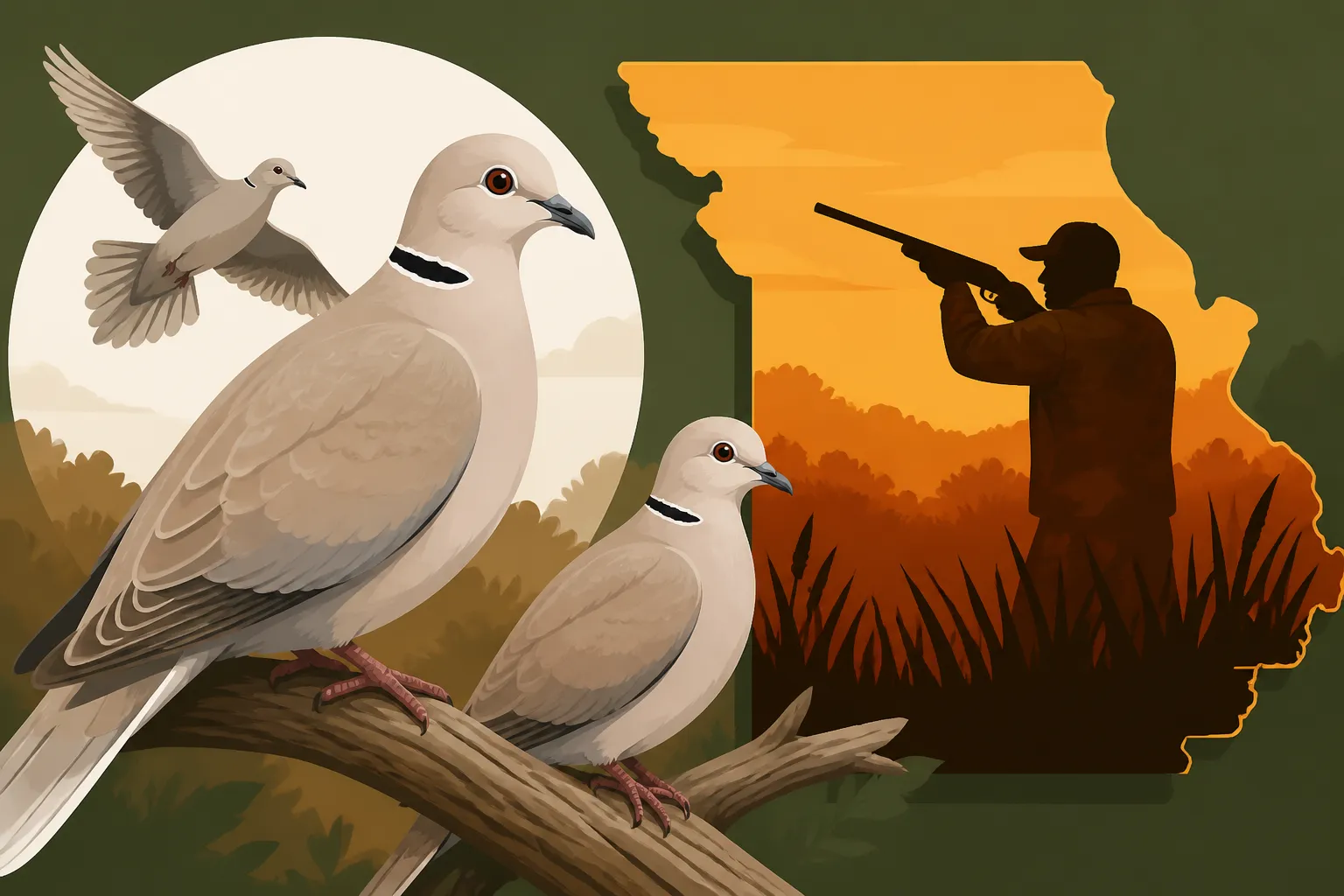
Eurasian collared doves are quite a bit larger than mourning doves, often mistaken for small pigeons due to their stockier build. They boast a pale, sandy-gray plumage, with a distinctive black collar or half-collar on the back of their neck, which is where they get their name. Their tail is square, unlike the pointed tail of the mourning dove, and they typically have dark primary flight feathers. Their call is also different, a rhythmic "coo-COO-coo" that's often repeated, rather than the softer, mournful coo of our native species. When they fly, they have a somewhat heavier, less erratic flight pattern compared to the quick, darting movements of a mourning dove. This difference in size, color, and call makes them fairly easy to distinguish once you know what to look for.
It's not uncommon for hunters, especially those who grew up solely with mourning doves, to initially be confused by their larger cousins. I remember the first time I saw one perched on a power line near a harvested cornfield; I thought it was a small pigeon at first glance. But once you notice that characteristic black collar and their more robust body, it becomes clear you're looking at a collared dove. They're often seen in pairs or small groups, frequenting residential areas, farms, and agricultural fields where food is plentiful. They seem quite adaptable, thriving in areas with human activity, making them a common sight even in suburban settings.
Origin and Spread in North America
The story of the Eurasian collared dove in North America is one of remarkable expansion. These birds are not native to our continent; their journey began in the Bahamas in the 1970s, likely from an accidental or intentional release of captive birds. From there, they spread rapidly through Florida and then across the entire United States, reaching Missouri relatively quickly. Their incredible adaptability, high reproductive rate, and generalist diet have allowed them to colonize new territories with astonishing speed. They are now found in every state, a testament to their success as an invasive species.
Their spread is a classic example of an introduced species finding an ecological niche and exploiting it. They don't seem to compete directly with mourning doves for nesting sites or primary food sources in a way that significantly impacts mourning dove populations, which is good news for our native birds. However, their sheer numbers and rapid reproduction mean they're a force to be reckoned with. This colonization isn't unique to Missouri; you can find these birds from coast to coast, often surprising locals with their sudden appearance and strong presence.
Hunting Eurasian Collared Doves in Missouri
Given their status as an introduced species, the rules and regulations for hunting Eurasian collared doves in Missouri are quite different from those for our native mourning doves. Understanding these distinctions is crucial to ensure you're hunting legally and ethically.
Permit Requirements and Regulations
Unlike mourning doves, which are classified as migratory game birds and have specific federal and state seasons and bag limits, Eurasian collared doves are generally considered an unclassified species in Missouri, similar to feral pigeons. This means they are not covered under federal migratory bird regulations. For hunters, this translates to year-round hunting opportunities and no daily bag or possession limits, as long as you possess a valid small game hunting permit. This is a significant difference and one that often catches hunters by surprise. It essentially means that if you have your Missouri Resident Small Game Permit Cost or Missouri Combination Hunting and Fishing Permit, you're good to go.
However, while there are no federal migratory bird regulations on them, all general hunting regulations still apply. This includes Missouri Hunter Education Requirements for those who need it, proper identification, and adherence to safe hunting practices. Always double-check the current Missouri Department of Conservation (MDC) regulations, as rules can change. For instance, while you don't need HIP registration for collared doves specifically, if you're hunting them alongside mourning doves, which is often the case in a dove field, you absolutely need your Missouri Federal Duck Stamp Requirement and Missouri HIP Registration for Migratory Birds if you're going after the migratory ones.
Seasons and Daily Limits
As mentioned, one of the most appealing aspects of Eurasian collared doves for hunters is their open season. In Missouri, they can generally be hunted year-round. This offers a fantastic opportunity for wingshooters to hone their skills outside of the traditional Missouri Dove Season Opening Date in September. You don't have to wait for specific dates; if you're out scouting for deer, or just enjoying a walk in late winter, and you see collared doves, you can pursue them.
There are also no daily bag limits or possession limits for Eurasian collared doves. This stands in stark contrast to mourning doves, where bag limits are carefully managed. For a wingshooter, this means that if you find a strong concentration of collared doves, you can potentially harvest a good number without worrying about exceeding a daily cap, as long as you are harvesting them for consumption. This makes them an excellent target for those looking to stock their freezer with lean, wild game meat throughout the year.
| Characteristic | Eurasian Collared Dove | Mourning Dove |
|---|---|---|
| Size | Larger, stockier, pigeon-like | Smaller, slender |
| Plumage Color | Pale sandy-gray | Brownish-gray |
| Neck Markings | Distinct black half-collar | No collar, iridescent sheen |
| Tail Shape | Square or slightly rounded | Long, pointed |
| Flight | Heavier, more direct | Fast, erratic, often whistling |
| Call | Rhythmic "coo-COO-coo" | Soft, mournful "Ooo-ah, coo-coo-coo" |
| Legal Status Missouri | Unclassified, year-round season, no bag limit | Migratory game bird, specific season/bag limit |
| Permit Need (for hunting) | Small Game Hunting Permit | Small Game Hunting Permit + HIP Registration |
Strategies for Hunting Collared Doves
Hunting Eurasian collared doves can be incredibly rewarding, especially outside of traditional dove season when other opportunities might be limited. Their habits and preferred habitats offer unique challenges and chances for success.
Scouting and Habitat
Just like with any successful hunt, scouting is paramount when it comes to collared doves. They tend to congregate in areas with readily available food and water, often close to human activity. Think about agricultural fields – especially harvested corn, wheat, or milo fields – livestock operations, and even suburban backyards with bird feeders. They are also drawn to open areas with scattered trees for perching and roosting. Using tools like the Missouri Conservation Atlas or online mapping resources can help you identify potential private land access or public areas with agricultural components. A good scouting tool, like the detailed maps you can find on platforms similar to GoHunt, can help you visualize these areas and understand land ownership.
Unlike mourning doves that might utilize vast expanses of open field, collared doves often stick closer to structures or distinct perches. Look for power lines, isolated dead trees, grain bins, or abandoned farm buildings near food sources. They don't typically travel far from these secure spots. Early morning and late afternoon are generally the most active times, when they're flying between roosts, feeding grounds, and water sources. Observing their flight paths and feeding patterns will give you the best chance to intercept them.
Decoying and Pass Shooting
Both decoying and pass shooting can be highly effective methods for hunting Eurasian collared doves. For pass shooting, identify natural flight corridors between their feeding and roosting areas. These might be over a fencerow, along the edge of a timbered draw, or simply between a harvested field and a nearby water source. Set up concealed along these routes, anticipating their flight. Remember, their flight is often more direct and less erratic than mourning doves, which can make for more predictable shots. However, they are still fast, so practice is key.
Decoying can be incredibly effective, especially if you set up near a preferred feeding or watering spot. Use a spread of dove decoys, preferably a mix of mourning dove and collared dove decoys if you have them, positioned on the ground or on elevated stands to mimic birds feeding or perching. Motion decoys, like spinning wing doves, can also be highly attractive. Just as with Decoy Placement for Pressured Birds for turkeys, paying attention to the wind direction relative to your setup and the decoys is crucial. The goal is to draw them in close for a clean, ethical shot. They are often less wary than mourning doves, particularly if they are unpressured, making decoying a very viable strategy.
Gear and Shotgun Choice
When it comes to gear for Eurasian collared doves, you'll find much of it overlaps with what you'd use for traditional dove hunting. A 12-gauge or 20-gauge shotgun is ideal. For shot size, typical dove loads like 7 1/2 or 8 shot will work perfectly. Since these birds are a bit larger and hardier than mourning doves, some hunters prefer 7 1/2 shot for a little extra punch, but 8 shot is certainly sufficient for close-range shots. Open chokes like improved cylinder or modified are generally best, offering a good spread for fast-moving targets. Make sure your shotgun is patterned correctly for your chosen load and choke, as every setup is a little different.
Beyond the shotgun and ammunition, you'll want good camouflage, especially if you're hunting in open fields. A comfortable seat or stool can make long waits much more enjoyable. Plenty of water is a must, especially if you're hunting during warmer months. Remember that even though there's no official "collared dove season," you'll still need to follow all general hunting safety rules, including wearing appropriate hunter orange if it's during a firearms deer season portion where it's required, such as Orange Requirements for Missouri Archers or Missouri's November Firearms Portion. A good pair of binoculars can also be helpful for Scouting Missouri Public Land Before Season and identifying potential hunting spots from a distance.
Cooking and Enjoying Your Harvest
One of the great joys of hunting, beyond the experience itself, is bringing home wild game to share with family and friends. Eurasian collared doves are not just fun to hunt; they are excellent table fare. Their meat is lean, dark, and flavorful, much like mourning dove meat, but with slightly larger breasts to work with.
Preparing Dove Breasts
Cleaning Eurasian collared doves is straightforward, much like mourning doves. Most hunters choose to simply breast out the birds, as there isn't much meat on the legs and wings. To breast out a dove, lay it on its back, part the feathers on the breast, and make a small incision through the skin and breastbone. Then, simply pull the breast meat away from the bone on either side. You'll be left with two beautiful, dark red breasts, ready for cooking. Ensure you clean them thoroughly, removing any shot, feathers, or connective tissue.
It's a quick process, and even if you harvest a good number of birds, you can have them cleaned and ready in a relatively short amount of time. If you're out hunting on a warm day, it's always a good idea to get your birds on ice as quickly as possible to preserve the quality of the meat. This ensures that the efforts you put into hunting translate into a delicious meal back home.
Simple and Delicious Recipes
Dove meat is incredibly versatile in the kitchen. For many, the classic preparation is simply wrapping the dove breasts in bacon and grilling them. The bacon adds moisture and fat, preventing the lean dove meat from drying out, while imparting a fantastic smoky flavor. A simple marinade of Italian dressing, soy sauce, or even just salt, pepper, and garlic powder for an hour or two before grilling can elevate the flavor even further. Grill them quickly over medium-high heat until the bacon is crispy and the dove meat is cooked through but still tender.
Beyond grilling, dove breasts can be pan-fried, baked, or even used in stews and stir-fries. They absorb flavors wonderfully. Try them seared quickly in a hot skillet with butter and herbs, then served over wild rice or a fresh salad. You can also bread and fry them like chicken tenders for a crispy treat, or simmer them in a rich gravy. Since they are a bit larger than mourning doves, they stand up well to slightly heartier preparations. Don't be afraid to experiment; you'll likely find that Eurasian collared doves quickly become a favorite wild game dish in your kitchen.
Disclaimer
This article is for general informational purposes only and does not constitute professional advice. Laws, prices and regulations vary by location and change over time. Consult a qualified professional for guidance on your specific situation.