How Far a Gobbler Travels in Spring
One of the most maddening parts of spring turkey hunting in Missouri is when you hear that booming gobble at first light, only for the bird to vanish into thin air, leaving you wondering if he just sprouted wings and flew to the next county. It's enough to make you pull your hair out! This guide is here to shed some light on just how far a gobbler typically travels during the spring season and, more importantly, what influences those movements so you can adjust your tactics and finally get that bird to commit.
The Dynamics of a Missouri Gobbler's Spring Travel
Understanding how far a gobbler might travel isn't just about a number; it's about grasping the whole intricate dance they do in the spring. Their daily movements are a complex mix of instinct, social dynamics, and the specific environment they find themselves in. Missing a gobbler because you set up too close or too far often comes down to misjudging this dynamic.
Roosting and Daily Routine
Every spring morning in Missouri, the routine typically begins on the roost. Gobblers will fly up into prominent trees at dusk, often with hens, to spend the night safely off the ground. When that first hint of dawn paints the eastern sky, the real show begins. Gobblers will start sounding off from their roosts, eager to announce their presence to any nearby hens. From this roost, their first movement of the day is often a flight down to the ground.
Once on the ground, their primary goal is to gather hens. If hens are already with them on the roost or gather quickly beneath them, a gobbler might not move far at all, perhaps only a few dozen yards to a nearby strutting zone – an open area where he can display. However, if no hens are present or he hears distant hen calls, he might travel a few hundred yards, sometimes even half a mile or more, to get to where he thinks the hens are. This initial "fly-down" movement is critical, and understanding where he's likely to go can make or break your morning hunt. Thinking about Calling a Missouri Gobbler Off the Roost really starts here, with where he's going to hit the ground.
Habitat and Terrain Considerations
Missouri's diverse landscape plays a huge role in how far and where a gobbler travels. A gobbler in the rugged Ozark timber, for example, might be restricted by steep hollows, dense cedar thickets, or rocky bluffs. His movements might be more vertical, working ridges and benches, or following creek bottoms. In this kind of terrain, a half-mile journey might take him through significant elevation changes and thick cover.
Contrast that with the rolling farm country of north Missouri, where large timber blocks are broken up by expansive crop fields. Here, a gobbler might travel much further horizontally, covering open ground quickly to get from one timbered fencerow to another or to reach a strutting zone in a picked bean field. Obstacles like major rivers, busy roads, or wide-open fields without cover can also influence his path, forcing him to take longer, circuitous routes or stick to the safety of timber edges. Understanding the specific habitat is key to anticipating his line of travel. When you're out there, really pay attention to how the land lays out – it's going to tell you a lot about how a bird will move. Trying to anticipate these movements is a big part of the game, whether you're Hunting Turkeys in Ozark Hollows or adapting to more open areas.
Hunting Pressure and Gobbler Adaptations
There's no doubt that hunting pressure has a profound effect on how gobblers behave and how far they're willing to travel. Early in the season, or on properties with minimal pressure, a gobbler might be more vocal and more willing to travel openly to investigate calls. He might even cut across open fields without much hesitation.
However, as the season progresses, or on heavily hunted public land, gobblers quickly become warier. They learn to associate human presence with certain areas, like parking lots or popular ridges. A pressured gobbler might become "call-shy," meaning he's heard every cluck and yelp under the sun and is less likely to respond aggressively. He might gobble less on the roost, fly down silently, and move much further before making himself known, often skirting around common hunter approaches. He might use dense cover to travel, making long detours to avoid being seen. In these situations, a gobbler's travel distance can increase significantly as he seeks out quieter, undisturbed areas, forcing hunters to adjust their tactics, perhaps with more aggressive "run-and-gun" approaches or by focusing on less accessible terrain. Knowing When Missouri Gobblers Go Quiet is a vital piece of information.
Typical Travel Distances and Patterns
While every gobbler is an individual and every day is different, there are some general patterns to their travel that can help us put the puzzle pieces together. Think of these not as hard rules, but as a starting point for your spring turkey strategy.
From Roost to Strut Zone
The most predictable travel of a gobbler occurs right after fly-down. Typically, a gobbler will move from his roost tree to a preferred strutting zone. This could be anywhere from a mere 50 yards to 400 or 500 yards, depending on the availability of open ground and the presence of hens. If a group of hens is already under his roost tree, he might only take a few steps before commencing his display. If he hears a distant hen or needs to move to an area with better visibility or an abundance of fresh green growth that attracts hens, he'll stretch his legs.
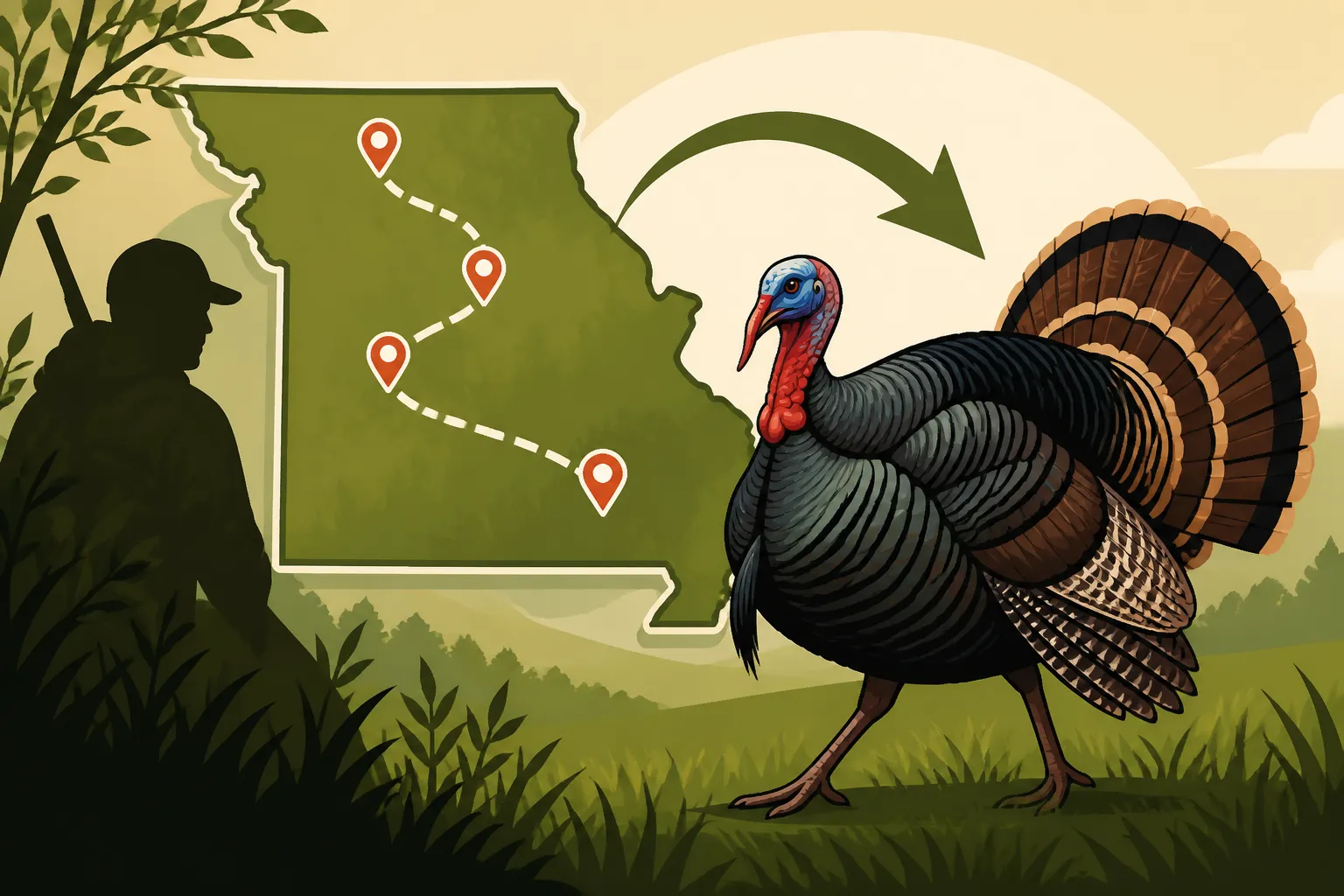
These strutting zones are usually areas where he can be seen and heard easily: a field edge, a logging road, a small open knoll in the timber, or a clearing where he can puff up and strut. He'll want to be close to food sources like tender young grasses or insects, and often near a water source too. Identifying these strut zones during pre-season scouting is crucial, as it gives you a strong indication of his initial travel path. Many hunters use mapping software like GoHunt to mark potential roosting trees and nearby strutting areas, helping visualize these critical travel paths.
Mid-Morning Movements and Seeking Hens
As the morning progresses, especially after the hens have been bred and start drifting off to their nests, a gobbler's travel patterns can become a bit more erratic, but also more predictable in their intent. When those hens leave him, he becomes a lonely old bird, and this is often when he becomes most responsive to a hunter's calls. At this point, he's actively looking for more companionship.
He might travel further in search of new hens, often ranging up to a mile or even more over the course of a few hours. These birds are now truly "seeking," moving through the timber, along ridge lines, or skirting field edges, gobbling periodically to advertise their availability. This is often the prime time for more aggressive tactics like Run-and-Gun Turkey Tactics in the Missouri Ozarks, where you move, call, listen, and move again, trying to intercept a traveling bird. His willingness to travel for a convincing call significantly increases once he's by himself.
Afternoon and Evening Routes
By the afternoon, gobblers often quiet down considerably, but they are still moving. Their travel in the late afternoon often revolves around feeding and slowly making their way back towards their preferred roosting areas. These movements can be quieter and more deliberate. They might feed in fields or clearings, picking through insects and greens, and then work their way along timber edges or through sparse woods towards a cluster of tall, stout trees they've used before.
Sometimes, they might join up with other gobblers or even a small group of hens for the evening roost. The travel distances can still be substantial, especially if they've been pushed from their usual areas or are feeding far from their roost. Understanding these return routes can be very effective for an afternoon hunt, as you can often intercept a bird that's on a predictable path. Setting up along a known travel corridor or near an afternoon food source can pay off. It's a different game than the morning rush, but understanding these later movements is key for Hunting Gobblers in the Afternoon.
Here's a quick summary of typical gobbler travel patterns:
| Time of Day | Primary Goal | Typical Travel Distance (from start of period) | Key Influencers | Hunting Strategy Implication |
|---|---|---|---|---|
| Pre-Dawn | Roosting, calling | Minimal (in tree) | Location of hens, nearby gobblers | Listen, position for fly-down |
| Fly-Down | Gather hens, find strut zone | 50-500 yards | Hen presence, open ground, food sources | Intercept early, be close to strut zone |
| Mid-Morning | Seek new hens, display | 0.5 – 1+ mile (over several hours) | Hens leaving, hunting pressure, habitat | Aggressive calling, run-and-gun, find lonely birds |
| Afternoon | Feed, return to roost | 0.25 – 0.75 mile | Food availability, known roosting areas, security | Intercept along travel corridors, near food |
| Dusk | Fly to roost | 50-200 yards (to roost tree) | Safety, preferred roost trees | Final setup near roost, quiet approach |
Strategies for Understanding and Capitalizing on Gobbler Travel
Knowing that gobblers travel isn't enough; you need actionable strategies to leverage that knowledge. It's about being proactive and adaptable.
Pre-Season Scouting and Observation
The absolute best way to understand how far a gobbler travels in your hunting area is to put in the time before the season even opens. Scouting Missouri Public Land Before Season is invaluable for turkeys. Spend time walking the timber, looking for droppings, scratch marks, and shed feathers. Identify potential roost trees – often the tallest trees on a ridge or near a water source. Look for open areas that would make good strutting zones. Use mapping tools like GoHunt to mark these locations, noting terrain features, potential travel corridors, and barriers.
During the pre-season, you can even go out at dusk and dawn to listen for gobblers on the roost. This will give you concrete data on where birds are roosting and in what general direction they might be flying down and traveling. If you know a bird typically flies down into a specific creek bottom from a ridge-top roost, you can set up accordingly, rather than guessing. Pay attention to pinch points, saddles, and benches that might funnel turkey movement, similar to how deer use these features.
Adapting to Changing Conditions
Gobbler travel isn't static. It's heavily influenced by daily factors, and the most successful hunters are those who can adapt on the fly. Weather, for instance, can change everything. On a cold, windy morning, gobblers might be less vocal and stay put longer, only traveling short distances to a sheltered strut zone. On a warm, clear morning, they might be more active and willing to roam.
The presence of hens is another huge factor. If a gobbler is henned-up, he might not travel much at all, content to stay with his harem. Your calling might draw the hens, but the gobbler will often stay put, expecting the hens to come to him. Once the hens leave him, however, he becomes much more susceptible to traveling to a call. Hunting pressure also dictates movement. If you're on public land and hear other hunters working a bird, you might need to adjust your approach, circling wide to get ahead of the bird or waiting for quieter periods. You'll need to know When Missouri Gobblers Go Quiet to really be effective. Don't be afraid to change your plan mid-hunt if what you're seeing or hearing doesn't match your initial expectations.
Effective Calling and Decoy Strategies
Your calling strategy should be directly informed by your understanding of gobbler travel. If a gobbler is on the roost and you're set up to intercept his fly-down, soft tree yelps might be enough to get him to commit a short distance. If he's already on the ground and moving away, more aggressive cutting and yelping might be needed to grab his attention and make him change his direction of travel.
Decoys can also play a crucial role, especially when you anticipate a gobbler traveling a certain route. Placing a hen or jake decoy in a strutting zone or along a travel corridor can be enough to pull a bird those crucial last few yards. For example, if you know a gobbler consistently crosses a specific fencerow to get to a field, setting up just inside the timber with a decoy visible in the field can intercept him. Remember, decoys aren't always about drawing a bird from far away, but often about convincing a bird that's already traveling in your general direction to close the distance. Proper Decoy Placement for Pressured Birds can make all the difference, especially on wary gobblers that might hang up just out of range.
Always remember that a gobbler is rarely going to travel directly to you in a straight line, especially on public land. He's going to use the terrain, he's going to try to see the hen he's hearing, and he's going to approach with caution. By understanding his typical travel patterns and the factors that influence them, you can increase your chances of being in the right place at the right time.
Disclaimer
This article is for general informational purposes only and does not constitute professional advice. Laws, prices and regulations vary by location and change over time. Consult a qualified professional for guidance on your specific situation.