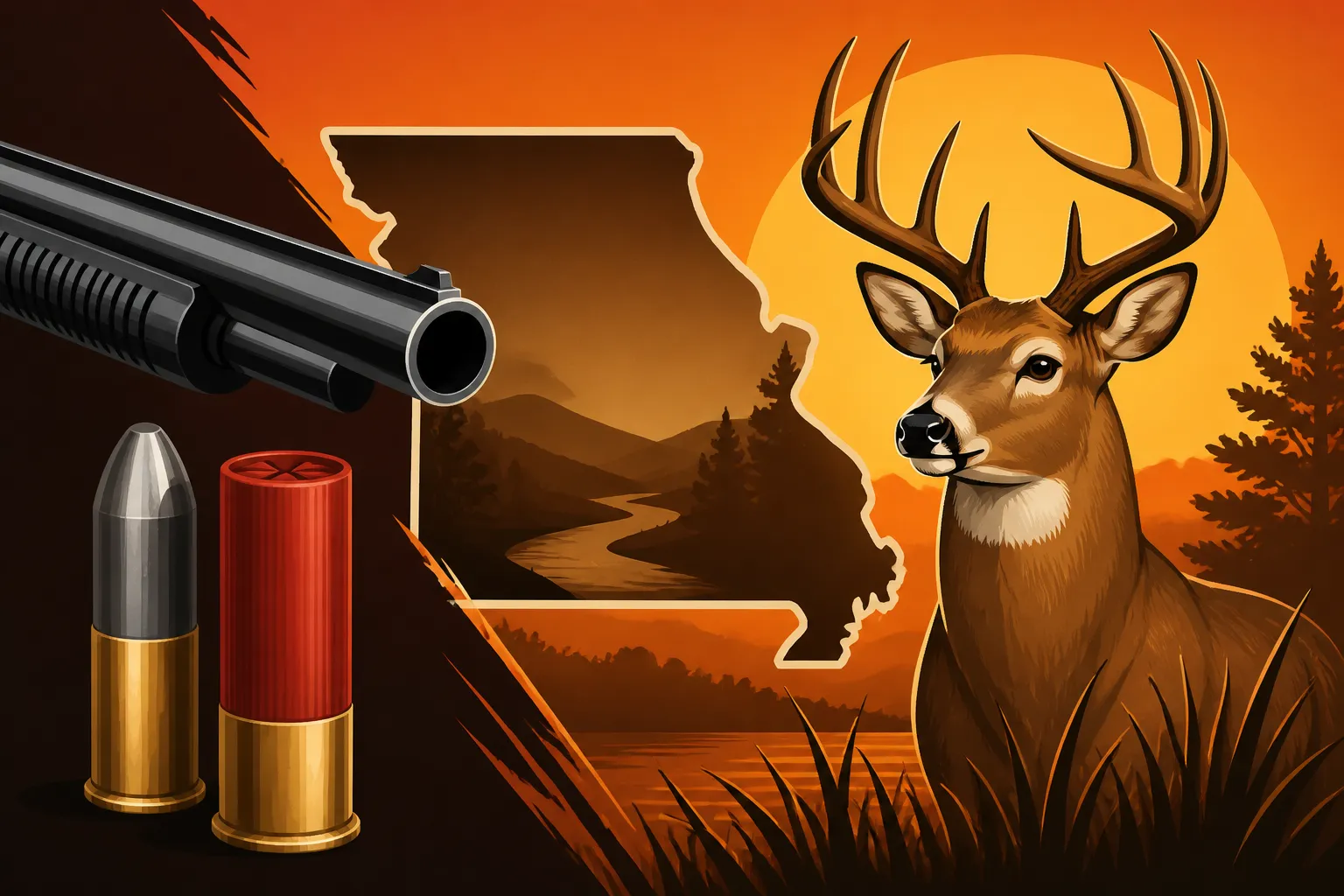
Slug Guns and Shotgun Deer Loads
For many Missouri deer hunters, the sound of a shotgun pumping a fresh round into the chamber is as much a part of the autumn ritual as the crunch of frosted leaves underfoot. But for folks accustomed to rifles, the nuances of slug guns and their ammunition can feel like navigating a dense thicket without a compass. This guide is dedicated to untangling the complexities of shotgun deer hunting in the Show-Me State, helping you understand the gear, the loads, and the techniques that will make you more effective in the timber and along the fields.
Understanding Missouri's Shotgun Deer Hunting Tradition
Missouri's deer hunting landscape is rich with tradition, and for many decades, the shotgun played a central role, especially in areas with denser populations or specific regulations. While modern firearm options have expanded, the slug gun remains a potent and popular choice for a significant portion of the hunting community.
Why Shotguns for Deer in Missouri?
Historically, shotguns were often mandated in regions deemed "shotgun-only" due to population density, proximity to residential areas, or perceived safety concerns regarding the longer range of rifle bullets. Even though many of these restrictions have eased or been eliminated over time, the tradition and effectiveness of the slug gun persist. Many hunters, especially those on smaller private tracts or in areas with thick cover, prefer the perceived safety and ample knockdown power of a heavy slug that typically won't travel as far as a high-powered rifle bullet. It provides a confident feeling, knowing your projectile is doing its work quickly and not overpenetrating into areas you don't intend. For hunters who grew up with shotguns, it's often a familiar and trusted tool, one they've honed their skills with for years.
When you're hunting smaller timber blocks, particularly those bordering agricultural fields or even suburban development, a shotgun firing slugs offers a peace of mind that a rifle might not. You're thinking about the trajectory and the potential impact beyond your target. A slug, while still incredibly powerful and requiring the utmost respect, generally has a much more limited effective range compared to many centerfire rifle cartridges. This makes it an excellent choice for those situations where you know your shots will be relatively close, say within 100 to 125 yards, and you want to ensure the projectile expends its energy within that tight hunting zone.
Historical Context and Evolving Regulations
For decades, certain counties in Missouri were designated "shotgun-only," or required hunters to use shotguns during the primary Missouri's November Firearms Portion. This was largely a management decision aimed at promoting hunter safety and addressing concerns in more populated areas. Over time, as deer management evolved and ballistics technology improved, many of these restrictions were lifted, allowing for the use of rifles in most counties during the firearms portions. However, the legacy of these rules means that many hunters still possess and prefer their slug guns. The Legal Firearms for Missouri Deer regulations are much more permissive today, but the shotgun remains a viable and often chosen option.
Think about your grandpa's hunting stories. Chances are, a trusty 12-gauge with a slug barrel was front and center during deer season. That's the tradition we're talking about. While you can now take a modern sporting rifle into many of those same woods, the familiarity and proven track record of the slug gun keep it in many gun safes. Plus, the advancements in slug technology mean today's slug guns are far more accurate and effective than their predecessors, narrowing the gap between them and rifles in terms of downrange performance within reasonable shotgun ranges.
Beyond the November Firearms Portion
While the shotgun shines during the traditional November firearms season, it’s also a key player in other hunting opportunities. For example, during the Missouri Alternative Methods Portion Dates, hunters are restricted to certain weapon types, and slug guns often fit comfortably within these regulations, offering another chance to tag a deer when rifles aren't permitted. This provides an extended utility for your shotgun, making it a versatile tool throughout different phases of the deer season.
It’s not just about the classic November hunt. If you're looking to extend your time in the woods and participate in these other specialized portions, your slug gun can be your ticket. Understanding the specific regulations for each portion, like the Missouri Early Antlerless Portion Dates or Missouri Late Antlerless Portion Dates, is crucial, but often, the trusty slug gun will meet the criteria, giving you more opportunities to fill your freezer. This versatility is a major reason why many Missouri hunters hold onto their slug guns, even if they also own rifles.
The Anatomy of a Slug Gun: Rifled vs. Smoothbore
The term "slug gun" isn't just about loading a slug into any shotgun. True slug guns are often specialized, featuring modifications that significantly improve accuracy with deer slugs. The biggest distinction lies in the barrel: smoothbore or rifled.
Smoothbore Shotguns and Foster Slugs
A smoothbore shotgun is what most people picture when they think of a standard shotgun. The barrel interior is perfectly smooth, designed to allow shot charges to exit cleanly. When using a smoothbore for deer hunting, you'll typically be employing what are known as Foster slugs, or sometimes Brenneke slugs. These slugs are designed with rifling-like grooves on their exterior, which are actually intended to deform and compress as they pass through the choke, not impart spin. Their accuracy relies on a shuttlecock effect, with the weight concentrated forward, causing them to fly nose-first.
Hunting with a smoothbore and Foster slugs is a time-honored tradition for many. These setups are usually most effective at shorter ranges, generally under 75 yards, perhaps pushing to 100 yards with practice and a good optic. They are incredibly powerful at close quarters, delivering a significant blow to the deer. The advantage here is versatility; your smoothbore shotgun can pull double duty for deer season, then easily switch back to bird hunting with different ammunition. However, achieving consistent accuracy at longer distances can be a challenge. You might find yourself Reading Aerial Photos for Ozark Deer to identify tighter cover where these shorter-range shots are more likely.
Rifled Barrels and Sabot Slugs
For hunters seeking rifle-like accuracy from their shotgun, a rifled barrel is the answer. These barrels feature spiral grooves, just like a rifle, which impart a spin on the projectile. This spin stabilizes the slug in flight, leading to significantly improved accuracy and extended range. Rifled barrels are almost exclusively paired with sabot slugs. A sabot (pronounced "SAY-bow" or "SA-boh") is a plastic cup or wad that encases a smaller, typically hourglass-shaped projectile. The sabot engages the rifling, spinning the projectile, and then separates from the slug shortly after exiting the muzzle, allowing the aerodynamic slug to continue on its stabilized path.
A dedicated slug gun with a rifled barrel and sabot slugs can transform a shotgun into a highly effective deer weapon capable of ethical shots out to 150-200 yards, depending on the specific setup and the shooter's proficiency. This kind of accuracy truly opens up options for hunters in areas where longer shots might be available, such as across smaller fields or down a power line right-of-way. While a smoothbore is versatile, a rifled barrel for slugs is a specialized tool, often part of a dedicated slug gun or an interchangeable barrel for a modular shotgun system. When you use a service like GoHunt to scout areas, you can really appreciate having a setup that allows for precision shots across varied terrain.
Choosing Between Dedicated Slug Guns and Multi-Purpose Shotguns
The decision between a dedicated slug gun and a multi-purpose shotgun often comes down to budget, space in the gun safe, and how much you prioritize deer hunting with a shotgun versus other shotgun sports. A dedicated slug gun typically comes with a rifled barrel, sometimes a cantilever mount for optics, and potentially a heavier barrel profile to aid in accuracy and recoil absorption. These are built from the ground up to be precision deer-hunting machines.
On the other hand, many popular shotguns like the Remington 870 or Mossberg 500 offer interchangeable barrels. This allows you to swap a smoothbore bird barrel for a rifled slug barrel, turning your single shotgun into a versatile hunting tool. This offers flexibility and can be a more economical choice. If you primarily hunt turkeys in the spring Missouri Spring Turkey Season Dates or waterfowl in the fall Missouri Duck Season Dates by Zone, but also want to participate in deer season with a shotgun, an interchangeable barrel system might be ideal. Consider how often you'll be using the slug setup versus other applications.
| Feature | Smoothbore Barrel | Rifled Barrel |
|---|---|---|
| Primary Ammo | Foster (Rifled) Slugs, Brenneke Slugs | Sabot Slugs |
| Effective Range | ~50-100 yards (depending on slug/choke) | ~125-200 yards (depending on slug/gun) |
| Accuracy | Good at close range, drops off quickly | Excellent, rifle-like accuracy |
| Versatility | High (can shoot shot shells, slugs) | Low (slugs only, generally not for shot) |
| Cost | Often standard, less expensive ammo | Often specialized, more expensive ammo |
| Recoil | Can be stout, especially with heavy slugs | Can be stout, but dedicated guns may manage better |
| Best Use | Thick cover, short-range shots, multi-purpose | Longer shots, open areas, dedicated deer hunting |
Choosing the Right Deer Slug for Your Shotgun
Once you understand the barrel types, the next critical step is matching the right slug to your firearm. This isn't a "one size fits all" situation; the performance of your slug gun is highly dependent on the ammunition you feed it.
Foster (Rifled) Slugs: The Classic Choice
Foster slugs, often simply called "rifled slugs," are the workhorses of smoothbore shotguns. They are typically made of soft lead, with a hollow base and angled "rifling" on the exterior. This exterior rifling, as mentioned, is not for spin but for allowing the slug to compress as it passes through the shotgun's choke, and to reduce barrel friction. The hollow base helps shift the center of gravity forward, allowing the slug to fly somewhat stably, much like a badminton shuttlecock. They are generally inexpensive and readily available.
These slugs excel in situations where shots are up close and personal, like still-hunting through dense Missouri timber or Reading an Ozark Hollow for Deer Movement. Their heavy weight and large diameter deliver a devastating punch on impact, making them highly effective at dropping deer quickly within their effective range. Popular brands like Federal, Remington, and Winchester all offer excellent Foster slugs. When you're in those tight spots, sometimes it's less about extreme range and more about raw stopping power, and Foster slugs deliver on that front. Just be mindful of their trajectory, as they tend to drop quickly past 75 yards.
Sabot Slugs: Unleashing Rifle-Like Performance
Sabot slugs are designed for rifled barrels and are the key to unlocking true long-range accuracy from a shotgun. The actual projectile inside the sabot is often made of copper or a lead alloy, and its aerodynamic design, combined with the spin imparted by the rifling, allows for flatter trajectories and tighter groups at distances that would be unthinkable with a smoothbore. These slugs come in various weights and designs, from sleek, pointed projectiles to more traditional rounded tips, each with slightly different ballistic properties.
If you're investing in a rifled barrel, you must use sabot slugs to achieve its potential. Trying to shoot Foster slugs through a rifled barrel will lead to poor accuracy and can even damage the rifling over time. Sabot slugs from manufacturers like Hornady (SST slugs), Lightfield, Federal (Trophy Copper), and Winchester (XP3) are known for their precision and terminal performance. They do tend to be more expensive per round, but the increased accuracy and extended range are often worth the investment for serious slug gun hunters. This is where a resource like GoHunt can help you assess hunting areas where longer shots might be possible, justifying the sabot slug investment.
Ballistics and Terminal Performance Considerations
Understanding the ballistics of your chosen slug is crucial. While a slug gun isn't a long-range rifle, modern sabot slugs can achieve impressive velocities and energy figures. For example, many 12-gauge sabot slugs will launch at speeds exceeding 1,800 feet per second, carrying well over 1,500 foot-pounds of energy at 100 yards. This is more than enough to ethically take a whitetail deer. The key is to match the slug to your barrel and then practice extensively to know your specific setup's capabilities.
Terminal performance refers to how the slug behaves when it hits the target. Foster slugs, being soft lead, deform significantly on impact, creating a large wound channel and transferring a lot of energy very quickly. Sabot slugs, especially those with copper construction or bonded cores, are often designed for controlled expansion, creating a clean pass-through with excellent energy transfer. Both types are highly effective on deer, but knowing your slug's characteristics helps you predict its performance and make ethical shot placements. When comparing different loads, consider the kinetic energy and expansion characteristics to ensure you're using an effective and humane option.
Optimizing Accuracy: Sights, Scopes, and Practice
A slug gun, even with a rifled barrel, is only as accurate as the hunter behind it and the sighting system on top. Don't underestimate the importance of good optics and consistent practice.
Open Sights and Bead Sights for Short Ranges
Many smoothbore shotguns come equipped with a simple bead sight at the end of the barrel, or sometimes a basic set of open sights (a front blade and a rear notch). These are perfectly adequate for very close-range shots, typically under 50 yards, particularly in extremely dense cover where quick target acquisition is paramount. If you're Still-Hunting a Missouri Ozark Hollow and expect deer to appear within spitting distance, a simple bead might be all you need.
However, relying solely on a bead sight for deer hunting with slugs, even Foster slugs, limits your effective range and precision. It’s challenging to consistently place a slug in a deer’s vital zone at 75 yards or beyond with just a bead. For improved accuracy, even on a smoothbore, many hunters opt for a set of adjustable open sights (like rifle sights) or even a cantilever-mounted red dot sight. These provide a much more precise aiming point than a single bead, allowing for better grouping and increased confidence at slightly longer distances.
Mounting Optics: Red Dots and Low-Power Scopes
For any serious slug gun hunting, especially with a rifled barrel and sabot slugs, an optical sight is almost a necessity. Red dot sights are incredibly popular for slug guns. They offer rapid target acquisition, work well in low light, and provide an unmagnified view with a precise aiming point. They are fantastic for shots within 100-125 yards, particularly in timber where a deer might be moving or appear suddenly. Companies like Vortex, Bushnell, and Leupold offer robust red dot sights that can handle the heavy recoil of a slug gun.
For hunters who want to extend their range and maximize the accuracy of their rifled barrel, a low-power variable scope is the way to go. A 1-4x, 1.5-5x, or 2-7x scope provides enough magnification for precise shot placement out to 150-200 yards, while still offering a wide field of view for closer encounters. These scopes are designed to withstand the violent, sharp recoil impulse of a slug gun, which can be tougher on optics than even some magnum rifles. A quality scope, properly mounted, can truly transform your slug gun into a precision instrument, allowing you to confidently take shots you might otherwise pass up. Remember, when considering Rifle Scope Magnification for Missouri Deer, the principles largely apply to slug guns as well, focusing on low-light performance and ruggedness.
Range Practice and Patterning Your Slug Gun
No matter what kind of slug gun or sighting system you have, consistent practice at the range is non-negotiable. Unlike rifles, slug guns can be particularly finicky with ammunition. What shoots accurately in one gun might be wildly inaccurate in another, even of the same make and model. This means you absolutely must "pattern" your slug gun with several different brands and types of slugs to find what it shoots best. Buy a box or two of 3-4 different brands of slugs, head to the range, and see which one consistently groups the tightest.
Start at 25 yards to get on paper, then move back to 50 and 100 yards. For a rifled barrel with sabot slugs, you should be able to achieve 3-4 inch groups at 100 yards, possibly even better. For a smoothbore with Foster slugs, 4-6 inch groups at 75 yards is a good benchmark. Always shoot from a solid rest to eliminate human error. Understanding your slug gun's effective range and trajectory is critical. Don't assume that because a box says "200-yard range" that your specific gun will achieve that with pinpoint accuracy. Know your limits and respect them. GoHunt often has articles on various ballistic topics, and applying that knowledge to your slug gun helps you prepare for your hunt. This meticulous preparation is what differentiates a casual shooter from a confident, ethical hunter.
Carrying and Caring for Your Slug Gun in Missouri's Elements
Missouri hunting weather can be notoriously unpredictable, swinging from mild to frigid, sunny to pouring rain, all within a single day. Proper care and transport of your slug gun are essential for both its longevity and your safety.
Protecting Your Investment in the Field
When you're out in the field, whether you're navigating dense undergrowth or crossing open fields, your slug gun is exposed to the elements and potential bumps and scrapes. A good quality sling is invaluable for carrying your slug gun comfortably, freeing up your hands for climbing, carrying decoys, or simply navigating rough terrain. Consider one that’s durable, non-slip, and padded. For hunting in wet conditions, a simple rifle case or gun sleeve made of water-resistant material can offer protection during transport to and from your stand, but in the stand, it's about keeping it dry.
If rain or snow is in the forecast, consider using a camouflaged gun sock or even a heavy-duty garbage bag tied around your action and muzzle while sitting in your stand. This prevents moisture from getting into the action and barrel. You might be Hunting Missouri Deer in Deep Snow or facing an unexpected drizzle; moisture can quickly lead to rust if not addressed. Additionally, avoid leaning your gun against trees where it can easily slip and fall, potentially damaging optics or getting mud in the muzzle. Many hunters use a simple bipod or even just a piece of foam strapped to the stock to keep the barrel off the ground when resting.
Cleaning and Maintenance After the Hunt
After a day in the woods, especially if there was any moisture, it's crucial to properly clean and maintain your slug gun. This is even more important for a rifled barrel, as copper fouling from sabot slugs can build up. Start by ensuring the gun is unloaded and visually inspected. Then, wipe down all exterior metal surfaces with a silicone-treated cloth or a light coat of gun oil to prevent rust.
For the bore, run a couple of wet patches with a good quality bore cleaner through the barrel, then follow with a bore brush. For rifled barrels, use a copper solvent to remove any fouling. Finish with dry patches until they come out clean, and then a lightly oiled patch to protect the bore. Don't forget to clean the action, trigger group, and magazine tube. Refer to articles like Cleaning a Rifle After a Wet Sit for detailed advice, much of which applies directly to shotguns. Regular maintenance ensures your slug gun remains reliable and accurate for many seasons to come.
Transporting Your Slug Gun Safely
Safe transport of your slug gun is not just good practice; it's often legally mandated. In Missouri, firearms must be unloaded when transported in a vehicle. For shotguns, this means no shells in the chamber, magazine tube, or attached magazine. It's always best practice to transport your slug gun in a secure case, whether it's a soft case for short trips or a hard, lockable case for longer journeys or when leaving it unattended in a vehicle.
When traveling to and from Public Hunting Land in Missouri or even to a friend's private ground, make sure your slug gun is always handled with the utmost care. This includes ensuring it's never pointed in an unsafe direction, always treated as if it's loaded, and kept out of reach of unauthorized individuals, especially children. If you're using a vehicle to access remote areas, ensure your cased gun is secured so it doesn't slide around or get damaged by other gear. These simple steps contribute to a safer and more enjoyable hunting experience for everyone.
Disclaimer
This article is for general informational purposes only and does not constitute professional advice. Laws, prices and regulations vary by location and change over time. Consult a qualified professional for guidance on your specific situation.