Wind and Thermals in Ozark Hills
Oh, the Missouri Ozarks! If you've spent any time at all chasing whitetails or turkeys in those beautiful, rugged hills, you know the frustration. One minute, your scent checker is blowing straight uphill, and the next, it's swirling like a confused ghost, carrying your tell-tale human odor right into that hidden hollow where you just knew that big buck was bedded. It's enough to make you pull your hair out! But don't worry, friend, you're not alone. Understanding the nuances of wind and thermals in these unique landscapes is a critical skill for any serious Ozark hunter, and this guide is going to break down exactly how to read those invisible currents to your advantage.
Understanding the Basics of Air Movement in the Ozarks
The Ozarks are a fantastic place to hunt, but their topography—a jumble of steep ridges, deep hollows, and winding creek bottoms—creates a microclimate of air movement that can be incredibly tricky to navigate. It's not as simple as checking a weather app for a west wind and assuming that's what you'll get on your stand. In reality, you're dealing with two primary forces: the prevailing wind and localized thermals, and they often dance a chaotic tango that can expose you in a heartbeat.
The Prevailing Wind Versus Local Thermals
Let's start with the prevailing wind. This is the big, regional air movement you see on your weather forecast, often driven by larger pressure systems. If the forecast says "wind from the west at 10 mph," that's the general direction the air mass is moving. However, as this mass of air hits the Ozark landscape, it starts to get chopped up and redirected. Imagine a river flowing over rocks; the water doesn't just flow in a straight line, it eddies, swirls, and creates localized currents. The same thing happens with air.
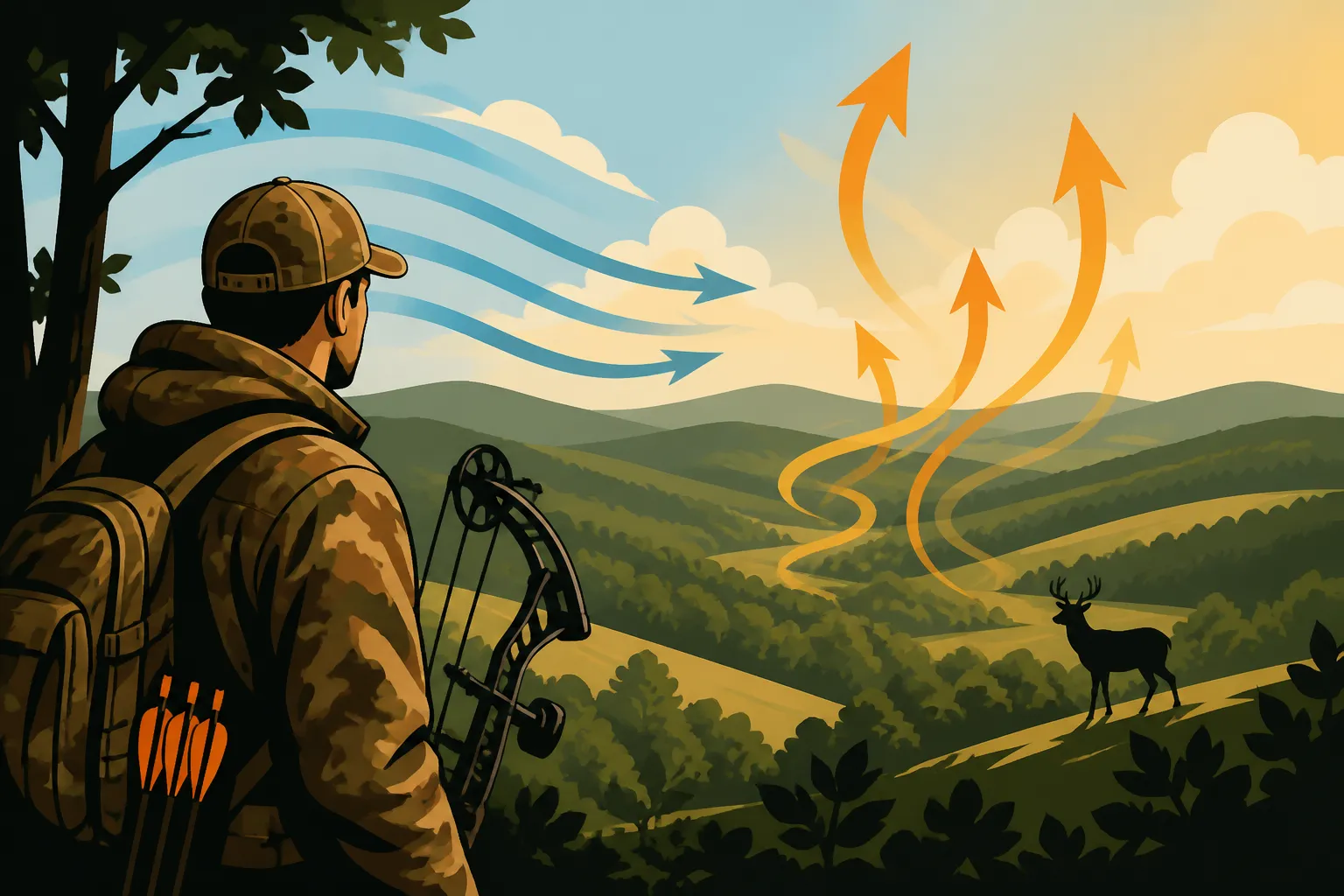
Thermals, on the other hand, are smaller, localized air currents created by temperature differences. As the sun rises, it warms the ground, and that warm air begins to rise. Conversely, as the sun sets and the ground cools, the air sinks. This constant cycle of rising and falling air creates predictable patterns, but these patterns can be easily overridden or influenced by the stronger prevailing wind, or even by specific features like a steep bluff or a dense cedar thicket. The real challenge, and where most hunters get busted, is when these two forces, the prevailing wind and the thermals, are trying to pull your scent in different directions.
How Solar Radiation Impacts Airflow
The sun is the unsung hero—or villain—of thermal activity. As daylight breaks over the Ozark hills, the sun begins to warm the exposed ground. South-facing slopes, for instance, warm up much faster than north-facing ones. As the ground heats, the air directly above it also warms, becoming less dense and rising. This creates an upward thermal current, pulling air from lower elevations up towards the ridge tops. This "thermal lift" is a consistent pattern you can bet on most clear mornings, making it tricky to approach deer bedded high on a ridge.
Conversely, as evening approaches and the sun dips below the horizon, the ground quickly cools. The air above it becomes denser and heavier, causing it to sink. This downdraft, or "thermal drain," pulls air from the ridge tops down into the hollows and creek bottoms. Understanding this daily cycle is paramount. If you're planning an evening hunt, knowing that thermals will likely carry your scent downhill means you need to position yourself carefully, perhaps on a ridge system that allows your scent to blow out into an open area, or above the likely deer travel routes.
Reading the Landscape for Air Movement Clues
The Ozark landscape itself is a giant cheat sheet for understanding wind and thermals, if you know how to read it. Every ridge, hollow, and bench acts as a funnel, a barrier, or an accelerator for air currents. Ignoring these natural contours is a recipe for disaster, no matter how much scent killer you douse yourself in.
Valleys and Hollows: Natural Funnels and Collection Zones
Deep hollows and valleys are notorious for swirling winds, but they also follow some predictable patterns. In the morning, as the sun begins to warm the slopes, air in the hollows will start to rise. If the hollow is narrow and steep, it acts like a chimney, channeling that warm air straight up and out. This means if you're trying to sneak up a hollow on a morning hunt, your scent is going straight up with you. Deer feeding their way down into a hollow, or already bedded low, will catch your scent from below.
In the evening, the opposite occurs. As the sun sets, cool air drains down into these hollows, pooling in the lowest spots. This is why creek bottoms can be deadly places for an evening hunt, as deer often travel these natural corridors, and the sinking air can carry your scent silently away from them, provided you're positioned correctly. However, a prevailing crosswind can still complicate things, pushing that cold air, and your scent, horizontally across the hollow rather than just downhill. Using a mapping tool like GoHunt can really help visualize the contours of these hollows and predict how air will move within them, letting you pinpoint those ideal ambush spots.
Ridge Systems and Benches: Highways and Ambush Points
Ridge tops and benches are critical areas for deer movement and present their own unique thermal challenges. On a clear day, ridge tops tend to catch the full brunt of the prevailing wind, making them somewhat more predictable than hollows. However, as that wind crests a ridge, it can create updrafts or downdrafts on the leeward side, causing swirling at the very top. Benches, which are flatter sections along a slope, are favorite travel routes and bedding areas for deer, but they can also be tricky. Air can get "trapped" or redirected by the steeper ground above and below them.
When hunting a bench, it's often wise to set up just off the bench, perhaps a little higher or lower, to ensure your scent isn't just hanging out on the deer's travel path. Remember, these benches are like highways for deer that want to conserve energy and move through the timber. By understanding how the wind will interact with the slope directly above and below a bench, you can better predict where your scent will go. For example, in the morning, thermals will pull your scent uphill, so sitting on a bench might mean your scent goes over the heads of deer below you but directly at deer higher up.
Consider these scenarios when scouting or selecting a stand:
- Morning on a south-facing ridge: Expect strong updrafts. Position yourself on the north side, or lower down, to keep your scent from blowing directly into uphill bedding areas.
- Evening in a deep hollow: Anticipate downdrafts. Setting up on a slight rise within the hollow or just above it can ensure your scent sinks away from approaching deer. For more detailed insights on how deer use these features, check out our guide on Hunting Missouri Ridge Saddles and Benches.
Practical Strategies for Hunting the Ozark Wind
Now that we've covered the basics of how air moves, let's talk about putting it into action. This isn't about eliminating your scent entirely, which is nearly impossible, but about managing it so that it travels where the deer aren't, or at least where they won't detect you until it's too late.
Approaching Your Stand Undetected
One of the biggest mistakes hunters make is blowing out their hunting area before they even get into their stand. Your entry and exit routes are just as important, if not more so, than your stand placement. Always plan your approach with the wind and thermals in mind. On a morning hunt with rising thermals, this might mean approaching from the lowest point possible and walking slightly off to the side of where you expect deer to be bedded or traveling. If you're going to hunt a ridge top, try to approach from the downwind side, using the ridge itself as a barrier.
In the evening, with falling thermals, you might need to approach from a higher elevation, allowing your scent to sink behind you as you move. This is where detailed topographic maps from services like GoHunt or your Missouri Conservation Atlas become invaluable. You can plot out routes that keep you out of creek bottoms in the morning and off ridge lines in the evening, ensuring you minimize your footprint. Always consider how your scent will move during your walk in and out, not just while you're on stand. This strategy is also crucial when you're Still-Hunting a Missouri Ozark Hollow on foot.
Stand and Blind Placement for Optimal Scent Control
This is where the rubber meets the road. No matter how much you scout, the wind on any given day can still be a challenge. The goal is to pick locations that offer multiple wind options or that inherently mitigate scent dispersal.
- Corners and Points: Look for sharp bends in a ridge or the point of a ridge that extends into a hollow. These areas can sometimes offer slightly more stable wind patterns, as the air current is forced to flow around a distinct feature.
- Leeward Sides: During strong prevailing winds, the leeward (downwind) side of a ridge can offer a more consistent, albeit often lighter, breeze. Deer will often travel these sheltered sides, and you can sometimes use the ridge to "block" your scent from reaching prime areas.
- Thermal Hubs: Identify areas where rising and falling thermals might converge or diverge, such as near major creek junctions or at the head of a large hollow. These areas can be tricky, but if you understand the thermal patterns, they can be phenomenal ambush points.
- Multiple Setups: The most successful Ozark hunters rarely rely on just one stand. Having two or three setups in the same general area, each catering to a different wind direction or thermal pattern, significantly increases your odds. For example, one stand for a northerly wind on a south-facing slope, and another for a southerly wind on the north-facing slope, or one for morning thermals and one for evening. You can learn more about strategic positioning in our piece on Treestand Setups in Hardwood Timber.
Table: Thermal Patterns in Ozark Hills
| Condition | Time of Day | Prevailing Wind | Thermal Movement | Ideal Stand Location | Risk Factor |
|---|---|---|---|---|---|
| Clear, Calm Morning | Sunrise-Midday | Light/Variable | Uphill/Up-slope (rising) | Higher than expected deer travel, along a side ridge, or on leeward side of main ridge. | Scent carried uphill into bedding areas. |
| Clear, Calm Evening | Mid-Afternoon-Sunset | Light/Variable | Downhill/Down-slope (sinking) | Just off a ridge or bench overlooking a hollow/creek bottom. | Scent carried downhill, can pool in hollows. |
| Breezy, Overcast Day | All Day | Moderate/Strong | Less pronounced | Primarily dictated by prevailing wind, slightly off ridge lines, using terrain as buffer. | Swirling wind due to terrain interaction. |
| Transition Times (Sunrise/Sunset) | Dawn/Dusk | Variable | Most chaotic | Often best to avoid directly on ridge/hollow, opt for mid-slope where thermals are stabilizing. | Extremely unpredictable scent dispersal. |
Using the Wind for Entry and Exit Routes
This often gets overlooked, but getting to your stand and leaving it without alerting deer is half the battle. Think about how deer use the landscape to move. They often use thermal highways. For instance, deer tend to travel up and down ridge lines or along benches. If you’re trying to hunt an area where deer are likely to be on a ridge at dawn, your best bet is often to enter from the very lowest part of the terrain, like a creek bottom, long before daylight. Then, use the darkness and the still-settling thermals to move quietly to your stand location just off the ridge. Your scent should be sinking into the hollow below you during this time.
Conversely, for an evening hunt, you might want to approach from higher ground, allowing any scent you generate to blow down and away from the ridge or bench where deer will be moving towards food sources. When exiting, reverse the logic. If you hunted a morning stand high on a ridge, waiting for the thermals to start falling in the afternoon, or for a solid prevailing wind to set in, can make your exit much safer. Always try to put a hill, a thick cedar patch, or a deep hollow between you and the known bedding/feeding areas as you come and go. Consider the specific challenges of Getting a Deer Out of a Hollow Alone if you have to track one into rough terrain.
Gear and Tools for Managing Wind and Scent
While no gear can perfectly counteract a poor wind strategy, some tools can significantly help you understand and manage your scent in the unpredictable Ozark environment. Don't underestimate the power of preparation and the right equipment.
Wind Checking Tools and Real-Time Weather
The simplest and most effective tool for real-time wind assessment is a good old-fashioned wind checker. These are typically squeeze bottles of fine powder that allow you to visualize air movement, not just the prevailing wind, but those sneaky eddies and swirls near your stand. Use it constantly. Test it above you, below you, and to the sides. You'll be amazed at how often the wind at your boot level is different from the wind 20 feet up in your stand, or just across the hollow.
Beyond that, modern technology offers powerful advantages. Weather apps that provide hourly wind direction and speed are essential for planning. Some, like AccuWeather or NOAA, can give you hyperlocal forecasts that account for elevation changes. Additionally, mapping applications such as GoHunt or OnX have incredibly detailed topographic maps that show elevation lines, drainage features, and even specific types of timber. These tools allow you to study the terrain beforehand, visualize how air might flow, and identify potential thermal traps or funnels. Plotting potential stand locations and entry/exit routes on these apps before you even step foot in the woods can save you a lot of wasted effort and busted hunts. This is a huge step up from simply relying on the Missouri Conservation Atlas in paper form, though that atlas is still an invaluable resource for general scouting.
Scent Control for Challenging Conditions
We all know the mantra: "Scent control, scent control, scent control." But in the Ozarks, it's not just about spraying down with an ozone product or washing your clothes in scent-free detergent. It's about a holistic approach that acknowledges the reality of swirling, unpredictable winds.
- Base Layers and Outerwear: Start with clean base layers and work your way out. Choose outer layers that are designed to block wind and minimize scent dispersion. While often discussed in the context of open fields, the principles of Wind-Blocking Outerwear for Open Fields are equally important in drafty timber stands. Fabrics that are quiet and don't pick up ambient odors readily are ideal.
- Storage and Transport: Don't just throw your hunting clothes in the back of your truck next to your gas can. Store them in scent-proof bags or containers. Dress at the trailhead, or even better, a good distance away, to avoid picking up car or parking lot odors.
- Personal Hygiene: Scent-free soaps, shampoos, and deodorants are a given. Even seemingly minor things like breath mints or avoiding strong coffees before a hunt can make a difference when a thermal unexpectedly carries your breath downwind.
- Human Factor: No amount of spray can hide the scent of heavy perspiration. If you're busting butt hiking up a steep Ozark ridge, you're going to sweat. Plan your approach to be slow and steady, allowing your body to cool down before you reach your stand. Wear lighter layers on the walk in and change into warmer, heavier layers once you're settled. This is especially important during early season archery, where Field Dressing and Cooling in Early-Season Heat can be critical.
Remember, the goal isn't to be scent-free, but to manage your scent so effectively that even when the Ozark winds play their tricks, deer don't detect you until it's too late. It's a game of chess against nature, and with careful planning and an understanding of wind and thermals, you can definitely tip the odds in your favor.
Disclaimer
Hunting involves inherent risks, and it is the responsibility of each individual hunter to ensure their safety and comply with all local, state, and federal regulations. The information provided in this guide is for educational purposes only and should not replace professional guidance or personal experience. Always prioritize safety, respect wildlife, and adhere to ethical hunting practices.