Rattling Volume for Thick Timber
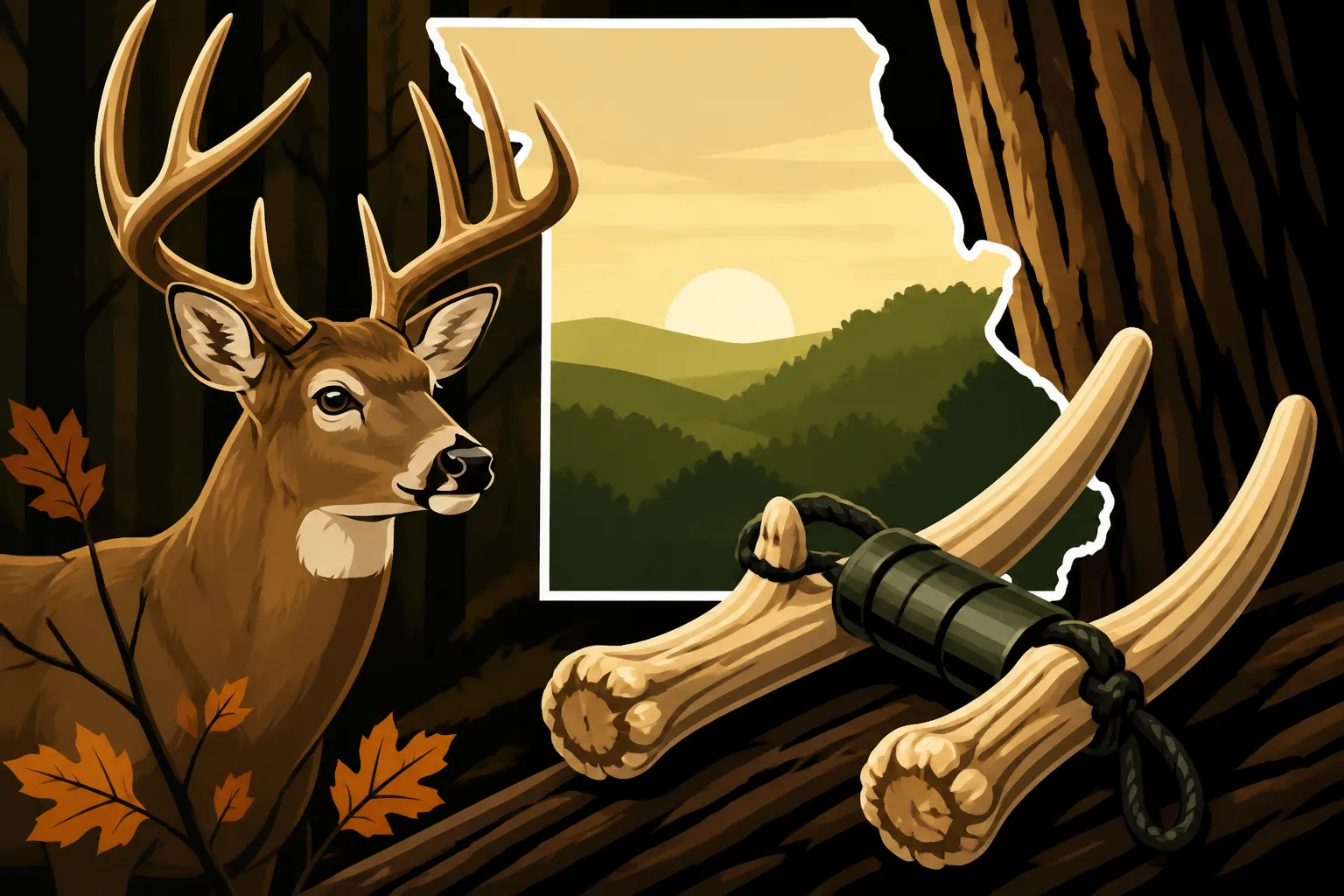
It's frustrating, isn't it? You spend hours perfecting your rattling sequence in the backyard, only to hit the woods, clash those antlers together, and feel like the sound just dies after 20 yards. When you're hunting in Missouri's notoriously thick timber, especially the kind found in the Ozarks or denser pockets of northern farm country, the traditional, loud, aggressive rattling often falls flat. This guide is all about mastering the art of subtle, effective rattling in dense cover, helping you draw in those wary whitetails when sound just won't carry.
Understanding How Sound Travels in Dense Missouri Timber
The dense timber across much of Missouri, whether it's the steep, rocky Ozark hillsides or the choked creek bottoms in agricultural areas, presents unique challenges for hunters trying to use rattling calls. Unlike open fields or sparse woods where sound can travel hundreds of yards, a thick forest acts like a giant sound sponge, absorbing and disrupting acoustic waves. Understanding this fundamental difference is the first step to successful rattling.
The Acoustic Obstacle Course of the Woods
Imagine your rattling sound as a wave trying to navigate a maze. Every tree trunk, every branch, every patch of underbrush, and even the leaf litter on the ground acts as an obstacle. These obstacles reflect, absorb, and refract sound waves, rapidly diminishing their intensity and range. It's not just about how loud you hit the antlers, but how effectively that sound can penetrate the environment. The closer the trees, the thicker the brush, the shorter the effective range of your call.
This is especially true in areas with heavy undergrowth like dogwoods, greenbrier, and cedars, common in many Missouri deer habitats. The air itself can also play a role; on damp, still mornings, sound might carry a little better, but wind, even a light breeze, can completely negate your efforts by pushing sound in unintended directions or masking it with ambient noise.
Deer Hearing Versus Human Perception
We tend to rattle at a volume we think a deer should hear, based on our own perception. However, a deer's hearing is incredibly acute, far surpassing ours, especially for subtle sounds and distinguishing direction. While we might hear a loud crash and associate it with fighting bucks, a deer can pick up on much finer details, like the snapping of twigs, the rustle of leaves, and the subtle clashing of tines. This means that a sound that seems "quiet" to us might actually be quite audible and convincing to a deer within its immediate vicinity.
Furthermore, deer in thick cover are often accustomed to a relatively quiet environment, punctuated by natural sounds. An unnaturally loud or prolonged rattling sequence might instantly put them on high alert, associating it with human activity or something overtly dangerous rather than a natural buck fight. This is why a nuanced approach to rattling volume is so critical in these situations.
Adjusting Your Rattling Strategy for Thick Cover
Given the sound-dampening nature of dense timber, a "go loud or go home" approach is almost guaranteed to fail. Instead, think "less is more" and "closer is better." Your strategy needs to adapt to the limitations of the environment and the wary nature of timber bucks.
Shorter, Softer Sequences
Forget about those five-minute, ear-splitting battles you see on TV that are meant for wide-open agricultural fields. In thick timber, your rattling sequences should be significantly shorter and much softer. Aim for bursts of 15-30 seconds of antler clashing, followed by long periods of silence – sometimes 10 to 15 minutes, or even longer. This mimics the reality of two bucks sparring or fighting; it’s rarely a continuous, drawn-out affair.
The volume itself should be controlled. Instead of violently smashing the antlers together, focus on softer, controlled clashes, grinding the bases, and tickling the tines. This creates a more realistic sound profile that suggests two bucks testing each other, rather than an all-out brawl. The goal is to pique curiosity, not to announce your presence to every animal in the zip code. You want to make them think, "Hey, what was that?" rather than "Oh no, trouble!"
Incorporating Environmental Sounds
One of the most effective ways to make your rattling more believable in dense timber is to integrate the sounds of the environment. When two real bucks fight, they aren't just clashing antlers; they're pushing through brush, scraping their hooves on the ground, and snapping twigs. You can emulate this. After a short, soft rattling sequence, kick some leaves around with your foot, or snap a small branch. Even pushing a rattling bag against a tree trunk can add realism.
This technique adds layers to your auditory deception. It suggests movement and interaction within the immediate area, making the deer believe the "fight" is happening right there in the thick stuff. Hunters often overlook this crucial element, but it can be the difference between a curious deer committing to investigate and one that simply hears some strange noises and moves on. If you're using a tool like GoHunt's mapping features to scout potential setups, pay attention to areas with good ground cover for these subtle additions.
| Rattling Environment | Recommended Volume | Sequence Length | Silence Between Sequences | Additional Tips |
|---|---|---|---|---|
| Thick Timber | Soft to Medium | 15-30 seconds | 10-20 minutes | Incorporate brush breaking, leaf kicking. Focus on realism, not distance. Get close to known deer travel routes. |
| Open Hardwoods | Medium to Loud | 30-60 seconds | 15-30 minutes | Can carry further. Mix in grunts. Good for Treestand Setups in Hardwood Timber. |
| Field Edges | Medium to Loud | 45-90 seconds | 20-40 minutes | More aggressive when deer are far out. Use with visual decoys. Refer to Decoying a North Missouri Buck. |
| River Bottoms | Medium | 30-45 seconds | 15-25 minutes | Sound can get absorbed by water and lush vegetation. Use grunts heavily. See Grunt Calls in Missouri River Bottoms. |
Optimizing Your Location and Timing
Even the best rattling technique will fail if you're not in the right spot at the right time. In thick Missouri timber, location and timing are arguably even more critical than in open country, because your effective sound range is so limited.
Setting Up in Natural Travel Corridors
Since your rattling won't carry far, you absolutely must set up where deer are already moving. Think about those natural funnels, pinch points, and cover transitions that deer naturally use to travel from bedding to feeding areas or simply to cruise for does. Creeks, ridge saddles, benches, and the edges of dense bedding areas are prime locations. For example, if you're Reading an Ozark Hollow for Deer Movement, you know those deer aren't going to be moving in a straight line through the deepest thicket, but rather along the subtle contours and paths of least resistance.
Your setup needs to be within about 50-100 yards of where you expect a deer to pass. Any further, and they might not hear you, or the sound might be too faint to draw their attention. This often means getting deeper into the woods, closer to bedding thickets, rather than sticking to the fringes. When considering Hunting Missouri Ridge Saddles and Benches, remember that these features naturally funnel deer and offer a good auditory backdrop for rattling.
The Best Time to Rattle in Missouri's Rut
Rattling is most effective during the pre-rut and the peak rut in Missouri, typically late October through mid-November. This is when bucks are most actively seeking does and are more likely to respond to the sound of other bucks fighting. During the pre-rut, bucks are establishing dominance and getting aggressive, making them susceptible to challenging calls. Hunting the Pre-Rut in Late October is a fantastic time to start experimenting with rattling.
As the rut intensifies in early November, especially during Hunting the Peak Rut Week in Missouri, bucks are often so focused on breeding that they're either locked down with a doe or frantically searching for one. The sound of a fight can often pull them away from a hot doe, either to investigate a potential competitor or simply out of sheer territorial aggression. Early mornings and late afternoons are generally the best times, as bucks are most active during these periods. However, don't rule out midday rattling in dense cover; mature bucks often move during the quiet midday hours, especially when pressured.
Combining Rattling with Other Calls and Visuals
Rattling alone, even when perfectly executed, might not always be enough to seal the deal in thick Missouri timber. Integrating other calls and even subtle visuals can significantly increase your chances of drawing in a buck.
Grunts and Bleats
Think of rattling as the main event, and grunts and bleats as the supporting cast. A buck grunt, especially a deep, guttural one, can add immense realism to your rattling sequence. It suggests a third buck moving into the "fight" or a buck challenging another. After a rattling sequence, try a few soft grunts. A doe bleat, particularly an estrous bleat, can also be highly effective, as it signifies a doe in heat that the fighting bucks might be competing over.
Many hunters use grunt tubes in conjunction with their rattling antlers. The key is subtlety. In thick cover, loud, aggressive grunting might spook more than it attracts. Keep your grunts short, sharp, and natural. Remember, you're trying to emulate a real-life scenario, and real deer aren't always screaming at each other. Learning Grunt Calls in Missouri River Bottoms can teach you how to adjust the volume and tone to match specific conditions.
Subtle Visuals and Scents
In dense timber, where visibility is limited, even a slight visual cue can make a huge difference. You might not want a full-blown decoy if you're trying to remain mobile, but a small, lightweight silhouette or even a partial decoy (like a head and neck) placed in a shooting lane can be enough. A buck hearing the rattling and then catching a glimpse of what appears to be another deer can be the final trigger for him to commit. Remember, in these environments, deer are often looking for the source of the sound, and if they can't see anything, they might hang up.
Scent can also be a game-changer. Using a dominant buck urine, estrous doe urine, or even a curiosity scent around your setup adds another layer of realism. A buck might approach cautiously, using his nose to confirm what his ears are telling him. While you want to minimize your own human scent, strategically placed deer scents can help guide an approaching buck into a shooting lane or hold his attention long enough for a shot. Just be mindful of Missouri Baiting and Feeding Rules and ensure your scent use complies with regulations.
Practical Tips for Rattling Success in Thick Missouri Woods
Successfully rattling in thick timber isn't just about technique; it's also about mindset, patience, and attention to detail. These practical tips can help you increase your odds.
Patience is a Virtue
One of the biggest mistakes hunters make when rattling in thick cover is giving up too soon. A buck that hears your rattling might not charge in immediately. He might circle downwind, approach slowly, or simply take his time to assess the situation. After a rattling sequence, remain absolutely still and silent for at least 10-15 minutes, sometimes even longer. Many bucks have been spotted sneaking in silently, almost like ghosts, long after the hunter thought nothing was coming.
This requires immense patience. Fight the urge to grab your phone, shift around, or give up. Every rustle you make, every movement, could be the one thing that spooks a wary buck that's just out of sight. Remember that deer in thick cover are often closer than you think, and they have the advantage of cover to approach undetected.
Staying Mobile and Adaptable
In thick timber, being tied to one spot isn't always the best approach. Consider a "run and gun" style of rattling, especially during the peak of the rut. This involves moving through promising areas—like along a creek bottom or a series of benches—stopping every few hundred yards to set up, rattle, and listen for 15-20 minutes. If nothing responds, quietly move on to the next promising spot. This strategy covers more ground and increases your chances of encountering a buck within your limited sound range.
This doesn't mean crashing through the woods. It means strategic, quiet movement from one calculated setup to the next. Using a mapping app like GoHunt can help you identify a series of promising locations beforehand, allowing you to move efficiently and minimize wasted time or spooking deer. When Still-Hunting a Missouri Ozark Hollow, you're already covering ground quietly, making it a perfect complement to this mobile rattling approach.
The Gear That Helps
While you can rattle with natural antlers, a good set of synthetic rattling antlers or a rattling bag can offer several advantages in thick timber. Synthetic antlers like those from Rattling Forks or Haas Outdoors are often more compact, quieter to carry, and produce consistent sounds. Rattling bags, like those from Primos, are incredibly convenient for producing soft, realistic clashing and grinding sounds with minimal effort, and they also allow you to simulate brush breaking more easily.
Whatever you choose, practice with it. Get a feel for how to control the volume, how to create realistic grinding sounds, and how to incorporate the sounds of branches and leaves. The more natural and controlled your sounds are, the more convincing you'll be to those wary Missouri whitetails.
Disclaimer
Hunting is an inherently dangerous activity. Always prioritize safety, follow all local and state regulations set forth by the Missouri Department of Conservation (MDC), and ensure you have the necessary permits and education. This guide is for informational purposes only and does not guarantee hunting success. Be respectful of wildlife and the environment.