Missouri Ruffed Grouse and Prairie Chickens
Many Missouri hunters, especially newer generations, are largely unaware that once-thriving populations of ruffed grouse and greater prairie chickens roamed the Show-Me State, offering unique hunting challenges that are now largely a distant memory. This guide aims to pull back the curtain on the complex history, ecological struggles, and current status of these iconic upland birds, providing a comprehensive look at what led to their decline and the ongoing efforts to preserve their last vestiges in Missouri.
The Silent Woods: Tracing Missouri's Ruffed Grouse History
For many who love the Missouri woods, the idea of hunting ruffed grouse feels like something out of an antique hunting magazine, not a contemporary possibility. Yet, there was a time when the drumming of a male grouse was a common sound echoing through the Ozark hills, a rhythmic beat signaling the arrival of spring and the presence of these elusive woodland birds. Understanding their history helps us appreciate just how much our landscapes have changed.
A Legacy of Abundance
Imagine Missouri before widespread European settlement. The Ozarks, in particular, were covered in vast, unbroken expanses of oak-hickory forest. These forests, often shaped by frequent natural fires ignited by lightning or Native American practices, had a more open understory in many areas but also dense thickets where young trees thrived after a disturbance. This mosaic of habitats, with varying ages and densities of timber, was the perfect environment for ruffed grouse.
Early settlers, pushing into the rugged Ozark frontier in the 19th century, frequently encountered these birds. Diaries and historical accounts often refer to "pheasants" in the woods, though it was almost certainly the ruffed grouse they were describing. They were a reliable food source, a challenging quarry for early market hunters, and a common part of the forest's tapestry. Their numbers peaked in many areas around the turn of the 20th century, following the initial wave of widespread logging that created an abundance of young, brushy habitat.
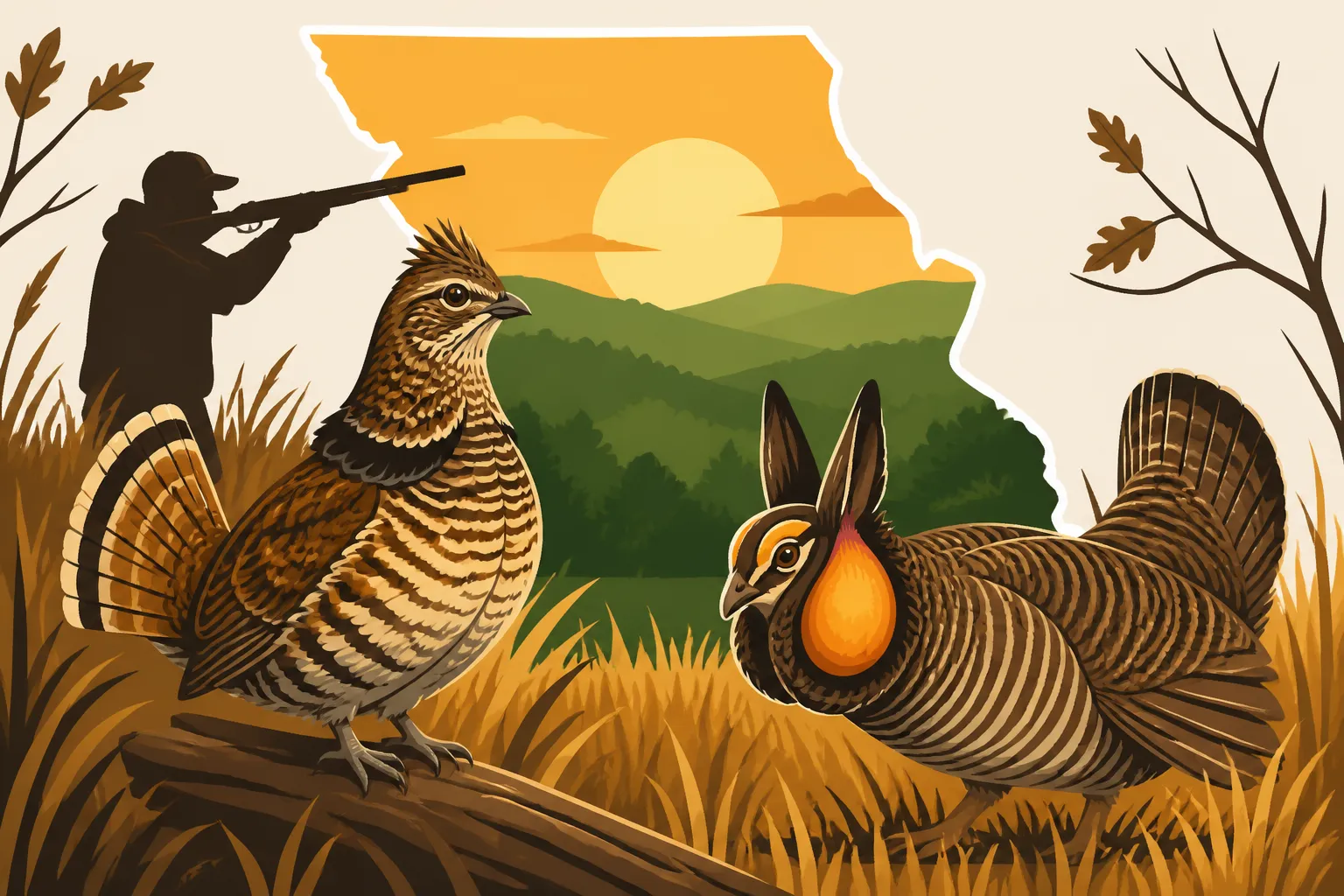
The drumming display of the male ruffed grouse is one of nature's subtle marvels. Standing on a log, he beats his wings rapidly, creating a vacuum that produces a low, resonant thumping sound that starts slowly and accelerates, much like a distant tractor trying to start. This distinctive sound was a regular fixture of the Missouri timber in spring, a sharp contrast to today where most contemporary Missouri hunters have never had the privilege of hearing it in the wild, let alone seeing the bird responsible.
The Axe and the Plow: Changing Landscapes
The fate of Missouri's ruffed grouse population is inextricably linked to the history of the state's forests. The late 19th and early 20th centuries saw widespread, unregulated logging across the Ozarks, often clear-cutting vast tracts of virgin timber to fuel burgeoning industries and railroads. Initially, this disturbance created an explosion of early successional habitat – dense, young saplings, shrubs, and brushy growth – which actually favored grouse, leading to a temporary boom in their numbers.
However, this boom was short-lived. The subsequent regrowth of these logged areas, coupled with aggressive fire suppression policies, led to forests that became increasingly uniform in age and density. Ruffed grouse thrive in a dynamic forest, needing a diverse mix of habitats: dense, young stands for nesting and brood-rearing cover, slightly older brushy areas for escape cover, and mature timber for foraging on buds, catkins, and mast. When large portions of the forest matured into dense, pole-timber stands with little understory diversity, the critical components of grouse habitat simply vanished.
Furthermore, as agriculture expanded, especially along river bottoms and flatter areas adjacent to the Ozark highlands, forest edges became increasingly fragmented. This created less interior forest habitat and more "edge" habitat, which, while beneficial for some species, can increase predation pressure on sensitive woodland birds like grouse. The nuanced habitat requirements of the ruffed grouse were slowly but steadily eroded by human intervention and a lack of understanding regarding their ecological needs.
The Lingering Remnants and Closed Seasons
The gradual decline of the ruffed grouse in Missouri eventually reached a critical point, leading the Missouri Department of Conservation (MDC) to close the state's ruffed grouse hunting season in 1999. This decision marked the end of an era and underscored the serious conservation challenges facing the species. Since then, populations have dwindled to extremely low numbers, scattered in isolated pockets within the most remote and suitable areas of the Ozarks.
These remaining populations are fragile and often exist in areas where some active habitat management, such as prescribed burning or targeted timber stand improvement, is still occurring, mimicking the natural disturbances they once relied on. Sightings of ruffed grouse in Missouri today are incredibly rare and are often considered significant events by both biologists and seasoned woodsmen who understand what a special bird they are. These accidental encounters often generate considerable excitement, a testament to their ghost-like presence.
Currently, there is no open season for ruffed grouse in Missouri, and the prospect of one returning in the foreseeable future is, unfortunately, highly unlikely. The focus has shifted entirely from hunting to preserving these last remnants and, where possible, enhancing habitat to prevent their complete disappearance from the Show-Me State. The silent woods where their drumming once echoed now serve as a stark reminder of habitat loss.
Echoes of the Prairie: Missouri's Greater Prairie Chicken Story
While the ruffed grouse retreated with the advancing forest, another iconic bird, the greater prairie chicken, vanished with the receding prairie. These magnificent birds were once as synonymous with the vast grasslands of northern and western Missouri as bison were to the American plains. Their story is a powerful illustration of how rapidly and completely an entire ecosystem can be transformed.
Lords of the Tallgrass
Imagine looking across what is now a patchwork of corn and soybean fields in northern Missouri, but instead seeing a boundless sea of tallgrass prairie, stretching as far as the eye could see. This was the historical domain of the greater prairie chicken. These birds were not just in the prairie; they were the prairie, their very existence inextricably linked to its vastness and ecological health. They relied on its dense cover for nesting, rearing their chicks, and evading predators, and on its diverse plant life for sustenance throughout the year.
One of the most remarkable aspects of prairie chicken life is their elaborate courtship ritual. In the spring, males gather on traditional "booming grounds," known as leks, where they engage in a spectacular display. They inflate bright orange air sacs on their necks, stamp their feet, and emit a deep, resonant "booming" sound that can carry for miles across the open prairie. This auditory spectacle, accompanied by sparring and dramatic dances, once defined the Missouri spring for anyone within earshot.
Early accounts from pioneers and naturalists often speak of literally hundreds, even thousands, of prairie chickens congregating for these booming displays. They were so abundant that they were a primary game bird, easily harvested and widely consumed. Their presence was a clear indicator of a healthy, expansive prairie ecosystem, a testament to the incredible biodiversity that once flourished in the heartland of Missouri.
The Vanishing Habitat
The narrative of the prairie chicken in Missouri is fundamentally one of devastating habitat loss and conversion. Missouri, often known as the "Show-Me State," was once a "Prairie State," with over 15 million acres of tallgrass prairie. Today, tragically, less than 1% of that original prairie remains. This rapid and near-total conversion of native grasslands to agricultural cropland, primarily for corn and soybeans, was the single greatest factor in the prairie chicken's decline.
The issue wasn't just about losing food sources; it was the complete eradication of the dense, undisturbed nesting cover that is absolutely crucial for chick survival. Prairie chicken chicks are precocial, meaning they hatch relatively developed, but they are incredibly vulnerable to exposure and predation in their first weeks. They rely on the thick, insulating cover of tall grasses for protection and an abundant insect population for rapid growth. Monoculture farming, urban sprawl, road construction, and the widespread use of pesticides further compounded the problem.
Even small fragments of prairie, when surrounded by vast agricultural fields, are often insufficient for long-term prairie chicken survival. These fragmented habitats suffer from "edge effects," where increased access for predators (like raccoons, skunks, and coyotes) and higher rates of nest parasitism from species like brown-headed cowbirds decimate nesting success. The extensive plowing and drainage that accompanied agricultural expansion permanently altered the landscape, leaving the prairie chicken with nowhere to go.
A Fragile Future: Remaining Populations
Today, the greater prairie chicken is listed as an endangered species at both the state and federal level in Missouri, highlighting the severity of its plight. The remaining viable populations are critically small, numbering only a few hundred birds total, and are confined to specific, intensively managed areas in northern and western Missouri. These areas are almost exclusively on large conservation areas owned by the Missouri Department of Conservation (MDC) or a handful of expansive private land tracts where dedicated conservation efforts are in place.
These remaining strongholds are the subject of active, often experimental, habitat restoration and management. Biologists work tirelessly to maintain the precise conditions prairie chickens need for survival, using tools like prescribed fire, grazing management, and native plant restoration. Unfortunately, even with these efforts, the populations are incredibly fragile and highly susceptible to fluctuations due to weather, predation, and genetic bottlenecks. You can learn more about Greater Prairie-Chicken Numbers in Missouri and Where Missouri Prairie Chickens Remain through MDC's reports.
The hope for the prairie chicken's future in Missouri rests entirely on expanding and connecting these precious fragments of native prairie. Without significant and sustained conservation action, this iconic bird, which once boomed across millions of acres, faces the very real threat of extirpation from the Show-Me State.
Unpacking the Decline: Core Challenges for Both Species
While ruffed grouse and greater prairie chickens occupy vastly different habitats – deep woods and open prairies, respectively – their stories of decline in Missouri share common threads. Both species fell victim to large-scale landscape changes driven by human settlement and agricultural expansion. Understanding these core challenges is critical to appreciating why their recovery is so difficult and why their presence today is so rare.
Habitat Quantity and Quality
For both species, the ultimate reason for their decline boils down to the loss of both the sheer quantity and specific quality of their preferred habitat. Ruffed grouse require a dynamic forest environment, one that cycles through early to mid-successional stages. This means a mosaic of young, dense thickets (for brood rearing and escape cover), brushy clearings, and mature timber (for food sources like mast and buds). This type of varied forest structure is challenging to maintain on a large scale without active timber management, which was historically achieved through natural disturbances like fire and storm events. When entire forests grow into uniform, mature stands without disturbance, the critical understory habitat for grouse disappears.
Similarly, prairie chickens need vast, unbroken tracts of diverse native tallgrass prairie. This isn't just any grass; it's specific native species that provide the structure and plant diversity essential for nesting, insect production (crucial for chick survival), and protection from predators. The conversion of nearly all of Missouri's original prairie to agriculture meant the wholesale destruction of this specialized habitat. Even a seemingly small change, such as the invasion of non-native fescue grasses into a remnant prairie, can drastically impact a prairie chicken's ability to successfully nest and rear young, as fescue lacks the necessary structure and harbors fewer insects. The challenges are highlighted by the Habitat Loss and Missouri Quail issue, which shares similar roots.
Fragmentation and Isolation
Beyond the outright loss of habitat, the fragmentation of what little remained has been devastating for both grouse and prairie chickens. As roads, human development, and agricultural expansion carved up once-continuous landscapes, the remaining pockets of suitable habitat became increasingly isolated. This creates numerous problems for wildlife populations.
First, isolated populations often suffer from reduced genetic diversity. When a small group of birds is cut off from others, their gene pool shrinks, making them more vulnerable to inbreeding, diseases, and less adaptable to environmental changes. This lack of genetic resilience can be a slow death sentence for a population, even if habitat appears adequate on the surface.
Second, fragmented habitats struggle to recover from local die-offs or poor breeding years. If a harsh winter or a particularly wet spring devastates a small, isolated population, there are no nearby populations to "spill over" and replenish the numbers. This makes these fragmented groups incredibly precarious. Furthermore, increased edge habitat resulting from fragmentation often leads to higher predation pressure, as predators can more easily access nests and vulnerable birds along forest or field edges. For both grouse in the woods and prairie chickens on the plains, fragmentation has proven to be a critical, often insurmountable, hurdle.
Predation and Other Pressures
While predation is a natural and healthy component of any ecosystem, fragmented habitats and human-altered landscapes can lead to unnaturally high predation pressure, which becomes a significant factor when wildlife populations are already stressed. Mesopredators like raccoons, opossums, skunks, and even free-ranging domestic cats and dogs can thrive near human development and agricultural areas, leading to an increased presence in sensitive wildlife habitats. These predators frequently prey on nests, eggs, and vulnerable chicks of ground-nesting birds like grouse and prairie chickens.
Beyond direct predation, both species are highly vulnerable to environmental pressures. Cold, wet springs can be catastrophic for chick survival, especially when populations are already at critically low levels. Chicks need warmth and a steady supply of insects for rapid growth, and prolonged periods of adverse weather can lead to widespread mortality. Droughts can also impact food availability and nesting cover.
While less documented as a primary driver of their initial decline in Missouri, diseases can also play a role, particularly in small, genetically compromised populations. The cumulative effect of these pressures – unnaturally high predation, adverse weather, and potential disease – can push already struggling populations towards extirpation, even when conservation efforts are in place. Understanding these intricate habitat requirements is the first step towards effective conservation, and advanced geographic information systems (GIS) and platforms, such as GoHunt, can assist researchers and managers in analyzing landscape-level changes and identifying critical habitat gaps.
Conservation's Last Stand: Efforts, Strategies, and Habitat Restoration
The dire status of ruffed grouse and greater prairie chickens in Missouri has led to dedicated, albeit challenging, conservation efforts by the Missouri Department of Conservation (MDC) and various partner organizations. While the scale of recovery varies for each species, the overarching strategy revolves around intensive habitat management, research, and fostering public awareness.
MDC's Dedicated Grouse Habitat Work
For ruffed grouse, the challenge of restoring a statewide, huntable population is currently viewed as insurmountable given the extensive landscape changes that have occurred. However, the MDC continues to manage specific conservation areas within the Ozarks with grouse in mind, aiming to support the remnant populations that still cling to existence. This isn't about creating vast new grouse range, but rather meticulously managing small pockets of existing habitat.
These efforts often involve targeted timber stand improvement (TSI), which might include thinning mature trees to encourage understory growth, or creating small patch cuts that allow sunlight to reach the forest floor and stimulate the dense, young growth grouse prefer. Prescribed burns, carefully implemented in timbered areas, are also crucial. These fires mimic historical natural disturbances, clearing out accumulated leaf litter and promoting the growth of early successional vegetation and soft mast-producing shrubs. Such burns are increasingly used on Missouri Conservation Areas.
While these localized efforts provide crucial benefits for the few remaining grouse, they also create valuable habitat for other forest-dwelling species, including white-tailed deer, wild turkeys, and various songbirds. It's a testament to the broad benefits of active forest management, even if the primary target species remains critically endangered. This proactive management offers lessons for broader wildlife health, even reflecting issues like Why Missouri Turkey Poult Survival Fell due to lack of good cover.
Prairie Chicken Strongholds and Partnerships
The conservation strategy for greater prairie chickens in Missouri is even more intensive, focusing almost exclusively on maintaining and expanding their few remaining strongholds. The MDC's primary approach centers on meticulously managing existing tracts of native tallgrass prairie, using a suite of tools designed to replicate the historical forces that shaped these ecosystems.
Prescribed fire is arguably the most critical tool in prairie chicken management. Regular burning controls invasive woody vegetation, removes thatch, stimulates the growth of native warm-season grasses and forbs, and improves insect populations – all vital components of prairie chicken habitat. Grazing management, when implemented carefully and rotationally, can also mimic historical bison grazing patterns, creating a mosaic of grass heights that benefits different stages of the prairie chicken life cycle. Efforts also include the removal of non-native, invasive plant species that outcompete native prairie plants.
Crucially, MDC works extensively with private landowners, recognizing that vast landscapes are required for these birds. Programs like the Conservation Reserve Program (CRP) or Wetland Reserve Program (WRP) incentivize private landowners to convert marginal croplands back to native grasses, providing invaluable nesting and foraging habitat. Specific areas like Taberville Prairie Conservation Area in St. Clair County or Wah'Kon-Tah Prairie in Vernon County are prime examples of these dedicated efforts. For conservation managers and private landowners collaborating on these vital initiatives, modern mapping and data analysis tools, similar to those available through platforms like GoHunt, provide invaluable assistance in identifying optimal restoration sites, tracking habitat changes, and monitoring the effectiveness of various management techniques. For those looking to explore such areas, resources like Scouting With the Missouri Conservation Atlas and Using the Atlas to Find an Area can be incredibly helpful.
The Critical Role of Public Awareness and Funding
Effective wildlife conservation, especially for species in such precarious positions, requires significant financial investment and broad public support. The one-eighth-cent conservation sales tax in Missouri is a vital funding source for MDC's extensive habitat management and research programs, directly benefiting species like the prairie chicken. Educating the public about the unique ecological value of these birds and the challenges they face helps garner the necessary support for these costly, long-term initiatives.
Beyond government agencies, conservation groups like The Ruffed Grouse Society and Audubon Missouri advocate tirelessly for these birds, raising funds and awareness. Researchers continually monitor population numbers, conduct banding studies, and engage in genetic research to better understand the health and viability of remaining populations. Citizen science initiatives, where volunteers report sightings or assist with habitat work, also play a role. For those interested in understanding habitat distribution or even identifying potential conservation easements, resources and digital mapping tools, including those offered by GoHunt, can provide invaluable geographic data. The future of these birds hinges not just on habitat work, but on a collective will to protect Missouri's natural heritage.
A Hunter's Perspective: Respecting the Past, Embracing the Present
For many hunters, the thought of pursuing ruffed grouse or prairie chickens in Missouri is a romantic notion, a wistful look back at a time when these birds were a legitimate part of the hunting landscape. While those days are largely gone, the story of their decline offers profound lessons and encourages a shift in focus toward appreciating and pursuing the stable upland game opportunities that Missouri still offers.
Lessons from Lost Opportunities
Older generations of Missouri hunters can recall stories, or even firsthand experiences, of encountering ruffed grouse in the Ozarks or hearing the distant booming of prairie chickens in the grasslands. This history serves as a poignant and powerful reminder of the fragility of wildlife populations and the critical importance of habitat. The loss of these unique hunting opportunities underscores how rapidly landscapes can change and how human activities, often unintentional, can have devastating impacts on species.
These historical losses have shaped current conservation strategies for other game species, emphasizing sustainable harvest limits, active habitat management, and proactive conservation. The experience teaches us that waiting until a species is on the brink is often too late for a robust recovery, let alone a return to hunting. It instills a sense of responsibility in today's hunters to be conservationists first, ensuring that the mistakes of the past are not repeated with other valued game.
Shifting Focus to Stable Upland Game
Since hunting ruffed grouse and greater prairie chickens is not an option in Missouri, upland bird enthusiasts have rightly shifted their focus to other, more stable populations. The good news is that Missouri still offers excellent opportunities for upland game, particularly for northern bobwhite quail and rabbits. Missouri Quail and Rabbit Seasons remain open, providing challenging and rewarding experiences.
While quail populations have faced their own challenges, the MDC has invested heavily in Missouri Bobwhite Population Trend recovery, focusing on large-scale habitat restoration landscapes across the state. These efforts, which include creating native grass buffers, controlled burns, and judicious cover management, are yielding positive results in many areas. Pheasant hunting is also available, albeit in a more restricted range, primarily in the Missouri Pheasant Range in the North. These species still offer the thrill of walking cover with a good dog, the explosive covey rise, and the camaraderie of the hunt. For hunters adapting to the reality of no grouse or prairie chicken seasons, technology aids in finding other opportunities. Platforms like GoHunt become indispensable for scouting public lands, identifying prime quail or rabbit habitat, understanding property boundaries, and even analyzing satellite imagery to pinpoint cover changes throughout the season.
Beyond the Harvest: Conservation and Appreciation
The story of Missouri's ruffed grouse and prairie chickens is a powerful call for hunters to embrace their role as conservationists, regardless of whether a season is open. Supporting the Missouri Department of Conservation through permit purchases, advocating for sound habitat management policies, and even participating in volunteer habitat improvement projects are ways to contribute directly to the health of all wildlife.
Even without a hunting season, the mere knowledge that these incredible birds still exist, however precariously, adds a layer of richness to the outdoor experience in Missouri. Observing a prairie chicken booming on a lek (from a respectful distance) or catching a rare glimpse of a grouse flushing in the Ozarks can be as rewarding as a successful hunt. These experiences foster a deeper appreciation for Missouri's diverse ecosystems and the incredible wild creatures that call them home. For those whose primary interest is observation rather than harvest, GoHunt and similar mapping applications can be powerful tools. They allow enthusiasts to pinpoint historical ranges, locate managed conservation areas, and better understand the unique ecological niches these magnificent birds occupy, making non-consumptive wildlife recreation more accessible and informed.
Comparative Outlook and Future Hope
When we look at the trajectories of Missouri's ruffed grouse and greater prairie chickens, we see two distinct species that met a shared, unfortunate fate: a dramatic decline due to human impact. However, their unique biological requirements and the specific nature of their habitat loss mean that their paths to potential recovery, and their ultimate outlook, diverge significantly.
Distinct Challenges, Shared Fate
Both grouse and prairie chickens experienced devastating habitat loss, but the exact nature of that loss was different. Ruffed grouse, as forest-dwelling birds, suffered from the homogenization of Missouri's timberlands. The lack of active forest management, coupled with fire suppression, led to vast areas of uniform, mature forest that lacked the critical early-to-mid successional stages necessary for grouse survival. Their decline was a story of a lack of forest dynamism and diversity.
Prairie chickens, on the other hand, were victims of near-total habitat annihilation. The vast native tallgrass prairies they depended upon were almost entirely converted to agriculture. For prairie chickens, it wasn't just about a change in habitat quality; it was about the physical removal of their entire ecosystem. This distinction highlights the daunting challenge of restoration: regenerating a dynamic forest is difficult, but reconstructing an entire, complex prairie ecosystem from scratch, on a scale large enough for prairie chickens, is an exponentially more challenging and costly endeavor.
Consequently, the chances of even a very limited recovery for ruffed grouse are marginally higher if sufficient, large-scale forest management (like that which created Hunting Missouri Ridge Saddles and Benches opportunities for other species) can occur in specific regions of the Ozarks. For prairie chickens, the prospect of broad recovery without massive land use changes remains incredibly slim, requiring the expensive and painstaking restoration of entire prairie ecosystems.
Public Perception and Political Will
Public perception and political will also play a role in the conservation trajectory of these species. The dramatic booming display of the prairie chicken is incredibly unique and iconic, often drawing significant public interest and advocacy. Its plight as an endangered species often garners more media attention and can sometimes translate into greater political will for conservation funding and land acquisition.
Ruffed grouse, being more secretive and less visually or audibly spectacular, tend to have a lower public profile. While dedicated grouse enthusiasts exist, their numbers are smaller, and their cause, while equally important, may face different challenges in terms of widespread public engagement. The intensive management required for both species, particularly for prairie chickens, can sometimes lead to conflicts with traditional agricultural practices or private land ownership, highlighting the complexities of conservation in a developed landscape.
A Future of Observation, Not Harvest
For the foreseeable future, both ruffed grouse and greater prairie chickens in Missouri remain primarily subjects of intensive conservation, scientific research, and non-consumptive observation for dedicated wildlife enthusiasts, rather than game birds. The idea of a hunting season reopening for either species in Missouri is not on the horizon.
However, their continued, albeit tenuous, presence in the Show-Me State is a powerful testament to the resilience of nature and the ongoing commitment of conservation efforts. Their stories serve as vital educational tools, reminding us of the interconnectedness of species and habitat, and the profound impact humans have on the natural world. Their very existence inspires hope and highlights the enduring value of preserving our wild heritage for future generations to cherish, even if only through observation.
Habitat Restoration Techniques for Upland Birds
The struggles of ruffed grouse and prairie chickens in Missouri offer invaluable lessons in habitat management. While their recovery remains uncertain, the techniques employed for their benefit are often broadly applicable to other upland bird species, like quail, and contribute to the overall health of Missouri's ecosystems. Understanding these methods is key to supporting all ground-nesting birds.
Forest Management for Grouse-like Habitat
Creating and maintaining habitat suitable for ruffed grouse, or even just for other forest-dwelling upland birds, requires active and deliberate forest management. One key technique is patch clear-cutting, where small, dispersed areas of timber are harvested. This allows sunlight to reach the forest floor, stimulating an explosion of young saplings, shrubs, and briars – precisely the dense, early successional cover that grouse, and many other species, need for nesting, brooding, and escape from predators. These cuts mimic natural disturbances like windstorms or disease outbreaks.
Another important method is timber stand improvement (TSI), which involves selectively thinning less desirable trees to promote the growth of healthier, more vigorous trees and encourage understory development. This can create a multi-layered forest with varied age classes and densities, providing diverse cover and food sources. Prescribed burning in forested environments is also crucial. Carefully controlled fires remove leaf litter, reduce competition from undesirable plants, and stimulate the growth of beneficial forbs and shrubs. These techniques help maintain the dynamic, diverse forest structure that grouse require and also benefit species like wild turkeys, whose poult survival is linked to good nesting and brooding cover. Areas managed with these methods might even create conditions similar to those found in Hunting Missouri Ridge Saddles and Benches, which are known travel corridors for deer.
Prairie Reconstruction and Management for Chickens
For greater prairie chickens and other grassland birds like quail, the challenge lies in prairie reconstruction and meticulous management. This is a complex and long-term process, often beginning with site preparation to eliminate existing non-native vegetation. Then comes the planting of diverse native grasses and forbs, carefully sourced to match the local eco-region. This isn't a quick fix; it requires patience and dedication to see a native prairie ecosystem establish itself.
Once established, prescribed fire is, hands down, the most critical tool for maintaining prairie health. Regular burns prevent the encroachment of woody vegetation, control invasive species, and rejuvenate the native grasses, ensuring they provide the dense, stiff cover crucial for nesting prairie chickens and bobwhite quail. What a Quail Restoration Landscape Is often incorporates these practices. Rotational grazing by livestock, when managed carefully to mimic historical bison herds, can also be used to create a mosaic of grass heights and densities, which benefits various wildlife at different times of the year. These intensive management practices are directly applicable to Where Missouri's Restoration Landscapes Are for quail and other grassland species.
The Benefits Beyond Target Species
It’s important to remember that these habitat restoration techniques, whether applied to forests or prairies, rarely benefit just a single target species. A holistic approach to land stewardship leads to a healthier, more resilient, and more biodiverse ecosystem overall. The dense, brushy patches created for grouse benefit rabbits, deer fawns, and countless songbirds. Restored native prairies are not only vital for prairie chickens but also for northern bobwhite quail, pheasants, myriad insect species (including crucial pollinators), and a host of other non-game wildlife.
By investing in these active management practices, we're not just hoping for the return of a specific bird; we're fostering vibrant, functional landscapes that support the full spectrum of Missouri's incredible wildlife heritage. These efforts embody the true spirit of conservation, recognizing that healthy habitats are the foundation for healthy wildlife populations, even if the ultimate goal isn't always a huntable surplus.
Missouri Upland Bird Comparison
Here's a quick look at the key differences and statuses of Missouri's iconic upland birds discussed in this guide:
| Feature | Ruffed Grouse | Greater Prairie Chicken | Northern Bobwhite Quail | Ring-Necked Pheasant |
|---|---|---|---|---|
| Primary Habitat | Dense, early successional oak-hickory forests | Vast native tallgrass prairies | Diverse mix of native grasses, shrubs, crop edges | Crop fields, grass ditches, fencerows |
| Historical Range | Primarily Ozarks (south & central MO) | Northern & Western MO prairies | Statewide | Northern MO only |
| Current Status | Extremely rare, critically endangered | Critically endangered, federally & state listed | Recovering in managed areas, still challenging | Stable in limited northern range |
| Hunting Season Status | Closed (since 1999), no prospect of reopening | Closed (since 1907), no prospect of reopening | Open, managed seasons (see Missouri Quail and Rabbit Seasons) | Open, limited seasons (see Missouri Pheasant Range in the North) |
| Key Identifying Feature | Male "drumming" on a log | Male "booming" on a lek (communal display ground) | Distinctive "bob-white!" whistle call | Cackling flush call, iridescent plumage |
| Primary Threat | Lack of dynamic forest management, habitat homogenization | Conversion of prairie to agriculture, fragmentation | Habitat fragmentation, lack of diverse cover | Habitat fragmentation, lack of diverse cover |
Disclaimer
The information provided in this guide is for general informational purposes only and is subject to change. Hunting regulations, season dates, and permit requirements in Missouri are established by the Missouri Department of Conservation (MDC) and can be modified annually. Always consult the official MDC website or their current printed regulations booklet before planning any hunting trip to ensure you have the most up-to-date and accurate information. It is the hunter's responsibility to know and follow all applicable laws and regulations.